
Pulp Fiction, 1865 · page 84 of 400
The Argosy — page 84: what you’re looking at
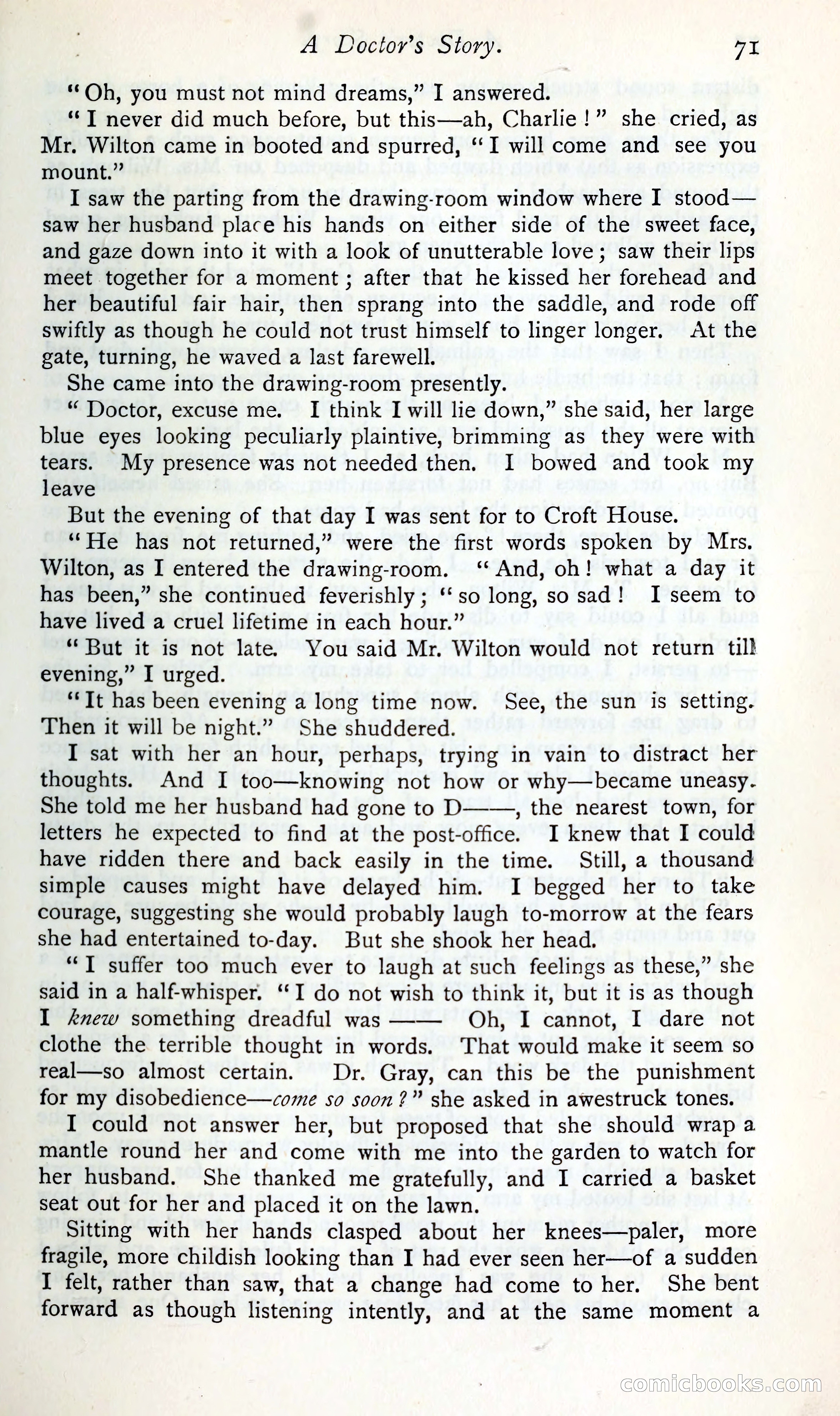
A restored page from Pulp Fiction, 1865. Page through the whole issue in the reader above.
📄 Transcribed text from this page (OCR, searchable)
Machine-transcribed from the original scan — historical spelling and the odd misread are preserved.
A LDoctor’s Story. ay, ‘Oh, you must not mind dreams,” I answered. ‘© T never did much before, but this—ah, Charlie!” she cried, as Mr. Wilton came in booted and spurred, ‘‘I will come and see you mount.” I saw the parting from the drawing-room window where I stood— saw her husband place his hands on either side of the sweet face, and gaze down into it with a look of unutterable love; saw their lips meet together for a moment; after that he kissed her forehead and her beautiful fair hair, then sprang into the saddle, and rode off swiftly as though he could not trust himself to linger longer. At the gate, turning, he waved a last farewell. She came into the drawing-room presently. “ Doctor, excuse me. I think I will lie down,” she said, her large blue eyes looking peculiarly plaintive, brimming as they were with tears. My presence was not needed then. I bowed and took my leave | But the evening of that day I was sent for to Croft House. ‘““He has not returned,” were the first words spoken by Mrs. Wilton, as I entered the drawing-room. ‘And, oh! what a day it has been,” she continued feverishly; ‘so long, so sad! I seem to have lived a cruel lifetime in each hour.” “But it is not late. You said Mr. Wilton would not return till evening,” I urged. ‘Tt has been evening a long time now. See, the sun is setting. Then it will be night.” She shuddered. I sat with her an hour, perhaps, trying in vain to distract her thoughts. And I too—knowing not how or why—became uneasy. She told me her husband had gone to D—-—,, the nearest town, for letters he expected to find at the post-office. I knew that I could have ridden there and back easily in the time. Still, a thousand simple causes might have delayed him. I begged her to take courage, suggesting she would probably laugh to-morrow at the fears she had entertained to-day. But she shook her head. ““T suffer too much ever to laugh at such feelings as these,” she said in a half-whisper. ‘‘I do not wish to think it, but it is as though I knew something dreadful was ——- Oh, I cannot, I dare not clothe the terrible thought in words. ‘That would make it seem so real—so almost certain. Dr. Gray, can this be the punishment for my disobedience—come so soon?” she asked in awestruck tones. I could not answer her, but proposed that she should wrap a mantle round her and come with me into the garden to watch for her husband. She thanked me gratefully, and I carried a basket seat out for her and placed it on the lawn. Sitting with her hands clasped about her knees—paler, more fragile, more childish looking than I had ever seen her—of a sudden I felt, rather than saw, that a change had come to her. She bent forward as though listening intently, and at the same moment a connicloooks (C(O)