
Pulp Fiction, 1865 · page 333 of 400
The Argosy — page 333: what you’re looking at
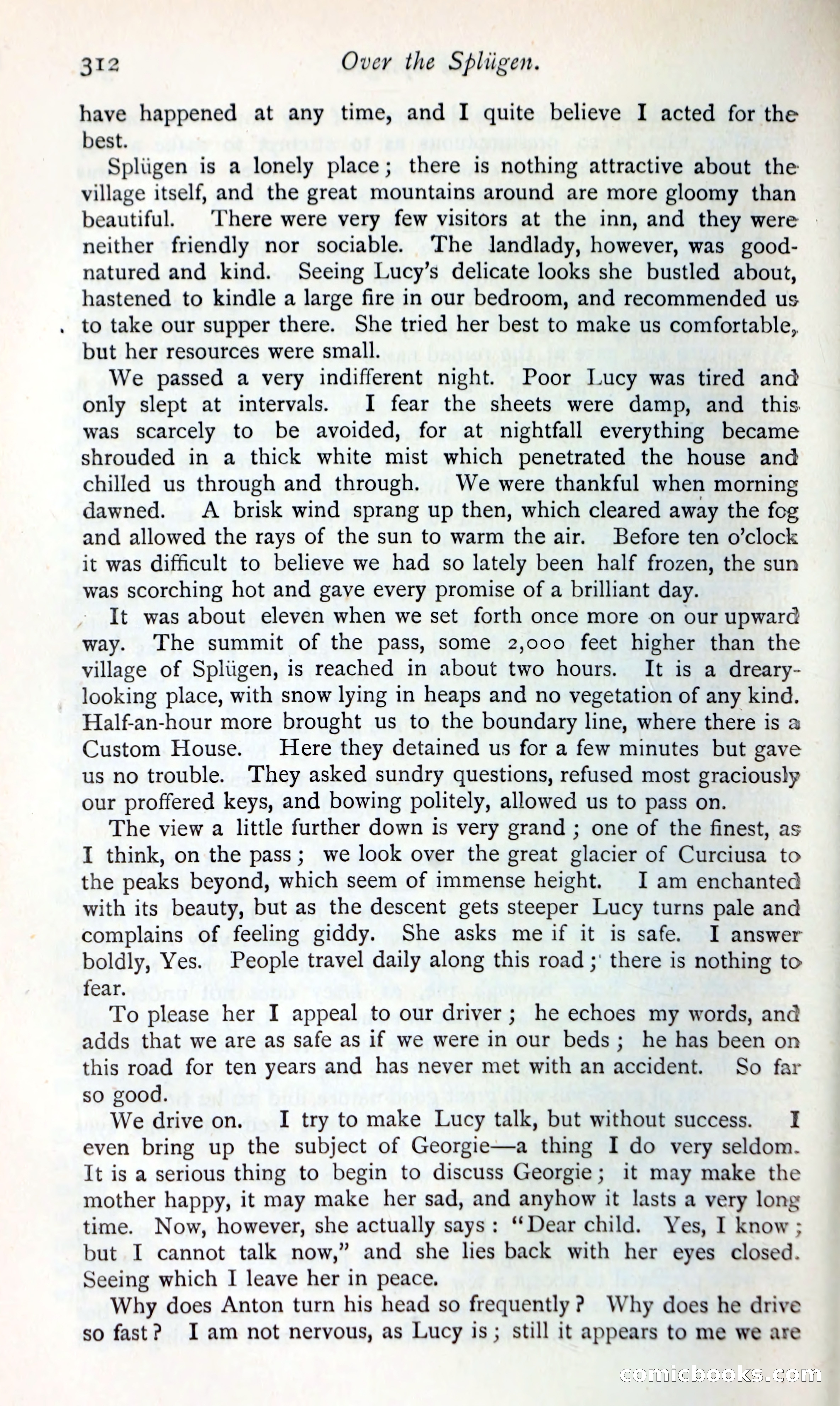
A restored page from Pulp Fiction, 1865. Page through the whole issue in the reader above.
📄 Transcribed text from this page (OCR, searchable)
Machine-transcribed from the original scan — historical spelling and the odd misread are preserved.
312 Over the Spligen. have happened at any time, and I quite believe I acted for the best. Spliigen is a lonely place; there is nothing attractive about the village itself, and the great mountains around are more gloomy than beautiful. There were very few visitors at the inn, and they were — neither friendly nor sociable. The landlady, however, was good- natured and kind. Seeing Lucy’s delicate looks she bustled about, hastened to kindle a large fire in our bedroom, and recommended us . to take our supper there. She tried her best to make us comfortable, but her resources were small. We passed a very indifferent night. Poor Lucy was tired and only slept at intervals. I fear the sheets were damp, and this was scarcely to be avoided, for at nightfall everything became shrouded in a thick white mist which penetrated the house and chilled us through and through. We were thankful when morning dawned. A brisk wind sprang up then, which cleared away the fog and allowed the rays of the sun to warm the air. Before ten o’clock it was difficult to believe we had so lately been half frozen, the sun was scorching hot and gave every promise of a brilliant day. It was about eleven when we set forth once more on our upwar@ way. The summit of the pass, some 2,o00 feet higher than the village of Spliigen, is reached in about two hours. It is a dreary- looking place, with snow lying in heaps and no vegetation of any kind. Half-an-hour more brought us to the boundary line, where there is a Custom House. Here they detained us for a few minutes but gave us no trouble. They asked sundry questions, refused most graciously our proffered keys, and bowing politely, allowed us to pass on. The view a little further down is very grand ; one of the finest, as I think, on the pass; we look over the great glacier of Curciusa to the peaks beyond, which seem of immense height. I am enchanted with its beauty, but as the descent gets steeper Lucy turns pale and complains of feeling giddy. She asks meif it is safe. I answer boldly, Yes. People travel daily along this road ;' there is nothing to fear. To please her I appeal to our driver; he echoes my words, and adds that we are as safe as if we were in our beds; he has been on this road for ten years and has never met with an accident. So far so good. We drive on. I try to make Lucy talk, but without success. I even bring up the subject of Georgie—a thing I do very seldom. It is a serious thing to begin to discuss Georgie; it may make the mother happy, it may make her sad, and anyhow it lasts a very long time. Now, however, she actually says: “Dear child. Yes, I know; but I cannot talk now,” and she lies back with her eyes closed. Seeing which I leave her in peace. Why does Anton turn his head so frequently ? Why does he drive so fast? Iam not nervous, as Lucy is; still it appears to me we are ECORNIELIOO; KS, EO) m