
Pulp Fiction, 1865 · page 323 of 400
The Argosy — page 323: what you’re looking at
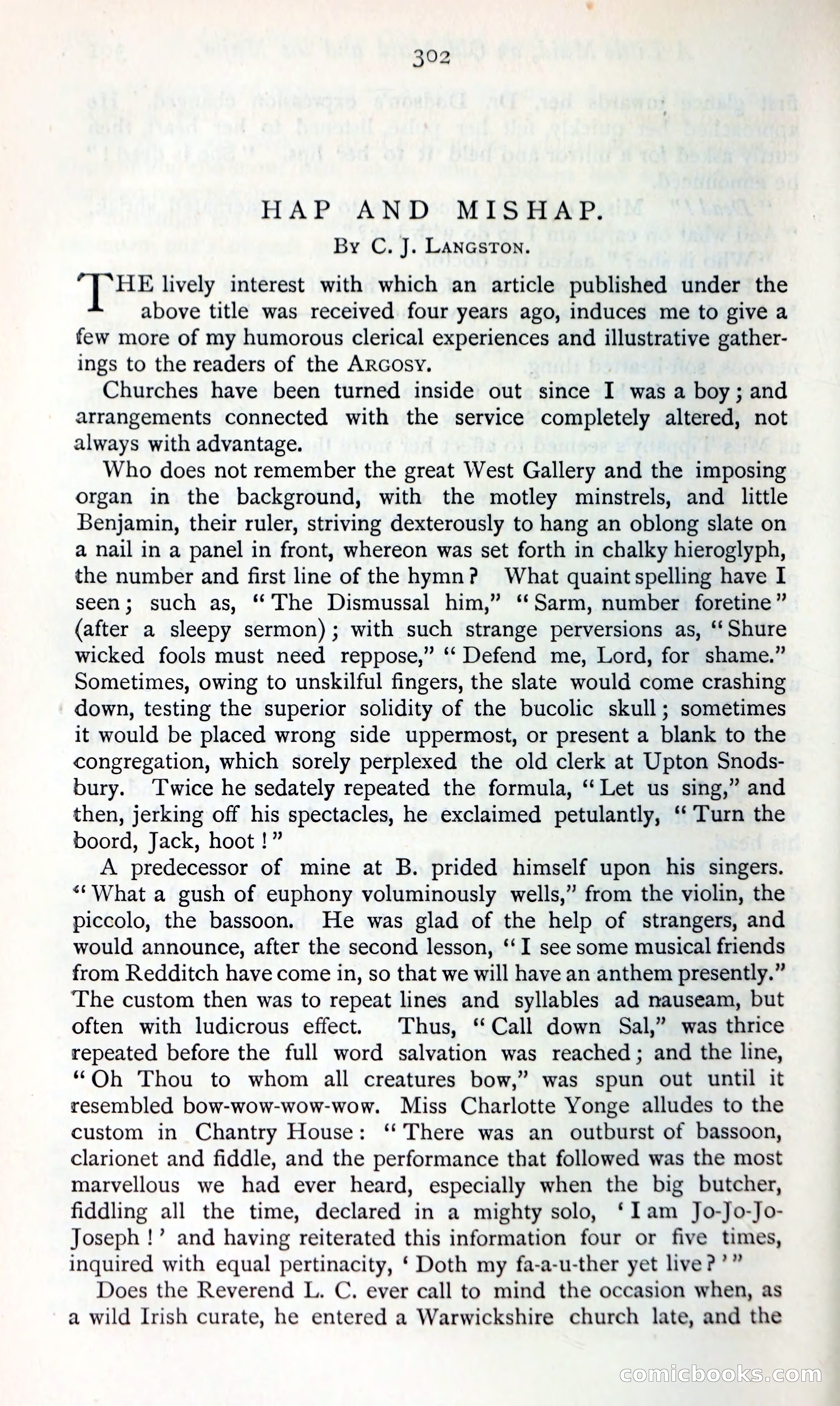
A restored page from Pulp Fiction, 1865. Page through the whole issue in the reader above.
📄 Transcribed text from this page (OCR, searchable)
Machine-transcribed from the original scan — historical spelling and the odd misread are preserved.
HAP AND MISHAP. By C. J. LANGsTon. 6 Bie lively interest with which an article published under the above title was received four years ago, induces me to give a few more of my humorous clerical experiences and illustrative gather- ings to the readers of the ARGosy. Churches have been turned inside out since I was a boy; and arrangements connected with the service completely altered, not always with advantage. Who does not remember the great West Gallery and the imposing organ in the background, with the motley minstrels, and little Benjamin, their ruler, striving dexterously to hang an oblong slate on a nail in a panel in front, whereon was set forth in chalky hieroglyph, the number and first line of the hymn? What quaint spelling have I seen; such as, ‘The Dismussal him,” ‘‘Sarm, number foretine”’ (after a sleepy sermon); with such strange perversions as, “Shure wicked fools must need reppose,” ‘‘ Defend me, Lord, for shame.” Sometimes, owing to unskilful fingers, the slate would come crashing down, testing the superior solidity of the bucolic skull; sometimes it would be placed wrong side uppermost, or present a blank to the congregation, which sorely perplexed the old clerk at Upton Snods- bury. ‘Twice he sedately repeated the formula, ‘‘ Let us sing,” and then, jerking off his spectacles, he exclaimed petulantly, ‘‘ Turn the boord, Jack, hoot !” A predecessor of mine at B. prided himself upon his singers. ‘What a gush of euphony voluminously wells,” from the violin, the piccolo, the bassoon. He was glad of the help of strangers, and would announce, after the second lesson, ‘‘ I see some musical friends from Redditch have come in, so that we will have an anthem presently.” The custom then was to repeat lines and syllables ad nauseam, but often with ludicrous effect. Thus, ‘‘ Call down Sal,” was thrice repeated before the full word salvation was reached; and the line, ‘Oh Thou to whom all creatures bow,” was spun out until it resembled bow-wow-wow-wow. Miss Charlotte Yonge alludes to the custom in Chantry House: ‘‘ There was an outburst of bassoon, clarionet and fiddle, and the performance that followed was the most marvellous we had ever heard, especially when the big butcher, fiddling all the time, declared in a mighty solo, ‘lam Jo-Jo-Jo- Joseph !’ and having reiterated this information four or five times, inquired with equal pertinacity, ‘ Doth my fa-a-u-ther yet live?’” Does the Reverend L. C. ever call to mind the occasion when, as a wild Irish curate, he entered a Warwickshire church late, and the COMMICEOOOKS.E©)