
Pulp Fiction, 1865 · page 302 of 400
The Argosy — page 302: what you’re looking at
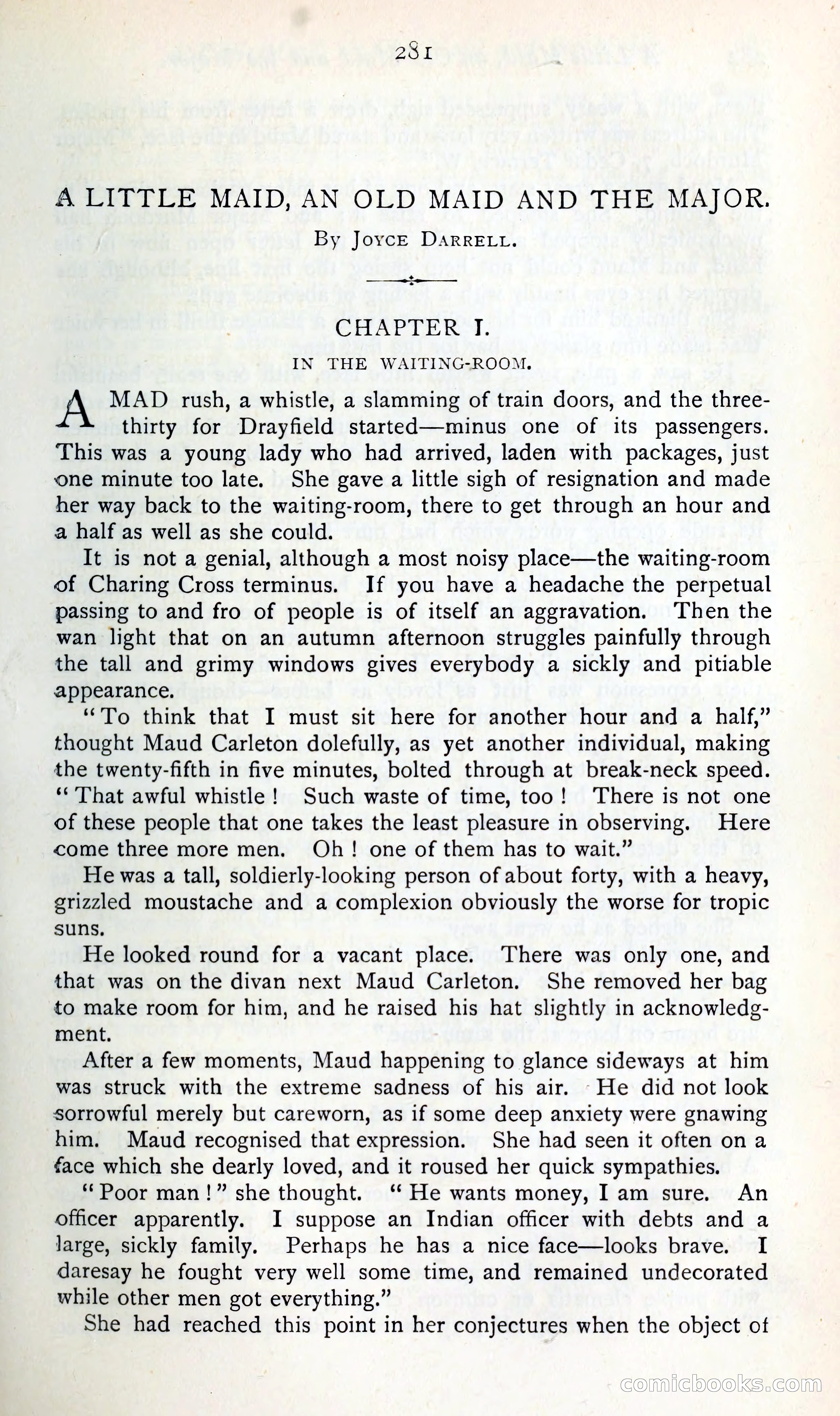
A restored page from Pulp Fiction, 1865. Page through the whole issue in the reader above.
📄 Transcribed text from this page (OCR, searchable)
Machine-transcribed from the original scan — historical spelling and the odd misread are preserved.
A LITTLE MAID, AN OLD MAID AND THE MAJOR. By Joyce DARRELL. CHAPTER I. IN THE WAITING-ROOM. A MAD rush, a whistle, a slamming of train doors, and the three- thirty for Drayfield started—minus one of its passengers. This was a young lady who had arrived, laden with packages, just one minute too late. She gave a little sigh of resignation and made her way back to the waiting-room, there to get through an hour and a half as well as she could. It is not a genial, although a most noisy place—the waiting-room of Charing Cross terminus. If you have a headache the perpetual passing to and fro of people is of itself an aggravation. ‘Then the wan light that on an autumn afternoon struggles painfully through the tall and grimy windows gives everybody a sickly and pitiable appearance. “To think that I must sit here for another hour and a half,” thought Maud Carleton dolefully, as yet another individual, making the twenty-fifth in five minutes, bolted through at break-neck speed. ‘‘’That awful whistle! Such waste of time, too! ‘There is not one of these people that one takes the least pleasure in observing. Here come three more men. Oh! one of them has to wait.” He was a tall, soldierly-looking person of about forty, with a heavy, grizzled moustache and a complexion obviously the worse for tropic suns. He looked round for a vacant place. ‘There was only one, and that was on the divan next Maud Carleton. She removed her bag to make room for him, and he raised his hat slightly in acknowledg- ment. After a few moments, Maud happening to glance sideways at him was struck with the extreme sadness of his air. -He did not look sorrowful merely but careworn, as if some deep anxiety were gnawing him. Maud recognised that expression. She had seen it often on a face which she dearly loved, and it roused her quick sympathies. ‘Poor man!” she thought. ‘‘ He wants money, Iam sure. An officer apparently. I suppose an Indian officer with debts and a large, sickly family. Perhaps he has a nice face—looks brave. I daresay he fought very well some time, and remained undecorated while other men got everything.” She had reached this point in her conjectures when the object of cConnicloooks (C(O)