
Pulp Fiction, 1865 · page 291 of 400
The Argosy — page 291: what you’re looking at
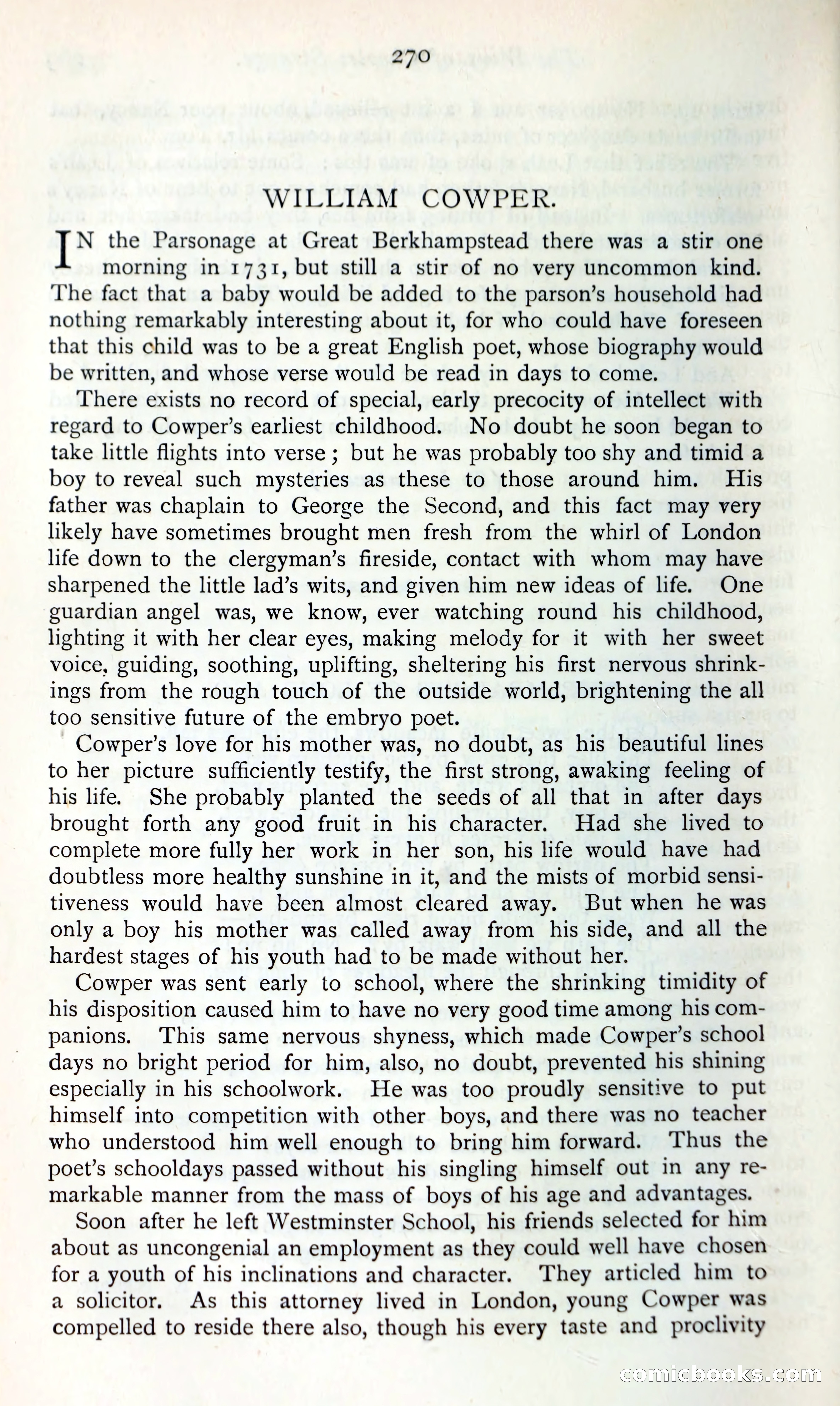
A restored page from Pulp Fiction, 1865. Page through the whole issue in the reader above.
📄 Transcribed text from this page (OCR, searchable)
Machine-transcribed from the original scan — historical spelling and the odd misread are preserved.
270 WILLIAM COWPER. N the Parsonage at Great Berkhampstead there was a stir one morning in 1731, but still a stir of no very uncommon kind. The fact that a baby would be added to the parson’s household had nothing remarkably interesting about it, for who could have foreseen that this child was to be a great English poet, whose biography would be written, and whose verse would be read in days to come. There exists no record of special, early precocity of intellect with regard to Cowper’s earliest childhood. No doubt he soon began to take little flights into verse ; but he was probably too shy and timid a boy to reveal such mysteries as these to those around him. His father was chaplain to George the Second, and this fact may very likely have sometimes brought men fresh from the whirl of London life down to the clergyman’s fireside, contact with whom may have sharpened the little lad’s wits, and given him new ideas of life. One guardian angel was, we know, ever watching round his childhood, lighting it with her clear eyes, making melody for it with her sweet voice, guiding, soothing, uplifting, sheltering his first nervous shrink- ings from the rough touch of the outside world, brightening the all too sensitive future of the embryo poet. Cowper’s love for his mother was, no doubt, as his beautiful ads to her picture sufficiently testify, the first strong, awaking feeling of his life. She probably planted the seeds of all that in after days brought forth any good fruit in his character. Had she lived to complete more fully her work in her son, his life would have had doubtless more healthy sunshine in it, and the mists of morbid sensi- tiveness would have been almost cleared away. But when he was only a boy his mother was called away from his side, and all the hardest stages of his youth had to be made without her. Cowper was sent early to school, where the shrinking timidity of his disposition caused him to have no very good time among his com- panions. ‘This same nervous shyness, which made Cowper’s school days no bright period for him, also, no doubt, prevented his shining especially in his schoolwork. He was too proudly sensitive to put himself into competiticn with other boys, and there was no teacher who understood him well enough to bring him forward. ‘Thus the poet’s schooldays passed without his singling himself out in any re- markable manner from the mass of boys of his age and advantages. Soon after he left Westminster School, his friends selected for him about as uncongenial an employment as they could well have chosen for a youth of his inclinations and character. They articled him to a solicitor, As this attorney lived in London, young Cowper was compelled to reside there also, though his every taste and proclivity CORnNIELOOLKS (E(0)