
Pulp Fiction, 1865 · page 281 of 400
The Argosy — page 281: what you’re looking at
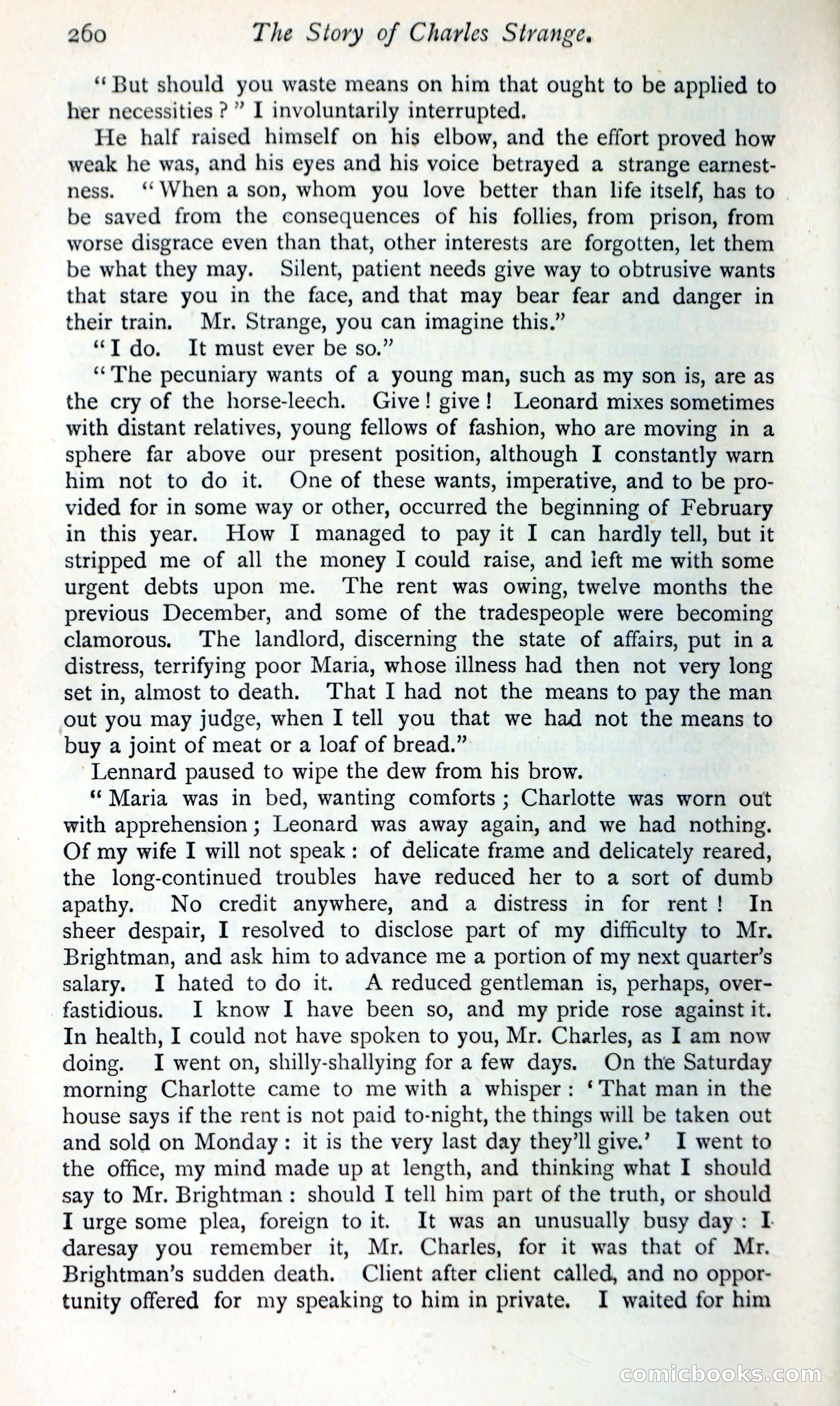
A restored page from Pulp Fiction, 1865. Page through the whole issue in the reader above.
📄 Transcribed text from this page (OCR, searchable)
Machine-transcribed from the original scan — historical spelling and the odd misread are preserved.
260 The Story of Charles Strange. ‘But should you waste means on him that ought to be applied to her necessities ?” I involuntarily interrupted. He half raised himself on his elbow, and the effort proved how weak he was, and his eyes and his voice betrayed a strange earnest- ness. ‘‘Whena son, whom you love better than life itself, has to be saved from the consequences of his follies, from prison, from worse disgrace even than that, other interests are forgotten, let them be what they may. Silent, patient needs give way to obtrusive wants that stare you in the face, and that may bear fear and danger in their train. Mr. Strange, you can imagine this.” “T do. It must ever be so.” ‘The pecuniary wants of a young man, such as my son is, are as the cry of the horse-leech. Give! give! Leonard mixes sometimes with distant relatives, young fellows of fashion, who are moving in a sphere far above our present position, although I constantly warn him not to do it. One of these wants, imperative, and to be pro- vided for in some way or other, occurred the beginning of February in this year. How I managed to pay it I can hardly tell, but it stripped me of all the money I could raise, and left me with some urgent debts upon me. ‘The rent was owing, twelve months the previous December, and some of the tradespeople were becoming clamorous. ‘The landlord, discerning the state of affairs, put ina distress, terrifying poor Maria, whose illness had then not very long set in, almost to death. That I had not the means to pay the man out you may judge, when I tell you that we had not the means to buy a joint of meat or a loaf of bread.” ‘Lennard paused to wipe the dew from his brow. “ Maria was in bed, wanting comforts ; Charlotte was worn out with apprehension ; Leonard was away again, and we had nothing. Of my wife I will not speak: of delicate frame and delicately reared, the long-continued troubles have reduced her to a sort of dumb apathy. No credit anywhere, and a distress in for rent! In sheer despair, I resolved to disclose part of my difficulty to Mr. Brightman, and ask him to advance me a portion of my next quarter’s salary. I hated todo it. A reduced gentleman is, perhaps, over- fastidious. I know I have been so, and my pride rose against it. In health, I could not have spoken to you, Mr. Charles, as I am now doing. I went on, shilly-shallying for a few days. On the Saturday morning Charlotte came to me with a whisper: ‘That man in the house says if the rent is not paid to-night, the things will be taken out and sold on Monday: it is the very last day they’ll give.’ I went to the office, my mind made up at length, and thinking what I should say to Mr. Brightman: should I tell him part of the truth, or should I urge some plea, foreign to it. It was an unusually busy day: I daresay you remember it, Mr. Charles, for it was that of Mr. Brightman’s sudden death. Client after client called, and no oppor- tunity offered for my speaking to him in private. I waited for him CORNIELIOOLKKS (E©) m