
Pulp Fiction, 1865 · page 273 of 400
The Argosy — page 273: what you’re looking at
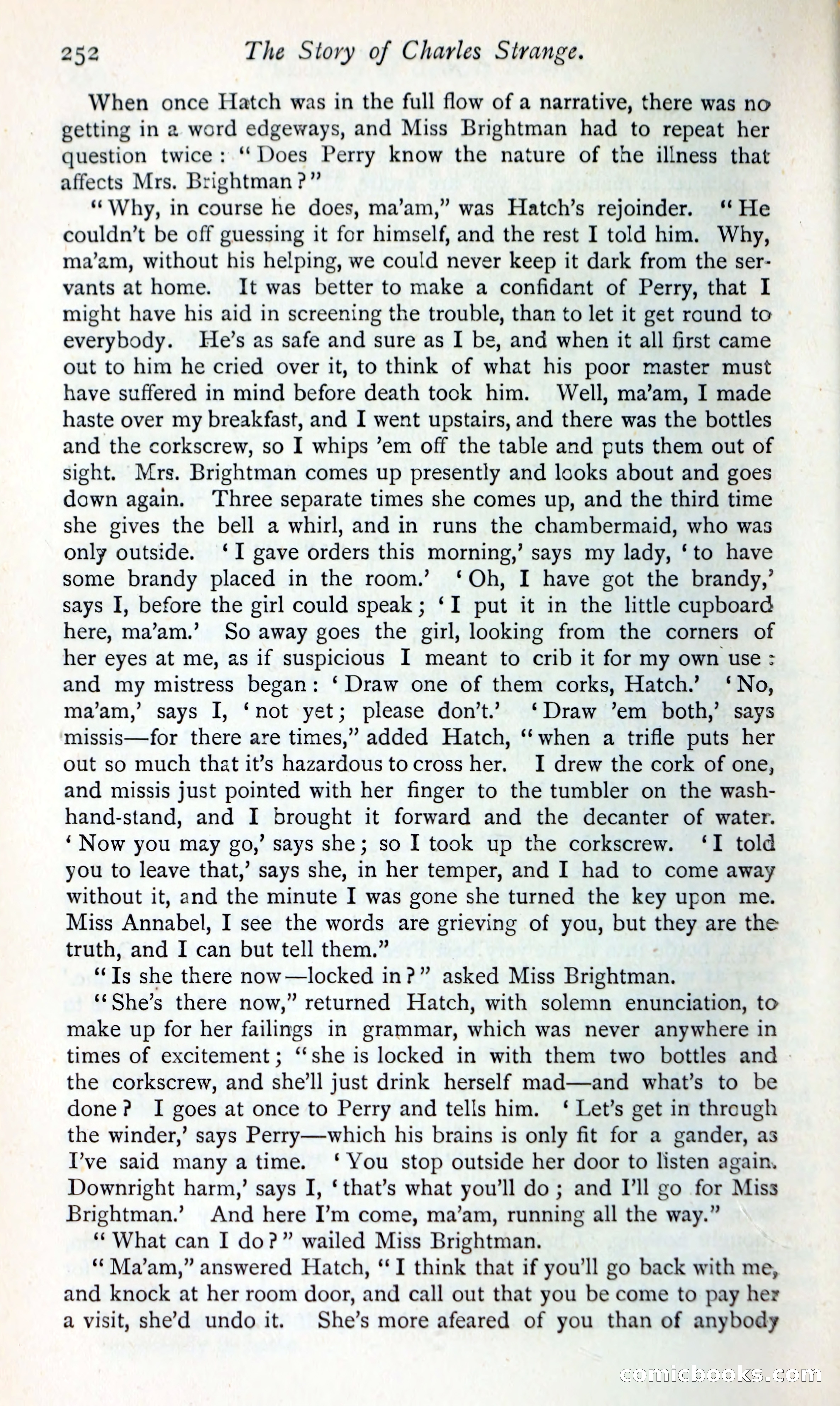
A restored page from Pulp Fiction, 1865. Page through the whole issue in the reader above.
📄 Transcribed text from this page (OCR, searchable)
Machine-transcribed from the original scan — historical spelling and the odd misread are preserved.
252 The Story of Charles Strange. When once Hatch was in the full flow of a narrative, there was no getting in a word edgeways, and Miss Brightman had to repeat her question twice: ‘‘ Does Perry know the nature of the illness that affects Mrs. Brightman ?” ‘Why, in course he does, ma’am,” was Hatch’s rejoinder. ‘‘He couldn’t be off guessing it for himself, and the rest I told him. Why, ma’am, without his helping, we could never keep it dark from the ser- vants at home. It was better to make a confidant of Perry, that I might have his aid in screening the trouble, than to let it get round to everybody. He’s as safe and sure as I be, and when it all first came out to him he cried over it, to think of what his poor master must have suffered in mind before death tock him. Well, ma’am, I made haste over my breakfast, and I went upstairs, and there was the bottles and the corkscrew, so I whips ’em off the table and puts them out of sight. Mrs. Brightman comes up presently and looks about and goes down again. ‘Three separate times she comes up, and the third time she gives the bell a whirl, and in runs the chambermaid, who was only outside. ‘I gave orders this morning,’ says my lady, ‘to have some brandy placed in the room.’ ‘Qh, I have got the brandy,’ says I, before the girl could speak; ‘I put it in the little cupboard here, ma’am.’ So away goes the girl, looking from the corners of her eyes at me, as if suspicious I meant to crib it for my own use > and my mistress began: ‘ Draw one of them corks, Hatch.’ ‘No, ma’am,’ says I, ‘not yet; please don’t.’ ‘Draw ’em both,’ says missis—for there are times,” added Hatch, ‘‘ when a trifle puts her out so much that it’s hazardous tocross her. I drew the cork of one, and missis just pointed with her finger to the tumbler on the wash- hand-stand, and I brought it forward and the decanter of water. ‘Now you may go,’ says she; so I took up the corkscrew. ‘I told you to leave that,’ says she, in her temper, and I had to come away without it, and the minute I was gone she turned the key upon me. Miss Annabel, I see the words are grieving of you, but they are the truth, and I can but tell them.” “Ts she there now—locked in?” asked Miss Brightman. ‘‘She’s there now,” returned Hatch, with solemn enunciation, to make up for her failings in grammar, which was never anywhere in times of excitement; ‘‘she is locked in with them two bottles and > the corkscrew, and she’ll just drink herself mad—and what’s to be done? I goes at once to Perry and tells him. ‘ Let’s get in through the winder,’ says Perry—which his brains is only fit for a gander, as I’ve said many atime. ‘ You stop outside her door to listen again, Downright harm,’ says I, ‘that’s what you’ll do; and I’ll go for Miss Brightman.’ And here I’m come, ma’am, running all the way.” “What can I do?” wailed Miss Brightman. “ Ma’am,” answered Hatch, “I think that if you'll go back with me, and knock at her room door, and call out that you be come to pay her a visit, she’d undo it. She’s more afeared of you than of anybody ECORNIELIOO KS, EO) m