
Pulp Fiction, 1865 · page 261 of 400
The Argosy — page 261: what you’re looking at
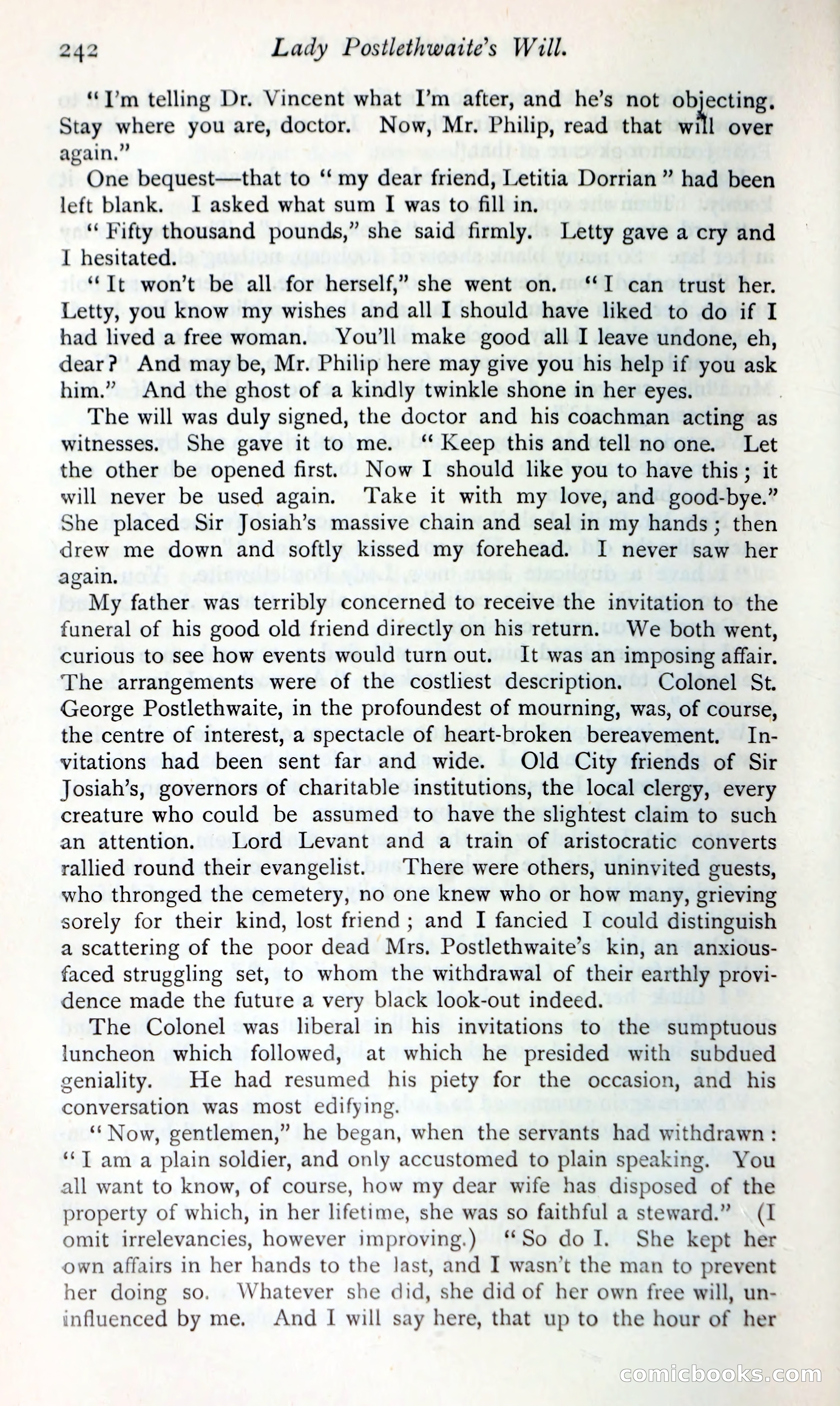
A restored page from Pulp Fiction, 1865. Page through the whole issue in the reader above.
📄 Transcribed text from this page (OCR, searchable)
Machine-transcribed from the original scan — historical spelling and the odd misread are preserved.
242 Lady Postlethwarte’s Wil. “Tm telling Dr. Vincent what I’m after, and he’s not objecting, Stay where you are, doctor. Now, Mr. Philip, read that will over again,” One bequest—that to “‘ my dear friend, Letitia Dorrian ” had been left blank. I asked what sum I was to fill in. ‘‘ Fifty thousand pounds,” she said firmly. Letty gave a cry and I hesitated. ‘Tt won’t be all for herself,” she went on. ‘I can trust her. Letty, you know my wishes and all I should have liked to do if I had lived a free woman. You'll make good all I leave undone, eh, dear? And may be, Mr. Philip here may give you his help if you ask him.” And the ghost of a kindly twinkle shone in her eyes. The will was duly signed, the doctor and his coachman acting as witnesses. She gave it to me. “ Keep this and tell no one. Let the other be opened first. Now I should lke you to have this; it will never be used again. ‘Take it with my love, and good-bye.” She placed Sir Josiah’s massive chain and seal in my hands; then drew me down and softly kissed my forehead. I never saw her again. My father was terribly concerned to receive the invitation to the funeral of his good old friend directly on his return. We both went, curious to see how events would turn out. It was an imposing affair. The arrangements were of the costliest description. Colonel St. George Postlethwaite, in the profoundest of mourning, was, of course, the centre of interest, a spectacle of heart-broken bereavement. In- vitations had been sent far and wide. Old City friends of Sir Josiah’s, governors of charitable institutions, the local clergy, every creature who could be assumed to have the slightest claim to such an attention. Lord Levant and a train of aristocratic converts rallied round their evangelist. ‘There were others, uninvited guests, who thronged the cemetery, no one knew who or how many, grieving sorely for their kind, lost friend; and I fancied I could distinguish a scattering of the poor dead Mrs. Postlethwaite’s kin, an anxious- faced struggling set, to whom the withdrawal of their earthly provi- dence made the future a very black look-out indeed. The Colonel was liberal in his invitations to the sumptuous luncheon which followed, at which he presided with subdued veniality. He had resumed his piety for the occasion, and his conversation was most edifying. ‘Now, gentlemen,” he began, when the servants had withdrawn: ‘‘T am a plain soldier, and only accustomed to plain speaking. You all want to know, of course, how my dear wife has disposed of the property of which, in her lifetime, she was so faithful a steward.” (1 omit irrelevancies, however improving.) “So dol. She kept her own affairs in her hands to the last, and I wasn’t the man to prevent her doing so. Whatever she did, she did of her own free will, un- influenced by me. And I will say here, that up to the hour of her ECORNIECLIOOKS, EO) im