
Pulp Fiction, 1865 · page 244 of 400
The Argosy — page 244: what you’re looking at
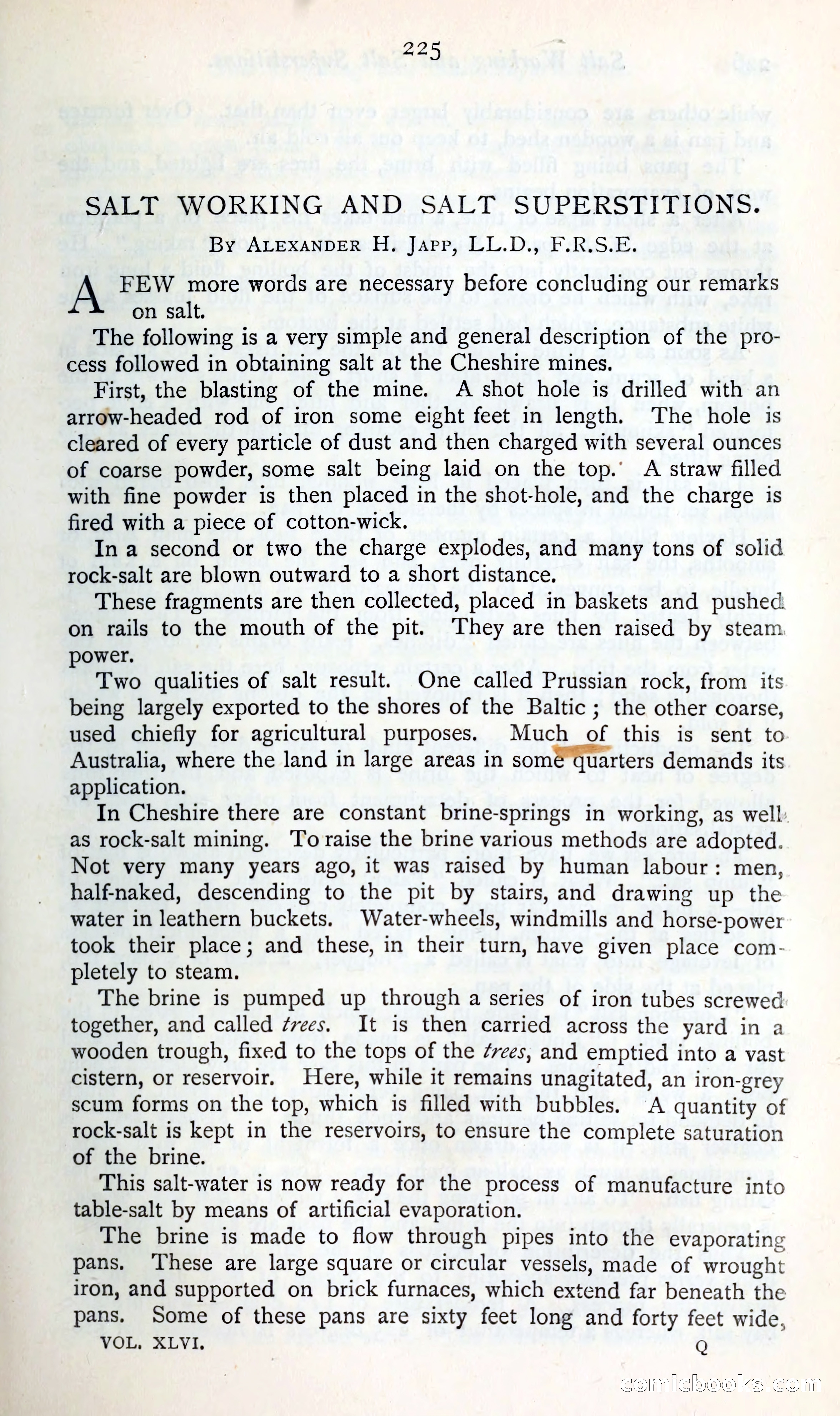
A restored page from Pulp Fiction, 1865. Page through the whole issue in the reader above.
📄 Transcribed text from this page (OCR, searchable)
Machine-transcribed from the original scan — historical spelling and the odd misread are preserved.
225 SALT WORKING AND SALT SUPERSTITIONS. By ALEXANDER H. Japp, LL.D., F.R.S.E. | A FEW more words are necessary before concluding our remarks on salt. The following is a very simple and general description of the pro- cess followed in obtaining salt at the Cheshire mines. First, the blasting of the mine. A shot hole is drilled with an arrow-headed rod of iron some eight feet in length. The hole is cleared of every particle of dust and then charged with several ounces of coarse powder, some salt being laid on the top.’ A straw filled with fine powder is then placed in the shot-hole, and the charge is fired with a piece of cotton-wick. In a second or two the charge explodes, and many tons of solid rock-salt are blown outward to a short distance. These fragments are then collected, placed in baskets and pushed on rails to the mouth of the pit. They are then raised by steam power. Two qualities of salt result. One called Prussian rock, from its being largely exported to the shores of the Baltic; the other coarse, used chiefly for agricultural purposes. Much of this is sent to Australia, where the land in large areas in somé quarters demands its application. In Cheshire there are constant brine-springs in working, as well: as rock-salt mining. Toraise the brine various methods are adopted. Not very many years ago, it was raised by human labour: men, half-naked, descending to the pit by stairs, and drawing up the water in leathern buckets. Water-wheels, windmills and horse-power took their place; and these, in their turn, have given place com- pletely to steam. The brine is pumped up through a series of iron tubes screwed together, and called ¢vees. It is then carried across the yard in a wooden trough, fixed to the tops of the ¢vees, and emptied into a vast cistern, or reservoir. Here, while it remains unagitated, an iron-grey scum forms on the top, which is filled with bubbles. A quantity of rock-salt is kept in the reservoirs, to ensure the complete saturation of the brine. This salt-water is now ready for the process of manufacture into table-salt by means of artificial evaporation. _ The brine is made to flow through pipes into the evaporating pans. These are large square or circular vessels, made of wrought iron, and supported on brick furnaces, which extend far beneath the pans. Some of these pans are sixty feet long and forty feet wide. VOL, &LVI. Q CON” (-) LNOOKS.EO