
Pulp Fiction, 1865 · page 142 of 400
The Argosy — page 142: what you’re looking at
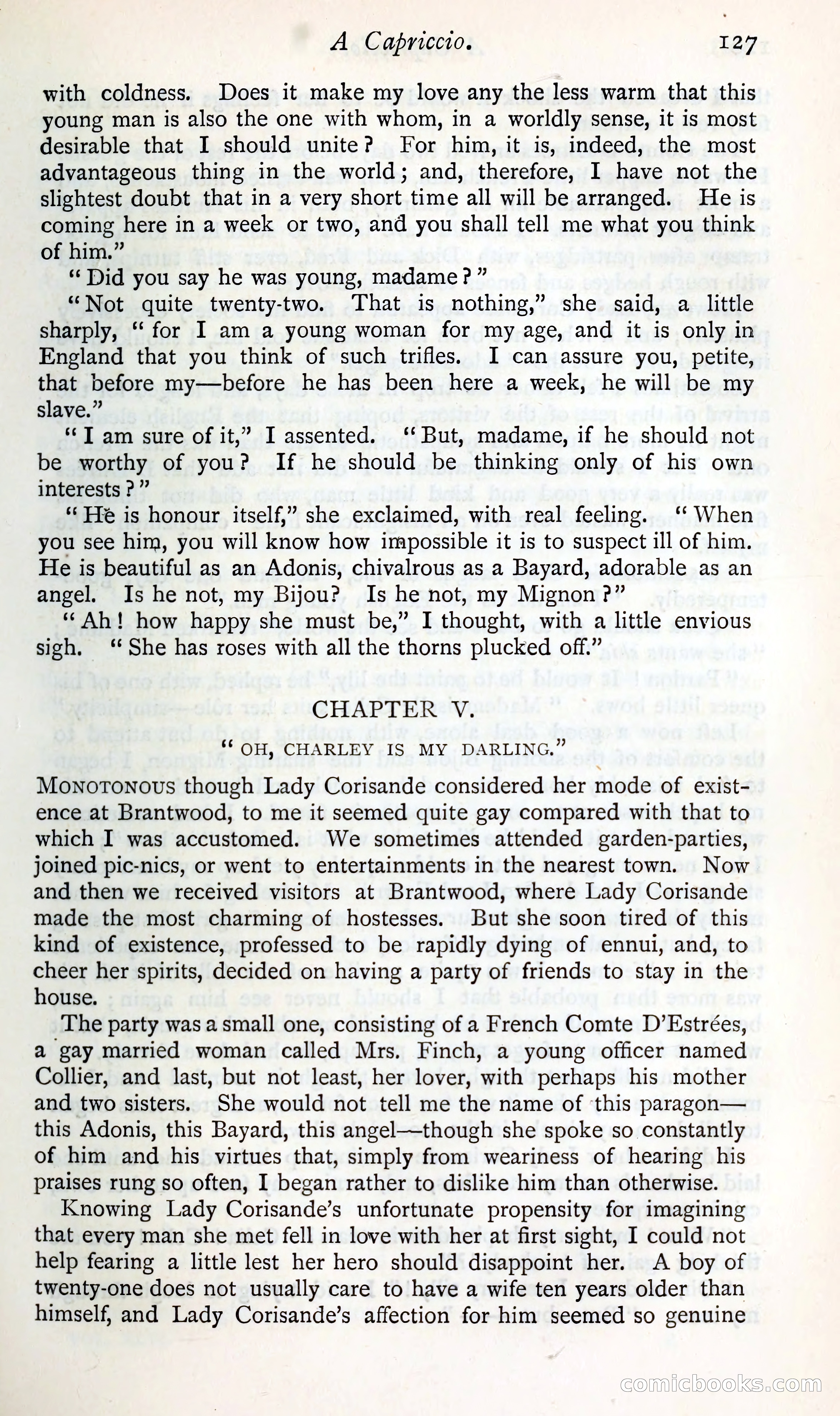
A restored page from Pulp Fiction, 1865. Page through the whole issue in the reader above.
📄 Transcribed text from this page (OCR, searchable)
Machine-transcribed from the original scan — historical spelling and the odd misread are preserved.
A Capnecio. 127 with coldness. Does it make my love any the less warm that this young man is also the one with whom, in a worldly sense, it is most desirable that I should unite? For him, it is, indeed, the most advantageous thing in the world; and, therefore, I have not the slightest doubt that in a very short time all will be arranged. He is coming here in a week or two, and you shall tell me what you think of him.” ‘Did you say he was young, madame P?” “Not quite twenty-two. That is nothing,” she said, a little sharply, “ for I am a young woman for my age, and it is only in England that you think of such trifles. I can assure you, petite, that before my—before he has been here a week, he will be my slave.” * T am sure of it,” I assented. ‘* But, madame, if he should not be worthy of you? If he should be thinking only of his own interests ?” ‘He is honour itself,” she exclaimed, with real feeling. ‘‘ When you see him, you will know how impossible it is to suspect ill of him. He is beautiful as an Adonis, chivalrous as a Bayard, adorable as an angel. Is he not, my Bijou? Is he not, my Mignon Pe” ‘Ah! how happy she must be,” I thought, with a little envious sigh. ‘* She has roses with all the thorns plucked off.” CHAPTER V. ** OH, CHARLEY IS MY DARLING.” Mownotonovus though Lady Corisande considered her mode of exist- ence at Brantwood, to me it seemed quite gay compared with that to which I was accustomed. We sometimes attended garden-parties, joined pic-nics, or went to entertainments in the nearest town. Now and then we received visitors at Brantwood, where Lady Corisande made the most charming of hostesses. But she soon tired of this kind of existence, professed to be rapidly dying of ennui, and, to cheer her spirits, decided on having a party of friends to stay in the house. The party was a small one, consisting of a French Comte D’Estrées, a gay married woman called Mrs. Finch, a young officer named Collier, and last, but not least, her lover, with perhaps his mother and two sisters. She would not tell me the name of ‘this paragon— this Adonis, this Bayard, this angel—though she spoke so constantly of him and his virtues that, simply from weariness of hearing his praises rung so often, I began rather to dislike him than otherwise. Knowing Lady Corisande’s unfortunate propensity for imagining that every man she met fell in love with her at first sight, I could not help fearing a little lest her hero should disappoint her. <A boy of twenty-one does not usually care to have a wife ten years older than himself, and Lady Corisande’s affection for him seemed so genuine connicloooks (C(O)