
Pulp Fiction, 1865 · page 128 of 400
The Argosy — page 128: what you’re looking at
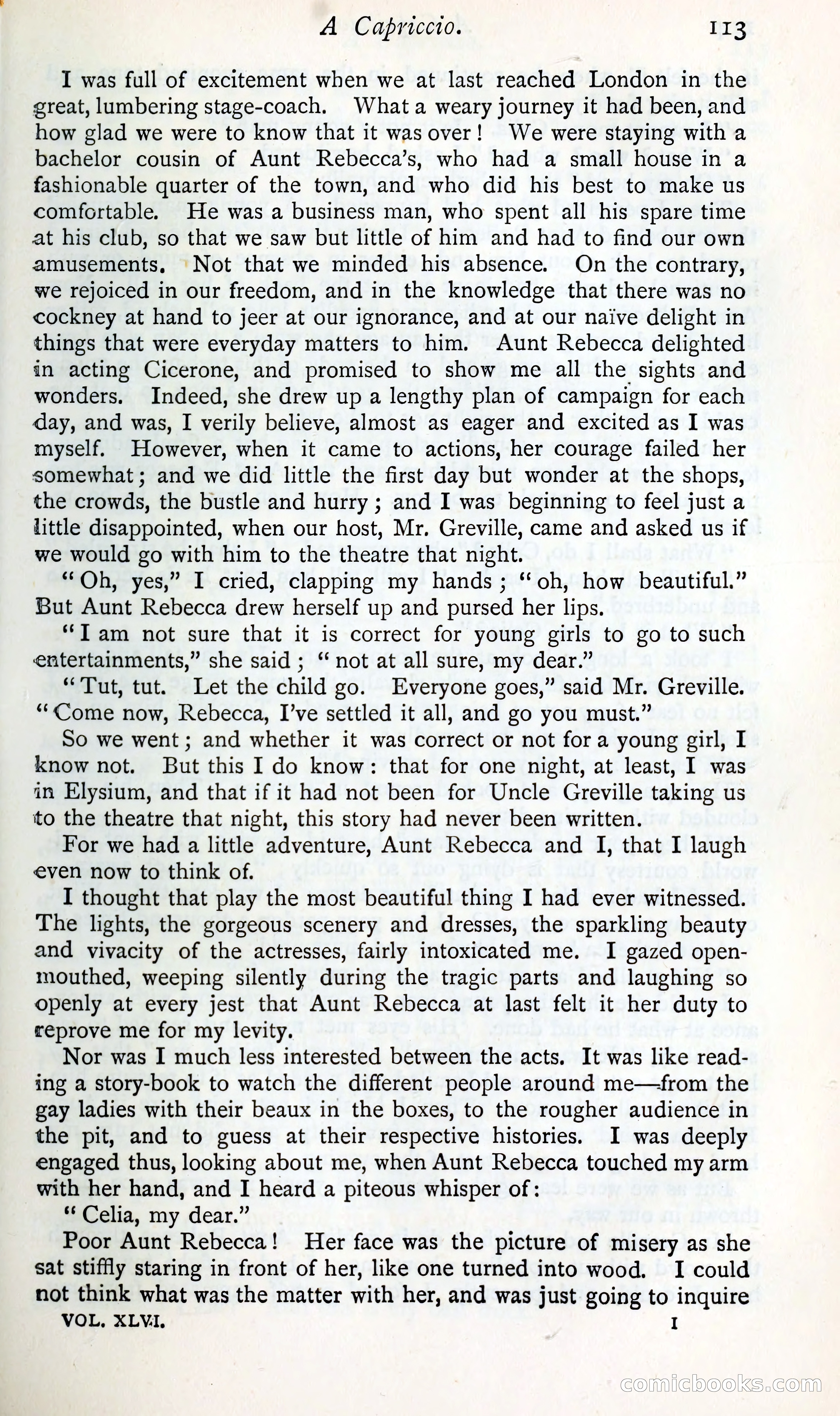
A restored page from Pulp Fiction, 1865. Page through the whole issue in the reader above.
📄 Transcribed text from this page (OCR, searchable)
Machine-transcribed from the original scan — historical spelling and the odd misread are preserved.
A Capriccio. Urs I was full of excitement when we at last reached London in the great, lumbering stage-coach. Whata weary journey it had been, and how glad we were to know that it wasover! We were staying with a bachelor cousin of Aunt Rebecca’s, who had a small house in a fashionable quarter of the town, and who did his best to make us comfortable. He was a business man, who spent all his spare time at his club, so that we saw but little of him and had to find our own amusements. Not that we minded his absence. On the contrary, we rejoiced in our freedom, and in the knowledge that there was no cockney at hand to jeer at our ignorance, and at our naive delight in things that were everyday matters to him. Aunt Rebecca delighted in acting Cicerone, and promised to show me all the sights and wonders. Indeed, she drew up a lengthy plan of campaign for each day, and was, I verily believe, almost as eager and excited as I was myself. However, when it came to actions, her courage failed her somewhat; and we did little the first day but wonder at the shops, the crowds, the bustle and hurry ; and I was beginning to feel just a little disappointed, when our host, Mr. Greville, came and asked us if we would go with him to the theatre that night. “Oh, yes,” I cried, clapping my hands; ‘‘oh, how beautiful.” Sut Aunt Rebecca drew herself up and pursed her lips. ‘lam not sure that it is correct for young girls to go to such entertainments,” she said; ‘not at all sure, my dear.” “Tut, tut. Let the child go. Everyone goes,” said Mr. Greville. “Come now, Rebecca, I’ve settled it all, and go you must.” SO we went; and whether it was correct or not fora young girl, I know not. But this I do know: that for one night, at least, I was in Elysium, and that if it had not been for Uncle Greville taking us to the theatre that night, this story had never been written. For we had a little adventure, Aunt Rebecca and I, that I laugh even now to think of. I thought that play the most beautiful thing I had ever witnessed. The lights, the gorgeous scenery and dresses, the sparkling beauty and vivacity of the actresses, fairly intoxicated me. I gazed open- mouthed, weeping silently during the tragic parts and laughing so openly at every jest that Aunt Rebecca at last felt it her duty to feprove me for my levity. Nor was I much less interested between the acts. It was like read- ing a story-book to watch the different people around me—from the gay ladies with their beaux in the boxes, to the rougher audience in the pit, and to guess at their respective histories. I was deeply engaged thus, looking about me, when Aunt Rebecca touched my arm with her hand, and I heard a piteous whisper of: ** Celia, my dear.” Poor Aunt Rebecca! Her face was the picture of misery as she sat stiffly staring in front of her, like one turned into wood. I could not think what was the matter with her, and was just going to inquire VOL, XLVI. I CON” (-) DOOKS (C(O) mn