
Pulp Fiction, 1865 · page 86 of 400
The Argosy — page 86: what you’re looking at
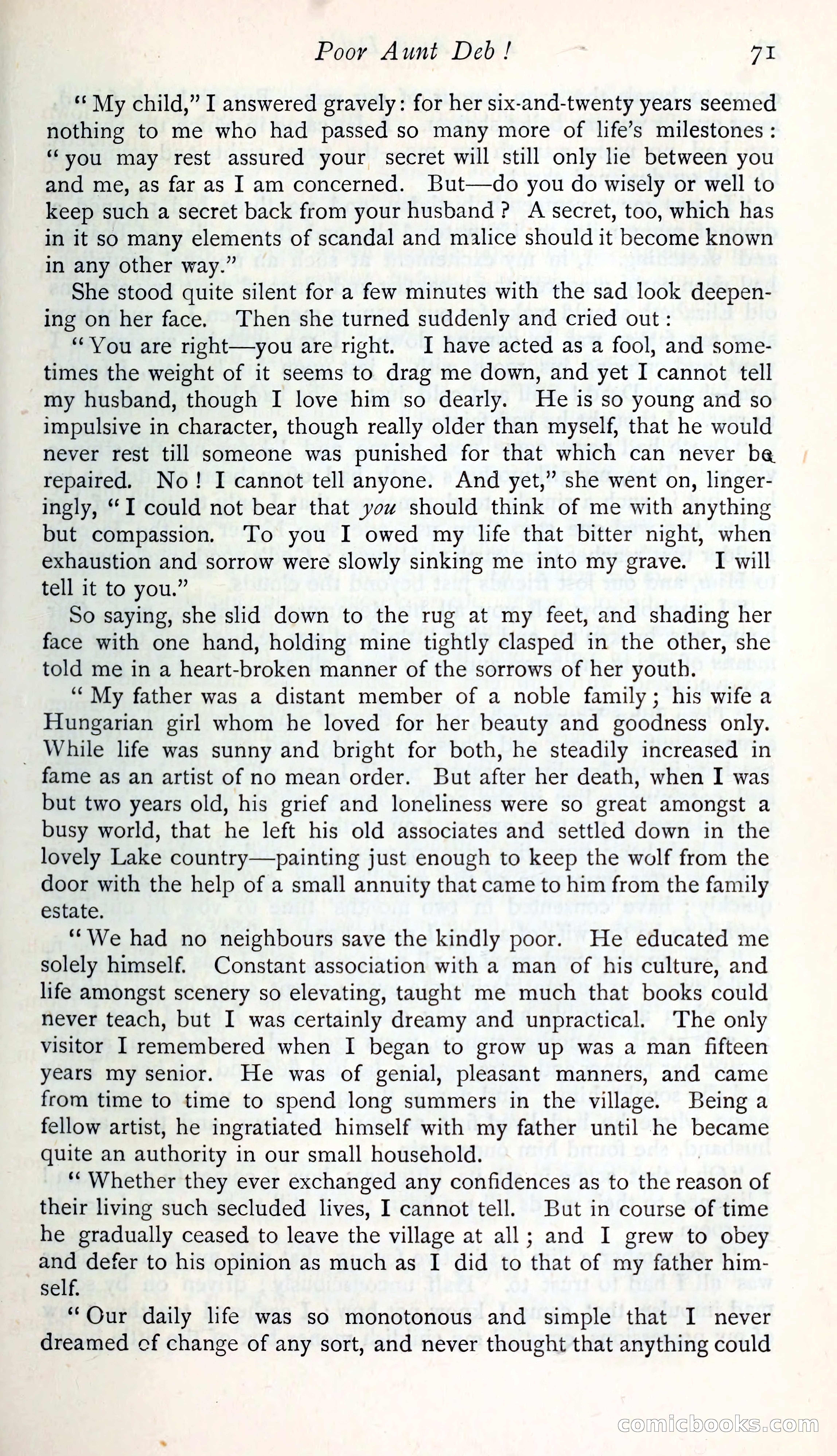
A restored page from Pulp Fiction, 1865. Page through the whole issue in the reader above.
📄 Transcribed text from this page (OCR, searchable)
Machine-transcribed from the original scan — historical spelling and the odd misread are preserved.
Poor Aunt Deb! 71 ‘* My child,” I answered gravely: for her six-and-twenty years seemed nothing to me who had passed so many more of life’s milestones : “vou may rest assured your secret will still only lie between you and me, as far as I am concerned. But—do you do wisely or well to keep such a secret back from your husband? A secret, too, which has in it so many elements of scandal and malice should it become known in any other way.” She stood quite silent for a few minutes with the sad look deepen- ing on her face. Then she turned suddenly and cried out: “You are right—you are right. I have acted as a fool, and some- times the weight of it seems to drag me down, and yet I cannot tell my husband, though I love him so dearly. He is so young and so impulsive in character, though really older than myself, that he would never rest till someone was punished for that which can never be repaired. No! I cannot tell anyone. And yet,” she went on, linger- ingly, “I could not bear that you should think of me with anything but compassion. To you I owed my life that bitter night, when exhaustion and sorrow were slowly sinking me into my grave. I will tell it to you.” So saying, she slid down to the rug at my feet, and shading her face with one hand, holding mine tightly clasped in the other, she told me in a heart-broken manner of the sorrows of her youth. ‘“ My father was a distant member of a noble family; his wife a Hungarian girl whom he loved for her beauty and goodness only. _ While life was sunny and bright for both, he steadily increased in fame as an artist of no mean order. But after her death, when I was but two years old, his grief and loneliness were so great amongst a busy world, that he left his old associates and settled down in the lovely Lake country—painting just enough to keep the wolf from the door with the help of a small annuity that came to him from the family estate. “We had no neighbours save the kindly poor. He educated me solely himself. Constant association with a man of his culture, and life amongst scenery so elevating, taught me much that books could never teach, but I was certainly dreamy and unpractical. The only visitor I remembered when I began to grow up was a man fifteen years my senior. He was of genial, pleasant manners, and came from time to time to spend long summers in the village. Being a fellow artist, he ingratiated himself with my father until he became quite an authority in our small household. ‘Whether they ever exchanged any confidences as to the reason of their living such secluded lives, I cannot tell. But in course of time he gradually ceased to leave the village at all; and I grew to obey and defer to his opinion as much as I did to that of my father him- self. “Our daily life was so monotonous and simple that I never dreamed cf change of any sort, and never thought that anything could COMICOOOKS.C© An