
Pulp Fiction, 1865 · page 67 of 400
The Argosy — page 67: what you’re looking at
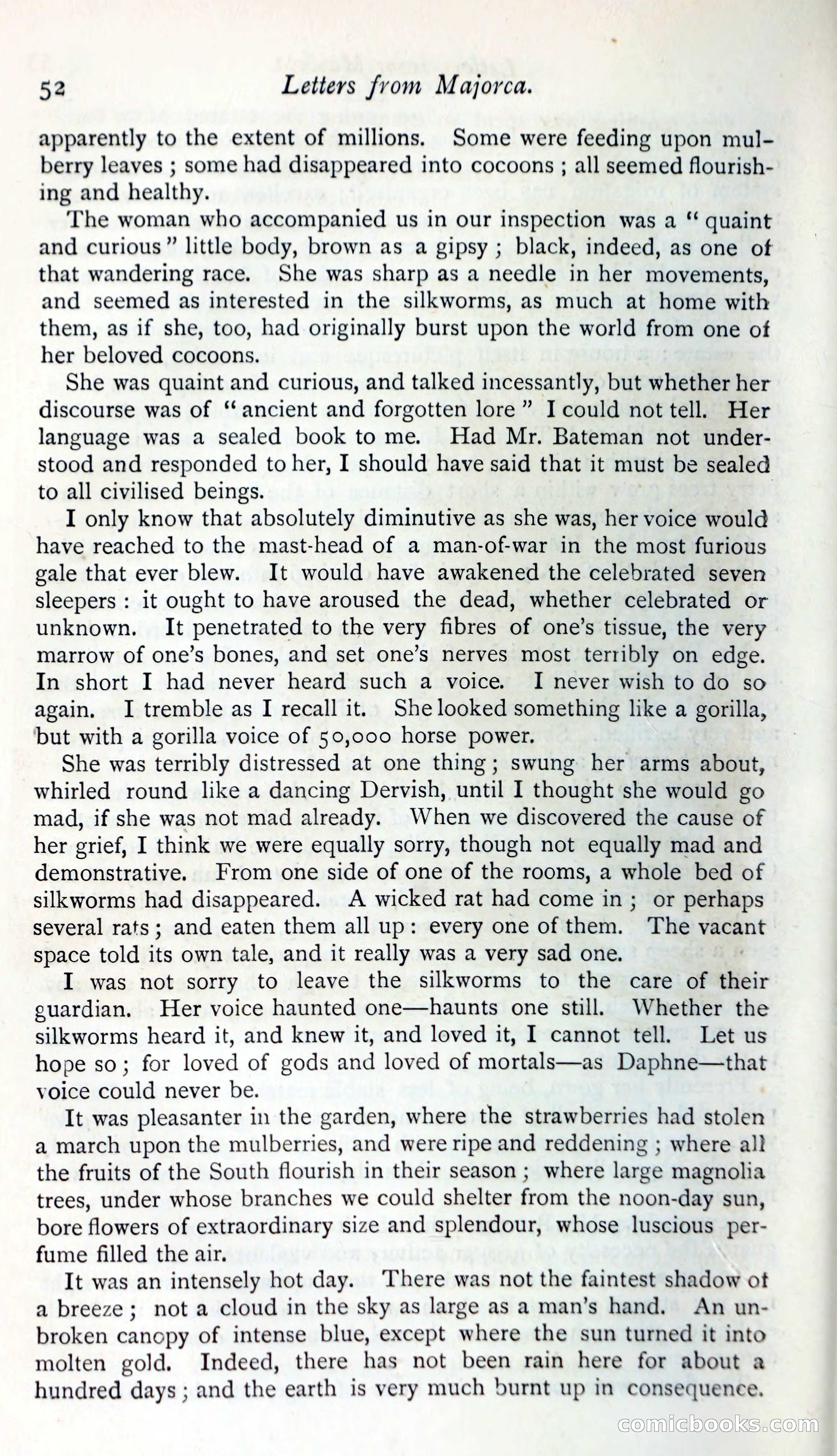
A restored page from Pulp Fiction, 1865. Page through the whole issue in the reader above.
📄 Transcribed text from this page (OCR, searchable)
Machine-transcribed from the original scan — historical spelling and the odd misread are preserved.
52 Letters from Majorca. apparently to the extent of millions. Some were feeding upon mul- berry leaves ; some had disappeared into cocoons ; all seemed flourish- ing and healthy. The woman who accompanied us in our inspection was a ‘‘ quaint and curious” little body, brown as a gipsy ; black, indeed, as one of that wandering race. She was sharp as a needle in her movements, and seemed as interested in the silkworms, as much at home with them, as if she, too, had originally burst upon the world from one of her beloved cocoons. She was quaint and curious, and talked incessantly, but whether her discourse was of “ancient and forgotten lore” I could not tell. Her language was a sealed book tome. Had Mr. Bateman not under- stood and responded to her, I should have said that it must be sealed to all civilised beings. | I only know that absolutely diminutive as she was, her voice would have reached to the mast-head of a man-of-war in the most furious gale that ever blew. It would have awakened the celebrated seven sleepers : it ought to have aroused the dead, whether celebrated or unknown. It penetrated to the very fibres of one’s tissue, the very marrow of one’s bones, and set one’s nerves most terribly on edge. In short I had never heard such a voice. I never wish to do so again. I tremble as I recall it. She looked something like a gorilla, but with a gorilla voice of 50,000 horse power. She was terribly distressed at one thing; swung her arms about, whirled round like a dancing Dervish, until I thought she would go mad, if she was not mad already. When we discovered the cause of her grief, I think we were equally sorry, though not equally mad and demonstrative. From one side of one of the rooms, a whole bed of silkworms had disappeared. A wicked rat had come in; or perhaps several rats; and eaten them all up: every one of them. The vacant space told its own tale, and it really was a very sad one. I was not sorry to leave the silkworms to the care of their euardian. Her voice haunted one—haunts one still. Whether the silkworms heard it, and knew it, and loved it, I cannot tell. Let us hope so; for loved of gods and loved of mortals—as Daphne—that voice could never be. It was pleasanter in the garden, where the strawberries had stolen a march upon the mulberries, and were ripe and reddening ; where all the fruits of the South flourish in their season; where large magnolia trees, under whose branches we could shelter from the noon-day sun, bore flowers of extraordinary size and splendour, whose luscious per- fume filled the air. It was an intensely hot day. ‘There was not the faintest shadow ot a breeze; nota cloud in the sky as large as a man’s hand. An un- broken canopy of intense blue, except where the sun turned it into molten gold. Indeed, there has not been rain here for about a hundred days ; and the earth is very much burnt up in consequence. CONNIE OO KS (CO) m