
Pulp Fiction, 1865 · page 53 of 400
The Argosy — page 53: what you’re looking at
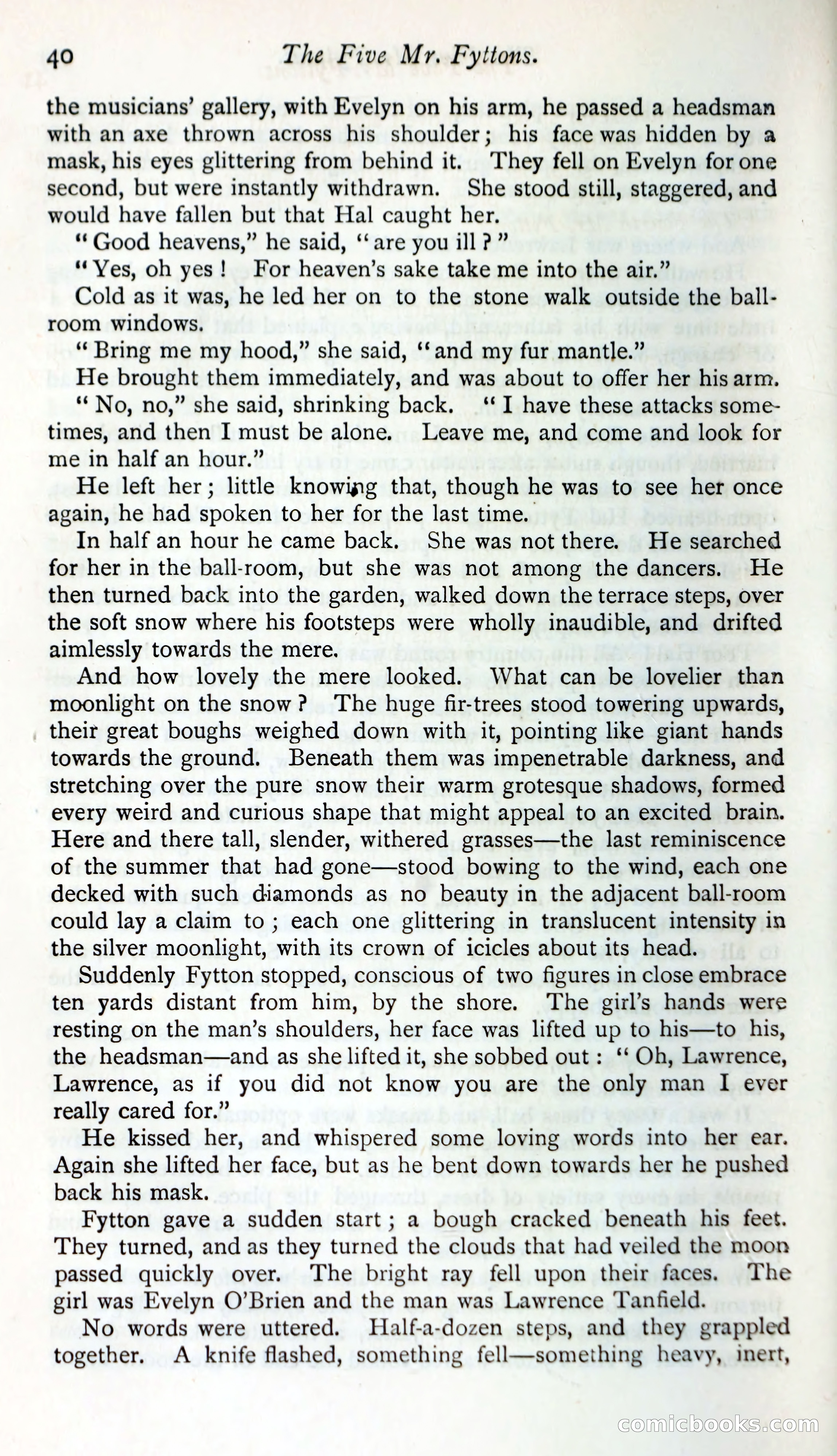
A restored page from Pulp Fiction, 1865. Page through the whole issue in the reader above.
📄 Transcribed text from this page (OCR, searchable)
Machine-transcribed from the original scan — historical spelling and the odd misread are preserved.
40 The Five Mr. Fyttons. the musicians’ gallery, with Evelyn on his arm, he passed a headsman with an axe thrown across his shoulder; his face was hidden by a mask, his eyes glittering from behind it. ‘They fell on Evelyn for one second, but were instantly withdrawn. She stood still, staggered, and would have fallen but that Hal caught her. ‘Good heavens,” he said, ‘‘ are you ill ? ” “Yes, oh yes! For heaven’s sake take me into the air.” Cold as it was, he led her on to the stone walk outside the ball- room windows. ‘Bring me my hood,” she said, ‘and my fur mantle.” He brought them immediately, and was about to offer her his arm. ** No, no,” she said, shrinking back. ‘‘I have these attacks some- times, and then I must be alone. Leave me, and come and look for me in half an hour.” He left her; little knowing that, though he was to see her once again, he had spoken to her for the last time. In half an hour he came back. She was notthere. He searched for her in the ball-room, but she was not among the dancers. He then turned back into the garden, walked down the terrace steps, over the soft snow where his footsteps were wholly inaudible, and drifted aimlessly towards the mere. And how lovely the mere looked. What can be lovelier than moonlight on the snow? The huge fir-trees stood towering upwards, their great boughs weighed down with it, pointing like giant hands towards the ground. Beneath them was impenetrable darkness, and stretching over the pure snow their warm grotesque shadows, formed every weird and curious shape that might appeal to an excited brain. Here and there tall, slender, withered grasses—the last reminiscence of the summer that had gone—stood bowing to the wind, each one decked with such diamonds as no beauty in the adjacent ball-room could lay a claim to; each one glittering in translucent intensity in the silver moonlight, with its crown of icicles about its head. Suddenly Fytton stopped, conscious of two figures in close embrace ten yards distant from him, by the shore. ‘The girl’s hands were resting on the man’s shoulders, her face was lifted up to his—to his, the headsman—and as she lifted it, she sobbed out: ‘‘ Oh, Lawrence, Lawrence, as if you did not know you are the only man I ever really cared for.” He kissed her, and whispered some loving words into her ear. Again she lifted her face, but as he bent down towards her he pushed back his mask. Fytton gave a sudden start; a bough cracked beneath his feet. They turned, and as they turned the clouds that had veiled the moon passed quickly over. ‘The bright ray fell upon their faces. The girl was Evelyn O’Brien and the man was Lawrence Tanfield. No words were uttered. MHalf-a-dozen steps, and they grappled together. A knife flashed, something fell—something heavy, inert, CORMICLMOOOKS.e© m