
Pulp Fiction, 1865 · page 46 of 400
The Argosy — page 46: what you’re looking at
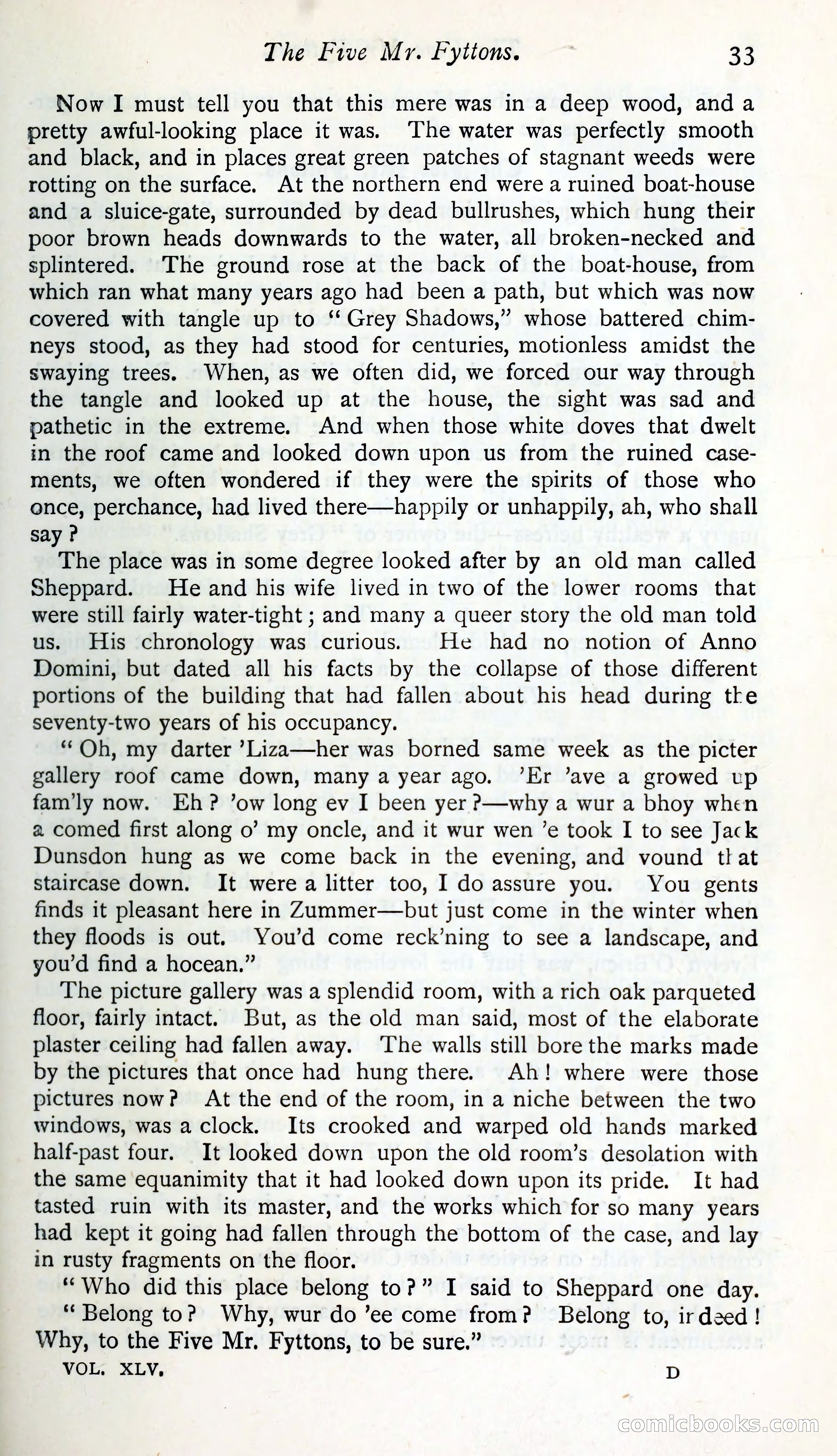
A restored page from Pulp Fiction, 1865. Page through the whole issue in the reader above.
📄 Transcribed text from this page (OCR, searchable)
Machine-transcribed from the original scan — historical spelling and the odd misread are preserved.
The Five Mr. Fyttons. 33 Now I must tell you that this mere was in a deep wood, anda pretty awful-looking place it was. The water was perfectly smooth and black, and in places great green patches of stagnant weeds were rotting on the surface. At the northern end were a ruined boat-house and a sluice-gate, surrounded by dead bullrushes, which hung their poor brown heads downwards to the water, all broken-necked and splintered. ‘The ground rose at the back of the boat-house, from which ran what many years ago had been a path, but which was now covered with tangle up to ‘‘ Grey Shadows,” whose battered chim- neys stood, as they had stood for centuries, motionless amidst the swaying trees. When, as we often did, we forced our way through the tangle and looked up at the house, the sight was sad and pathetic in the extreme. And when those white doves that dwelt in the roof came and looked down upon us from the ruined case- ments, we often wondered if they were the spirits of those who once, perchance, had lived there—happily or unhappily, ah, who shall say P The place was in some degree looked after by an old man called Sheppard. He and his wife lived in two of the lower rooms that were still fairly water-tight ; and many a queer story the old man told us. His chronology was curious. He had no notion of Anno Domini, but dated all his facts by the collapse of those different portions of the building that had fallen about his head during tke seventy-two years of his occupancy. “Oh, my darter ’Liza—her was borned same week as the picter gallery roof came down, many a year ago. ’Er ’ave a growed up fam'ly now. Eh ? ’ow long ev I been yer P—why a wur a bhoy when a comed first along o’ my oncle, and it wur wen ’e took I to see Jack Dunsdon hung as we come back in the evening, and vound tliat staircase down. It were a litter too, I do assure you. You gents finds it pleasant here in Zummer—but just come in the winter when they floods is out. You’d come reck’ning to see a landscape, and you'd find a hocean.” The picture gallery was a splendid room, with a rich oak parqueted floor, fairly intact. But, as the old man said, most of the elaborate plaster ceiling had fallen away. ‘The walls still bore the marks made by the pictures that once had hung there. Ah! where were those pictures now? At the end of the room, in a niche between the two windows, was aclock. Its crooked and warped old hands marked half-past four. It looked down upon the old room’s desolation with the same equanimity that it had looked down upon its pride. It had tasted ruin with its master, and the works which for so many years had kept it going had fallen through the bottom of the case, and lay in rusty fragments on the floor. ‘Who did this place belong to?” I said to Sheppard one day. ‘Belong to? Why, wur do ’ee come from? Belong to, irdaed! Why, to the Five Mr. Fyttons, to be sure.” VOL. XLV, D cComicooolks (SO) An