
Pulp Fiction, 1865 · page 343 of 400
The Argosy — page 343: what you’re looking at
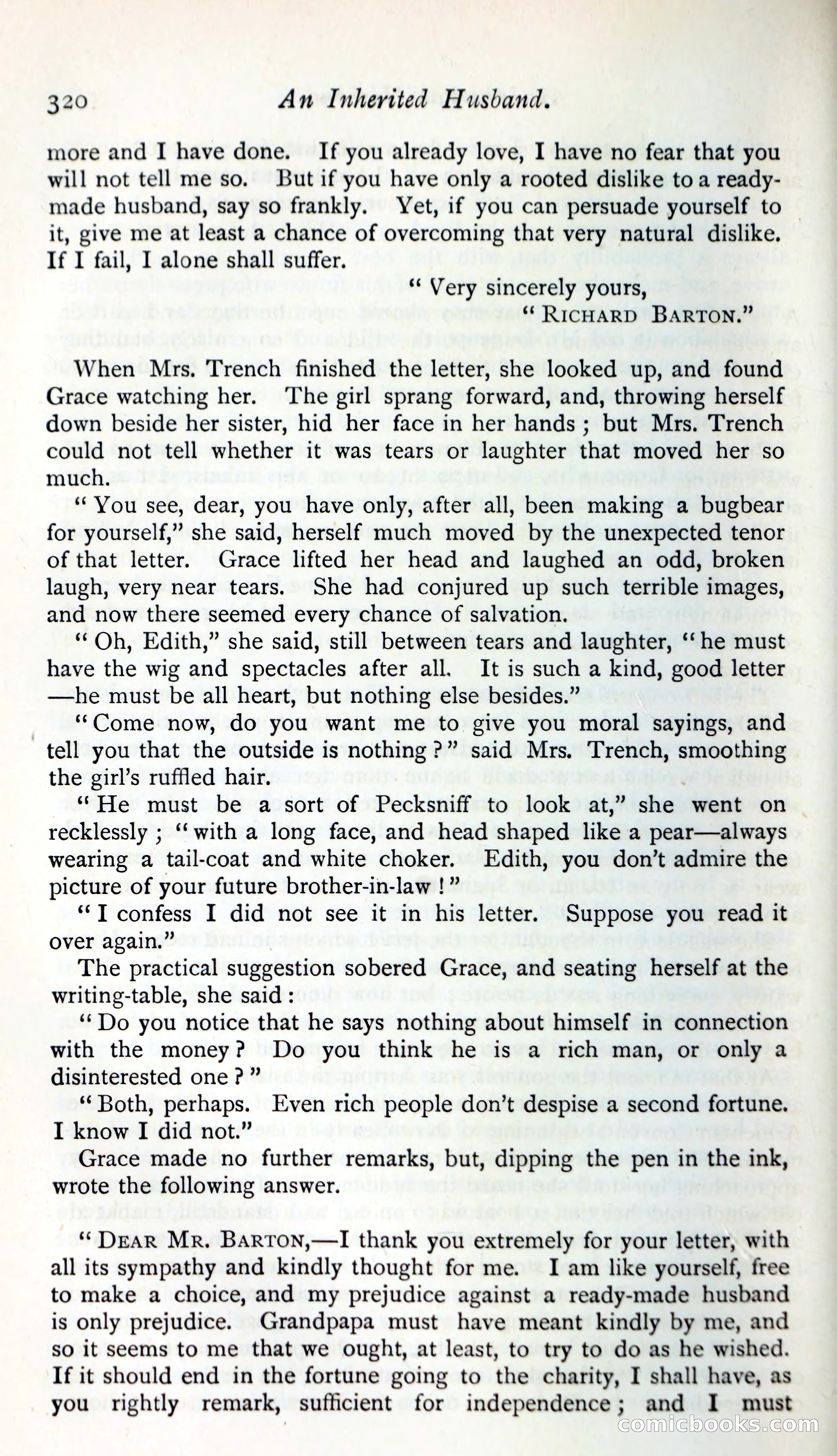
A restored page from Pulp Fiction, 1865. Page through the whole issue in the reader above.
📄 Transcribed text from this page (OCR, searchable)
Machine-transcribed from the original scan — historical spelling and the odd misread are preserved.
320 An Inherited Husband. more and I have done. If you already love, I have no fear that you will not tell me so. But if you have only a rooted dislike to a ready- made husband, say so frankly. Yet, if you can persuade yourself to — it, give me at least a chance of overcoming that very natural dislike. If I fail, I alone shall suffer. *‘ Very sincerely yours, “ RICHARD BARTON.” When Mrs. Trench finished the letter, she looked up, and found Grace watching her. ‘The girl sprang forward, and, throwing herself down beside her sister, hid her face in her hands ; but Mrs. Trench could not tell whether it was tears or laughter that moved her so much. ‘You see, dear, you have only, after all, been making a bugbear for yourself,” she said, herself much moved by the unexpected tenor of that letter. Grace lifted her head and laughed an odd, broken laugh, very near tears. She had conjured up such terrible images, and now there seemed every chance of salvation. ‘Oh, Edith,” she said, still between tears and laughter, ‘‘ he must have the wig and spectacles after all. It is such a kind, good letter —he must be all heart, but nothing else besides.” ‘Come now, do you want me to give you moral sayings, and tell you that the outside is nothing ?” said Mrs. Trench, smoothing the girl’s ruffled hair. ‘He must be a sort of Pecksniff to look at,” she ‘went on recklessly ; ‘with a long face, and head shaped like a pear—always wearing a tail-coat and white choker. Edith, you don’t admire the picture of your future brother-in-law !” ‘TI confess I did not see it in his letter. Suppose you read it over again.” The practical suggestion sobered Grace, and seating herself at the writing-table, she said: ‘Do you notice that he says nothing about himself in connection with the money? Do you think he is a rich man, or only a disinterested one ?” ‘Both, perhaps. Even rich people don’t despise a second fortune. I know I did not.” Grace made no further remarks, but, dipping the pen in the ink, wrote the following answer. ‘DEAR MR. BARTON,—I thank you extremely for your letter, with all its sympathy and kindly thought for me. I am like yourself, free to make a choice, and my prejudice against a ready-made husband is only prejudice. Grandpapa must have meant kindly by me, and so it seems to me that we ought, at least, to try to do as he wished. If it should end in the fortune going to the charity, I shall have, as you rightly remark, sufficient for independence; and I must ECORMICELIOO_ KS. (E©) m