
Pulp Fiction, 1865 · page 316 of 400
The Argosy — page 316: what you’re looking at
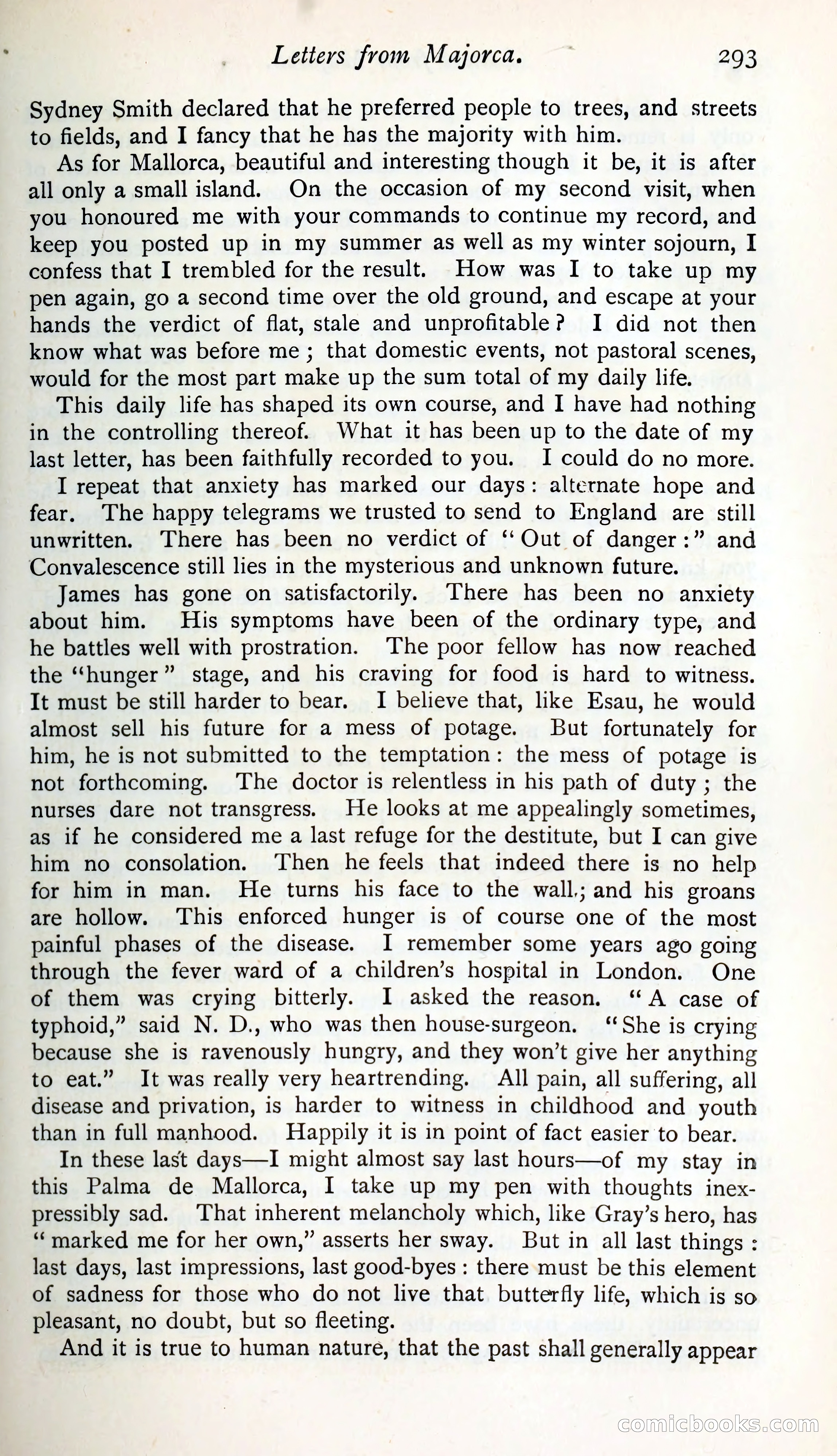
A restored page from Pulp Fiction, 1865. Page through the whole issue in the reader above.
📄 Transcribed text from this page (OCR, searchable)
Machine-transcribed from the original scan — historical spelling and the odd misread are preserved.
Letters from Majorca, 293 Sydney Smith declared that he preferred people to trees, and streets to fields, and I fancy that he has the majority with him. As for Mallorca, beautiful and interesting though it be, it is after all only a small island. On the occasion of my second visit, when you honoured me with your commands to continue my record, and keep you posted up in my summer as well as my winter sojourn, I confess that I trembled for the result. How was I to take up my pen again, go a second time over the old ground, and escape at your hands the verdict of flat, stale and unprofitable? I did not then know what was before me; that domestic events, not pastoral scenes, would for the most part make up the sum total of my daily life. This daily life has shaped its own course, and I have had nothing in the controlling thereof. What it has been up to the date of my last letter, has been faithfully recorded to you. I could do no more. I repeat that anxiety has marked our days: alternate hope and fear, The happy telegrams we trusted to send to England are still unwritten. There has been no verdict of ‘‘ Out of danger:” and Convalescence still lies in the mysterious and unknown future. James has gone on satisfactorily. ‘There has been no anxiety about him. His symptoms have been of the ordinary type, and he battles well with prostration. The poor fellow has now reached the “hunger” stage, and his craving for food is hard to witness. It must be still harder to bear. I believe that, like Esau, he would almost sell his future for a mess of potage. But fortunately for him, he is not submitted to the temptation: the mess of potage is not forthcoming. The doctor is relentless in his path of duty ; the nurses dare not transgress. He looks at me appealingly sometimes, as if he considered me a last refuge for the destitute, but I can give him no consolation. ‘Then he feels that indeed there is no help for him in man. He turns his face to the wall,; and his groans are hollow. ‘This enforced hunger is of course one of the most painful phases of the disease. I remember some years ago going through the fever ward of a children’s hospital in London. One of them was crying bitterly. I asked the reason. ‘A case of typhoid,” said N. D., who was then house-surgeon. ‘She is crying because she is ravenously hungry, and they won’t give her anything to eat.” It was really very heartrending. All pain, all suffering, all disease and privation, is harder to witness in childhood and youth than in full manhood. Happily it is in point of fact easier to bear. In these last days—I might almost say last hours—of my stay in this Palma de Mallorca, I take up my pen with thoughts inex- pressibly sad. That inherent melancholy which, like Gray’s hero, has “marked me for her own,” asserts her sway. But in all last things : last days, last impressions, last good-byes: there must be this element of sadness for those who do not live that butterfly life, which is so pleasant, no doubt, but so fleeting. And it is true to human nature, that the past shall generally appear Comicooolks (C(O)