
Pulp Fiction, 1865 · page 306 of 400
The Argosy — page 306: what you’re looking at
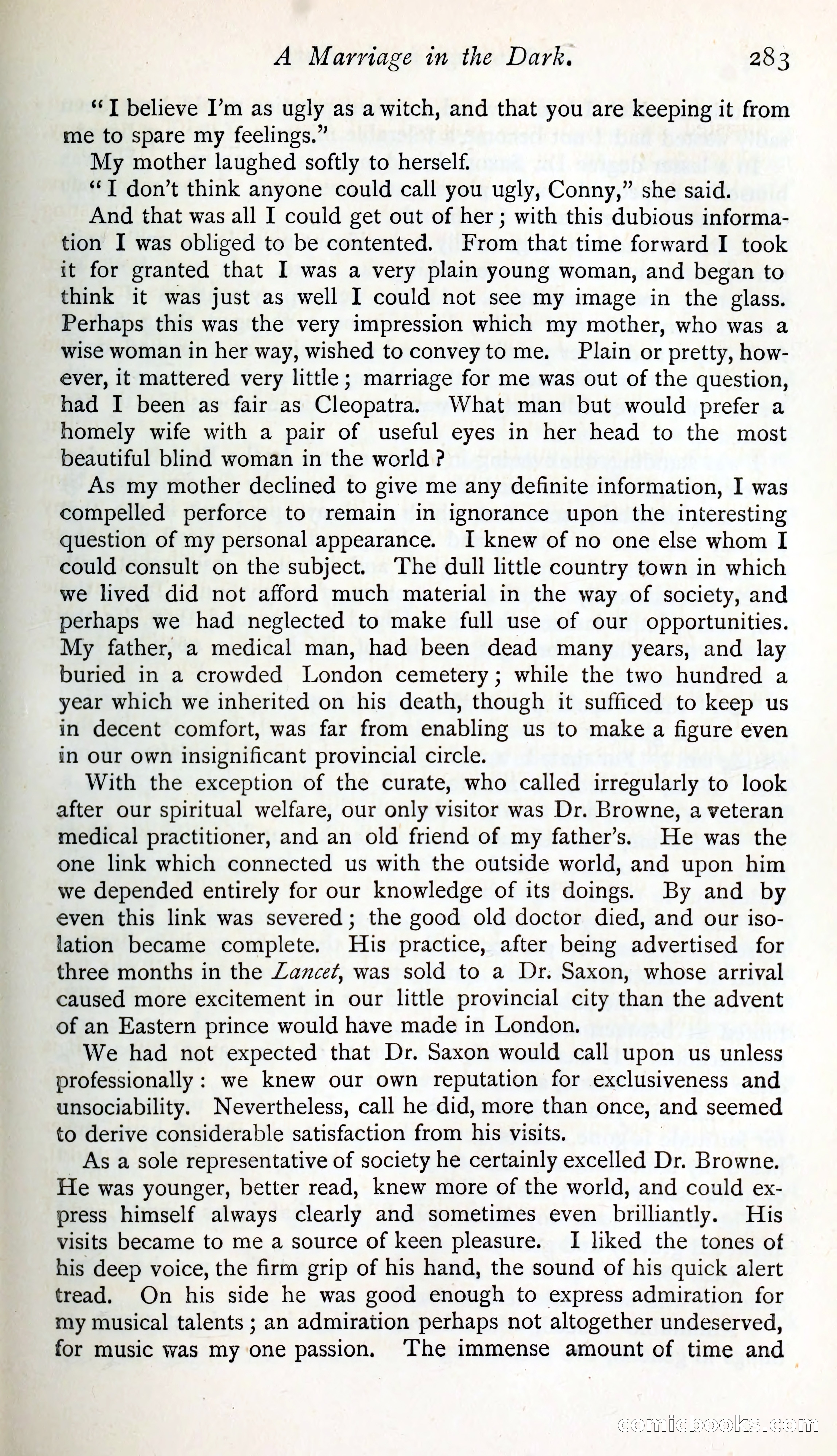
A restored page from Pulp Fiction, 1865. Page through the whole issue in the reader above.
📄 Transcribed text from this page (OCR, searchable)
Machine-transcribed from the original scan — historical spelling and the odd misread are preserved.
A Marriage in the Dark. 283 ‘TI believe I’m as ugly as a witch, and that you are keeping it from me to spare my feelings.” My mother laughed softly to herself. “I don’t think anyone could call you ugly, Conny,” she said. And that was all I could get out of her; with this dubious informa- tion I was obliged to be contented. From that time forward I took it for granted that I was a very plain young woman, and began to think it was just as well I could not see my image in the glass. Perhaps this was the very impression which my mother, who was a wise woman in her way, wished to conveyto me. Plain or pretty, how- ever, it mattered very little; marriage for me was out of the question, had I been as fair as Cleopatra. What man but would prefer a homely wife with a pair of useful eyes in her head to the most beautiful blind woman in the world P As my mother declined to give me any definite information, I was compelled perforce to remain in ignorance upon the interesting question of my personal appearance. I knew of no one else whom I could consult on the subject. The dull little country town in which we lived did not afford much material in the way of society, and perhaps we had neglected to make full use of our opportunities. My father, a medical man, had been dead many years, and lay buried in a crowded London cemetery; while the two hundred a year which we inherited on his death, though it sufficed to keep us in decent comfort, was far from enabling us to make a figure even in our Own insignificant provincial circle. With the exception of the curate, who called irregularly to look after our spiritual welfare, our only visitor was Dr. Browne, a veteran medical practitioner, and an old friend of my father’s. He was the one link which connected us with the outside world, and upon him we depended entirely for our knowledge of its doings. By and by even this link was severed; the good old doctor died, and our iso- lation became complete. His practice, after being advertised for three months in the Lancet, was sold to a Dr. Saxon, whose arrival caused more excitement in our little provincial city than the advent of an Eastern prince would have made in London. We had not expected that Dr. Saxon would call upon us unless professionally : we knew our own reputation for exclusiveness and unsociability. Nevertheless, call he did, more than once, and seemed to derive considerable satisfaction from his visits. _As a sole representative of society he certainly excelled Dr. Browne. He was younger, better read, knew more of the world, and could ex- press himself always clearly and sometimes even brilliantly. His visits became to me a source of keen pleasure. I liked the tones of his deep voice, the firm grip of his hand, the sound of his quick alert tread. On his side he was good enough to express admiration for my musical talents ; an admiration perhaps not altogether undeserved, for music was my one passion. The immense amount of time and COMICOOOKS.C©