
Pulp Fiction, 1865 · page 252 of 400
The Argosy — page 252: what you’re looking at
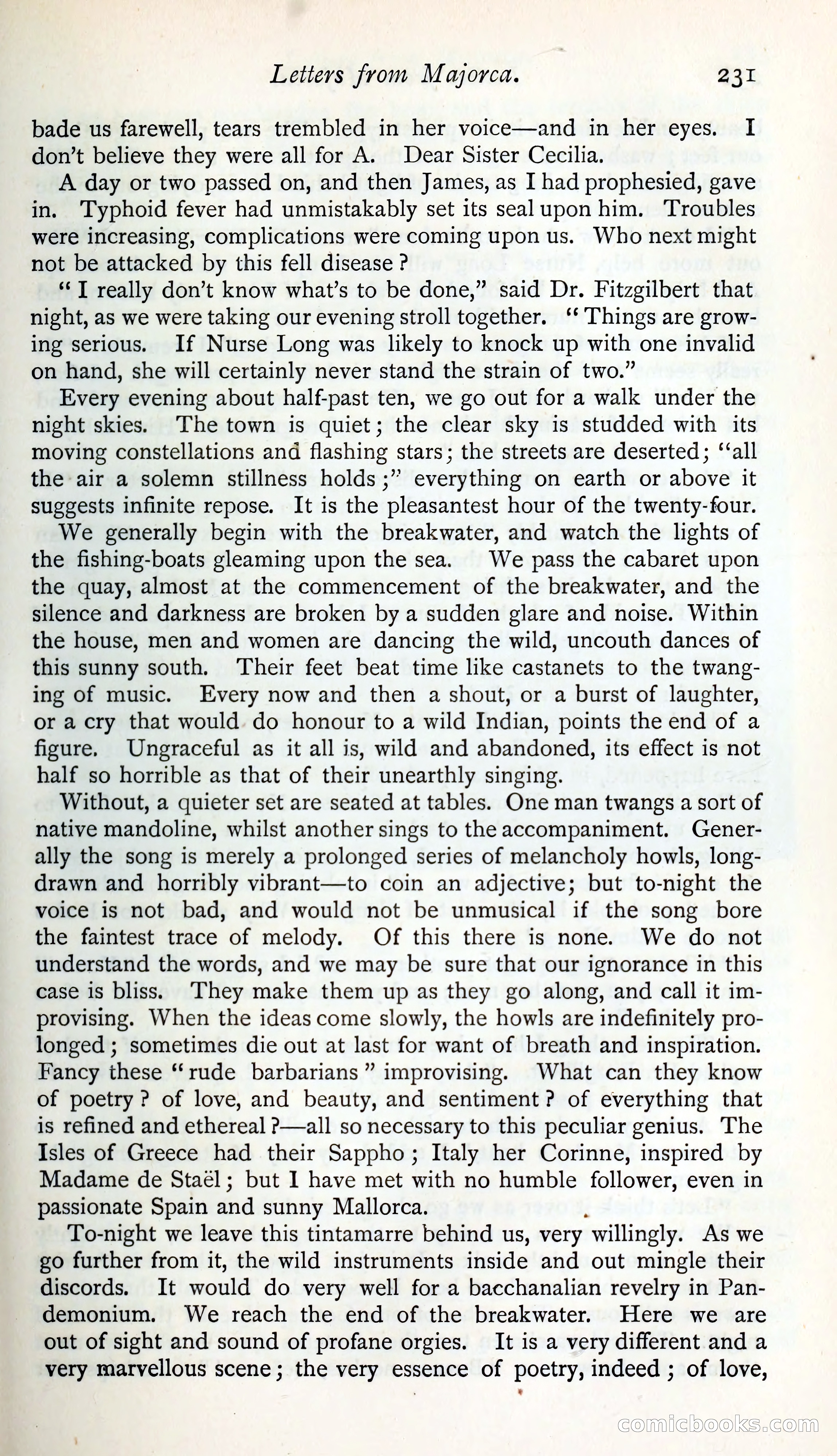
A restored page from Pulp Fiction, 1865. Page through the whole issue in the reader above.
📄 Transcribed text from this page (OCR, searchable)
Machine-transcribed from the original scan — historical spelling and the odd misread are preserved.
Letters from Majorca. 231 bade us farewell, tears trembled in her voice—and in her eyes. I don’t believe they were all for A. Dear Sister Cecilia. A day or two passed on, and then James, as I had prophesied, gave in. Typhoid fever had unmistakably set its sealupon him. Troubles were increasing, complications were coming upon us. Who next might not be attacked by this fell disease ? **T really don’t know what’s to be done,” said Dr. Fitzgilbert that night, as we were taking our evening stroll together. ‘* Things are grow- ing serious. If Nurse Long was likely to knock up with one invalid on hand, she will certainly never stand the strain of two.” Every evening about half-past ten, we go out for a walk under the night skies. The town is quiet; the clear sky is studded with its moving constellations and flashing stars; the streets are deserted; ‘‘all the air a solemn stillness holds ;” everything on earth or above it suggests infinite repose. It is the pleasantest hour of the twenty-four. We generally begin with the breakwater, and watch the lights of the fishing-boats gleaming upon the sea. We pass the cabaret upon the quay, almost at the commencement of the breakwater, and the silence and darkness are broken by a sudden glare and noise. Within the house, men and women are dancing the wild, uncouth dances of this sunny south. Their feet beat time like castanets to the twang- ing of music. Every now and then a shout, or a burst of laughter, or acry that would do honour to a wild Indian, points the end of a figure. Ungraceful as it all is, wild and abandoned, its effect is not half so horrible as that of their unearthly singing. Without, a quieter set are seated at tables. One man twangs a sort of native mandoline, whilst another sings to the accompaniment. Gener- ally the song is merely a prolonged series of melancholy howls, long- drawn and horribly vibrant—to coin an adjective; but to-night the voice is not bad, and would not be unmusical if the song bore the faintest trace of melody. Of this there is none. We do not understand the words, and we may be sure that our ignorance in this case is bliss. ‘They make them up as they go along, and call it im- provising. When the ideas come slowly, the howls are indefinitely pro- longed ; sometimes die out at last for want of breath and inspiration. Fancy these “rude barbarians” improvising. What can they know of poetry ? of love, and beauty, and sentiment ? of everything that is refined and ethereal P—all so necessary to this peculiar genius. The Isles of Greece had their Sappho; Italy her Corinne, inspired by Madame de Stael; but I have met with no humble follower, even in passionate Spain and sunny Mallorca. To-night we leave this tintamarre behind us, very “willingly. As we go further from it, the wild instruments inside and out mingle their discords. It would do very well for a bacchanalian revelry in Pan- demonium. We reach the end of the breakwater. Here we are out of sight and sound of profane orgies. It is a very different and a very marvellous scene; the very essence of poetry, indeed ; of love, comicooolks (S(O)