
Pulp Fiction, 1865 · page 248 of 400
The Argosy — page 248: what you’re looking at
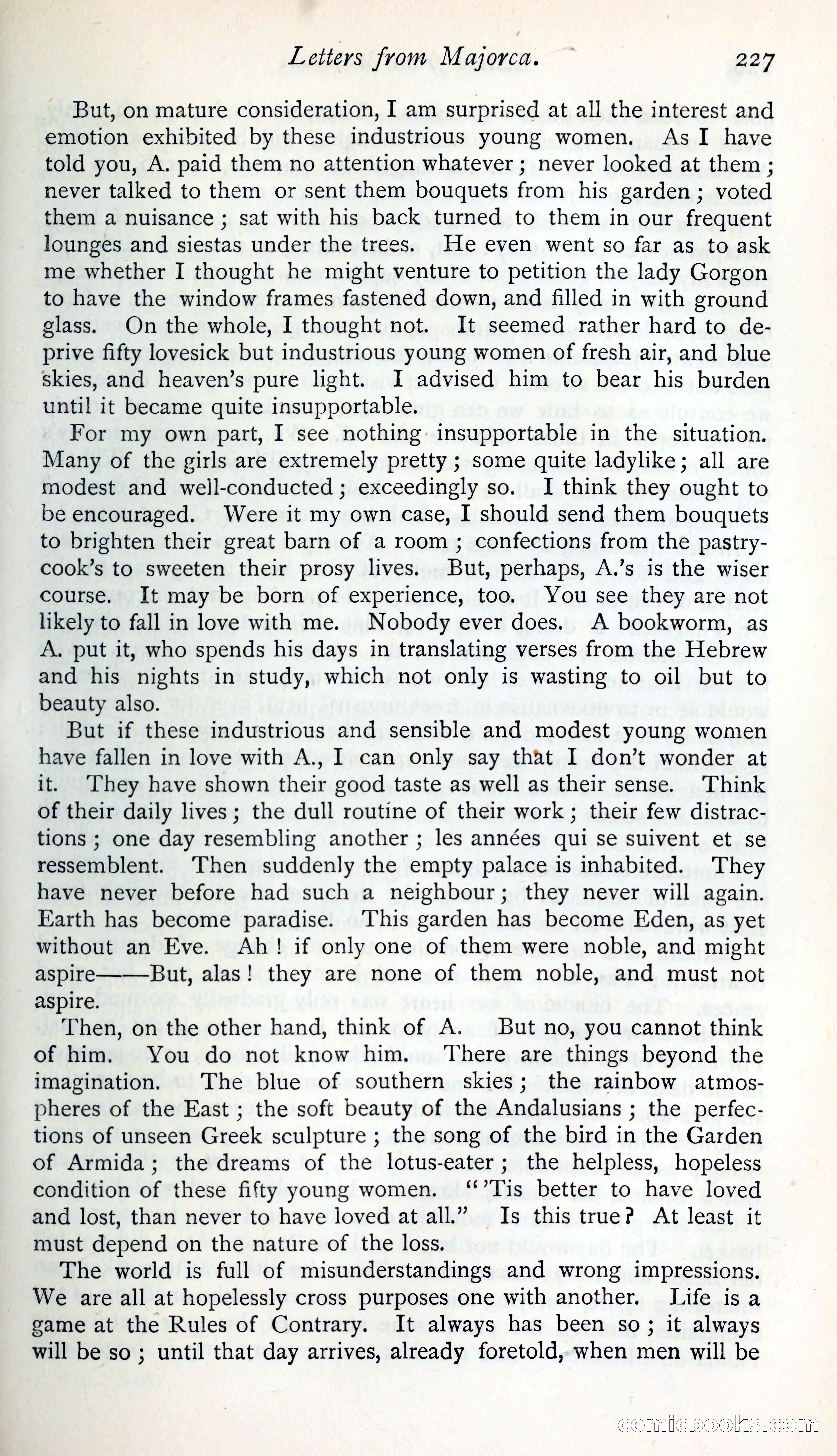
A restored page from Pulp Fiction, 1865. Page through the whole issue in the reader above.
📄 Transcribed text from this page (OCR, searchable)
Machine-transcribed from the original scan — historical spelling and the odd misread are preserved.
Letters from Majorca. — 227 But, on mature consideration, I am surprised at all the interest and emotion exhibited by these industrious young women. AsI have told you, A. paid them no attention whatever ; never looked at them ; never talked to them or sent them bouquets from his garden; voted them a nuisance ; sat with his back turned to them in our frequent lounges and siestas under the trees. He even went so far as to ask me whether I thought he might venture to petition the lady Gorgon to have the window frames fastened down, and filled in with ground glass. On the whole, I thought not. It seemed rather hard to de- prive fifty lovesick but industrious young women of fresh air, and blue skies, and heaven’s pure light. I advised him to bear his burden until it became quite insupportable. For my own part, I see nothing insupportable in the situation. Many of the girls are extremely pretty ; some quite ladylike; all are modest and weil-conducted ; exceedingly so. I think they ought to be encouraged. Were it my own case, I should send them bouquets to brighten their great barn of a room ; confections from the pastry- cook’s to sweeten their prosy lives. But, perhaps, A.’s is the wiser course. It may be born of experience, too. You see they are not likely to fall in love with me. Nobody ever does. A bookworm, as A. put it, who spends his days in translating verses from the Hebrew and his nights in study, which not only is wasting to oil but to beauty also. But if these industrious and sensible and modest young women have fallen in love with A., I can only say that I don’t wonder at it. They have shown their good taste as well as their sense. Think of their daily lives; the dull routine of their work ; their few distrac- tions ; one day resembling another ; les années qui se suivent et se ressemblent. ‘Then suddenly the empty palace is inhabited. They have never before had such a neighbour; they never will again. Earth has become paradise. ‘This garden has become Eden, as yet without an Eve. Ah! if only one of them were noble, and might aspire———But, alas! they are none of them noble, and must not aspire. Then, on the other hand, think of A. But no, you cannot think of him. You do not know him. There are things beyond the imagination. The blue of southern skies; the rainbow atmos- pheres of the East ; the soft beauty of the Andalusians ; the perfec- tions of unseen Greek sculpture ; the song of the bird in the Garden of Armida; the dreams of the lotus-eater; the helpless, hopeless condition of these fifty young women. ‘‘’Tis better to have loved and lost, than never to have loved at all.” Is this true? At least it must depend on the nature of the loss. The world is full of misunderstandings and wrong impressions. We are all at hopelessly cross purposes one with another. Life isa game at the Rules of Contrary. It always has been so; it always will be so; until that day arrives, already foretold, when men will be Conmicbooolks (C(O)