
Pulp Fiction, 1865 · page 320 of 400
The Argosy — page 320: what you’re looking at
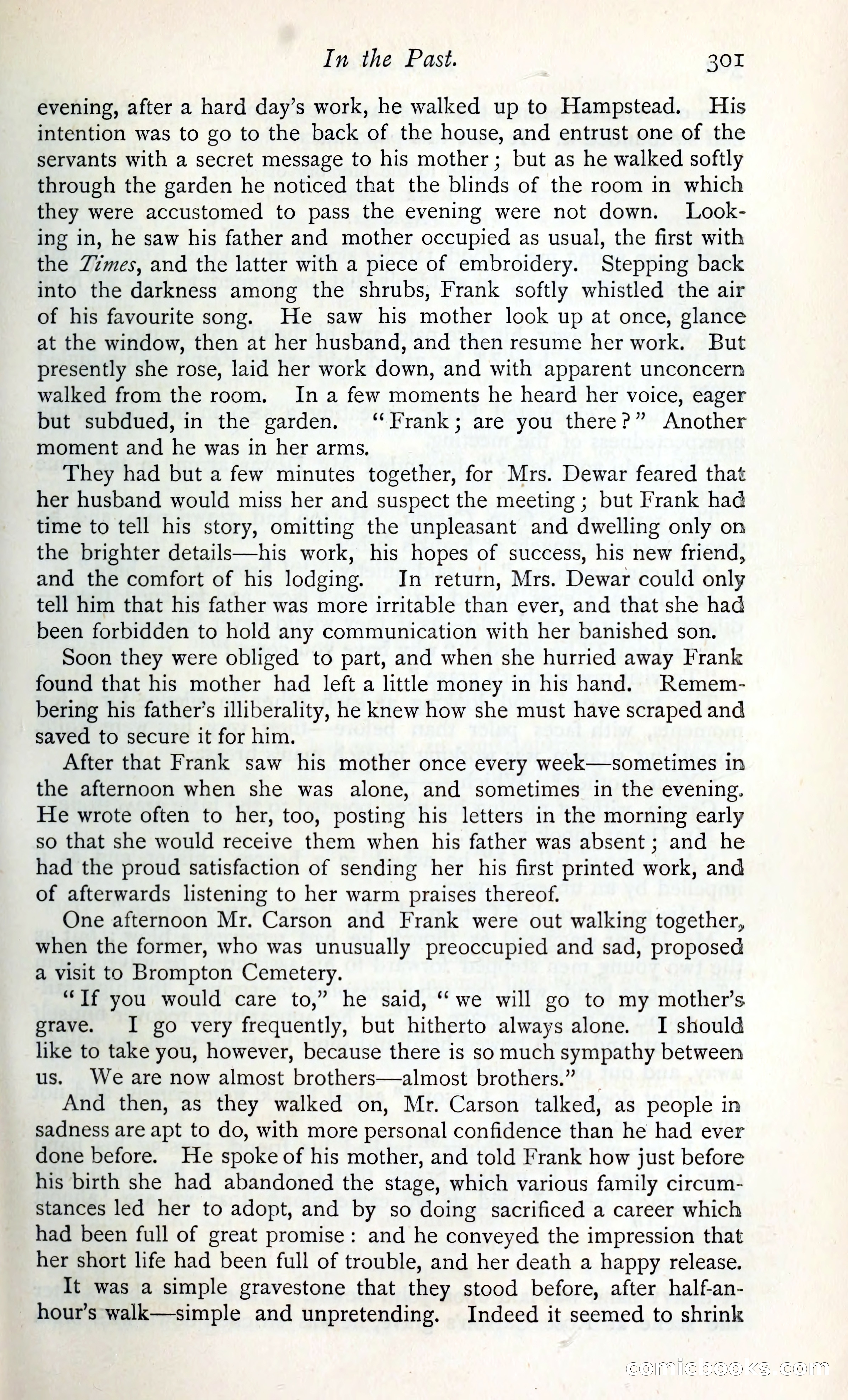
A restored page from Pulp Fiction, 1865. Page through the whole issue in the reader above.
📄 Transcribed text from this page (OCR, searchable)
Machine-transcribed from the original scan — historical spelling and the odd misread are preserved.
In the Past. 301 evening, after a hard day’s work, he walked up to Hampstead. Huis intention was to go to the back of the house, and entrust one of the servants with a secret message to his mother; but as he walked softly through the garden he noticed that the blinds of the room in which they were accustomed to pass the evening were not down. Look- ing in, he saw his father and mother occupied as usual, the first with the Zzmes, and the latter with a piece of embroidery. Stepping back into the darkness among the shrubs, Frank softly whistled the air of his favourite song. He saw his mother look up at once, glance at the window, then at her husband, and then resume her work. But presently she rose, laid her work down, and with apparent unconcern walked from the room. Ina few moments he heard her voice, eager but subdued, in the garden. ‘‘Frank; are you there?” Another moment and he was in her arms, They had but a few minutes together, for Mrs. Dewar feared that her husband would miss her and suspect the meeting ; but Frank had time to tell his story, omitting the unpleasant and dwelling only on the brighter details—his work, his hopes of success, his new friend, and the comfort of his lodging. In return, Mrs. Dewar could only tell him that his father was more irritable than ever, and that she had been forbidden to hold any communication with her banished son. Soon they were obliged to part, and when she hurried away Frank found that his mother had left a little money in his hand. Remem- bering his father’s illiberality, he knew how she must have scraped and saved to secure it for him. After that Frank saw his mother once every week—sometimes in the afternoon when she was alone, and sometimes in the evening. He wrote often to her, too, posting his letters in the morning early so that she would receive them when his father was absent ; and he had the proud satisfaction of sending her his first printed work, and of afterwards listening to her warm praises thereof. One afternoon Mr. Carson and Frank were out walking together, when the former, who was unusually preoccupied and sad, proposed a visit to Brompton Cemetery. “If you would care to,” he said, “we will go to my mother’s grave. I go very frequently, but hitherto always alone. I should like to take you, however, because there is so much sympathy between us. We are now almost brothers—almost brothers.” _ And then, as they walked on, Mr. Carson talked, as people in sadness are apt to do, with more personal confidence than he had ever done before. He spoke of his mother, and told Frank how just before his birth she had abandoned the stage, which various family circum- stances led her to adopt, and by so doing sacrificed a career which had been full of great promise: and he conveyed the impression that her short life had been full of trouble, and her death a happy release. It was a simple gravestone that they stood before, after half-an- hour’s walk—simple and unpretending. Indeed it seemed to shrink COMIC OOO ) SS an