
Pulp Fiction, 1865 · page 311 of 400
The Argosy — page 311: what you’re looking at
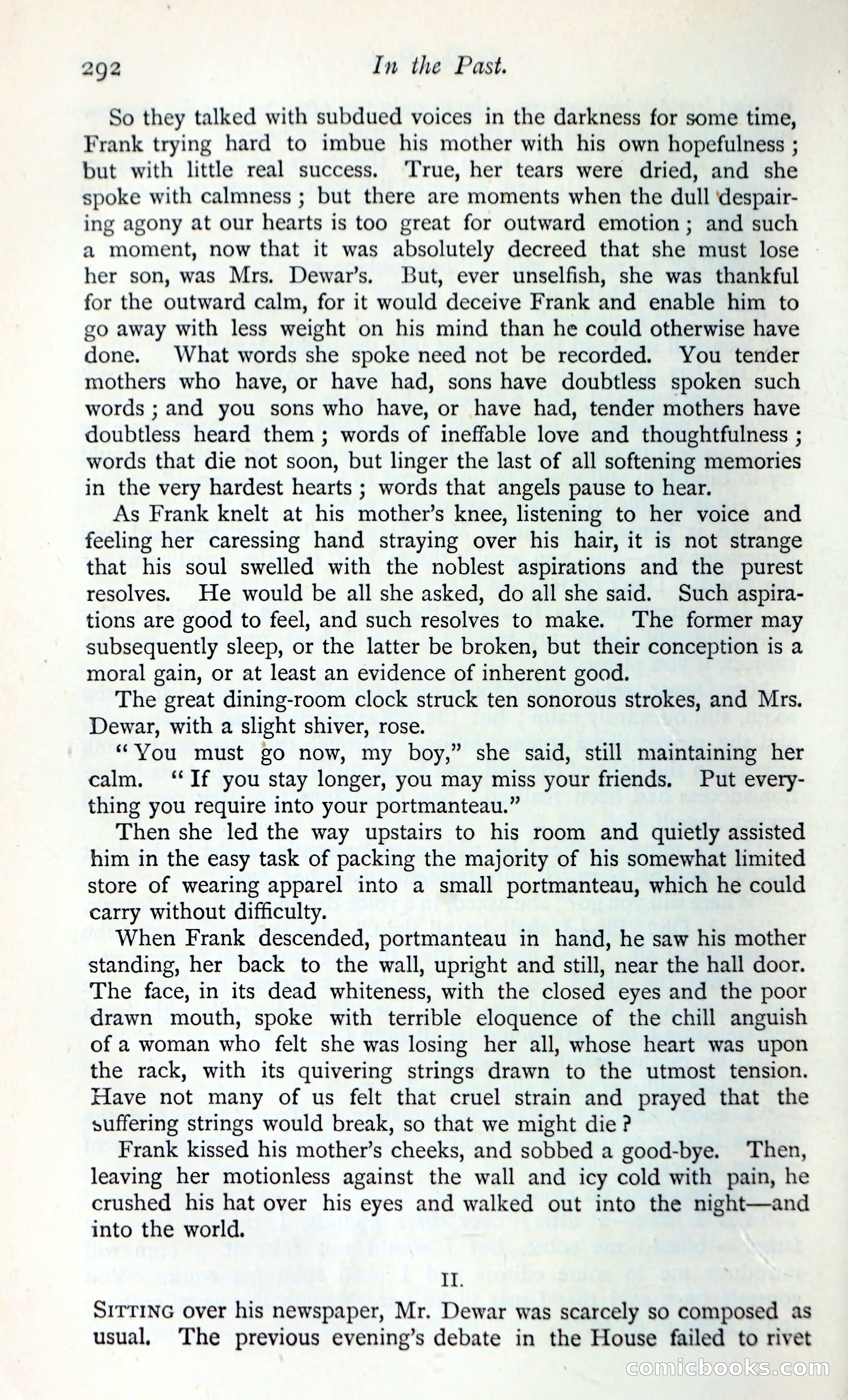
A restored page from Pulp Fiction, 1865. Page through the whole issue in the reader above.
📄 Transcribed text from this page (OCR, searchable)
Machine-transcribed from the original scan — historical spelling and the odd misread are preserved.
292 In the Past. So they talked with subdued voices in the darkness for some time, Frank trying hard to imbue his mother with his own hopefulness ; but with little real success. ‘True, her tears were dried, and she spoke with calmness ; but there are moments when the dull ‘despair- ing agony at our hearts is too great for outward emotion; and such a moment, now that it was absolutely decreed that she must lose » her son, was Mrs. Dewar’s. But, ever unselfish, she was thankful for the outward calm, for it would deceive Frank and enable him to go away with less weight on his mind than he could otherwise have done. What words she spoke need not be recorded. You tender mothers who have, or have had, sons have doubtless spoken such words ; and you sons who have, or have had, tender mothers have doubtless heard them ; words of ineffable love and thoughtfulness ; words that die not soon, but linger the last of all softening memories in the very hardest hearts ; words that angels pause to hear. As Frank knelt at his mother’s knee, listening to her voice and feeling her caressing hand straying over his hair, it is not strange that his soul swelled with the noblest aspirations and the purest resolves. He would be all she asked, do all she said. Such aspira- tions are good to feel, and such resolves to make. The former may subsequently sleep, or the latter be broken, but their conception is a moral gain, or at least an evidence of inherent good. The great dining-room clock struck ten sonorous strokes, and Mrs. Dewar, with a slight shiver, rose. “You must go now, my boy,” she said, still maintaining her calm. ‘If you stay longer, you may miss your friends. Put every- thing you require into your portmanteau.” Then she led the way upstairs to his room and quietly assisted him in the easy task of packing the majority of his somewhat limited store of wearing apparel into a small portmanteau, which he could carry without difficulty. When Frank descended, portmanteau in hand, he saw his mother standing, her back to the wall, upright and still, near the hall door. The face, in its dead whiteness, with the closed eyes and the poor drawn mouth, spoke with terrible eloquence of the chill anguish of a woman who felt she was losing her all, whose heart was upon the rack, with its quivering strings drawn to the utmost tension. Have not many of us felt that cruel strain and prayed that the suffering strings would break, so that we might die? Frank kissed his mother’s cheeks, and sobbed a good-bye. ‘Then, leaving her motionless against the wall and icy cold with pain, he crushed his hat over his eyes and walked out into the night—and into the world. Il. SITTING over his newspaper, Mr. Dewar was scarcely so composed as usual. The previous evening’s debate in the House failed to rivet COMICOOOKS.C©