
Pulp Fiction, 1865 · page 281 of 400
The Argosy — page 281: what you’re looking at
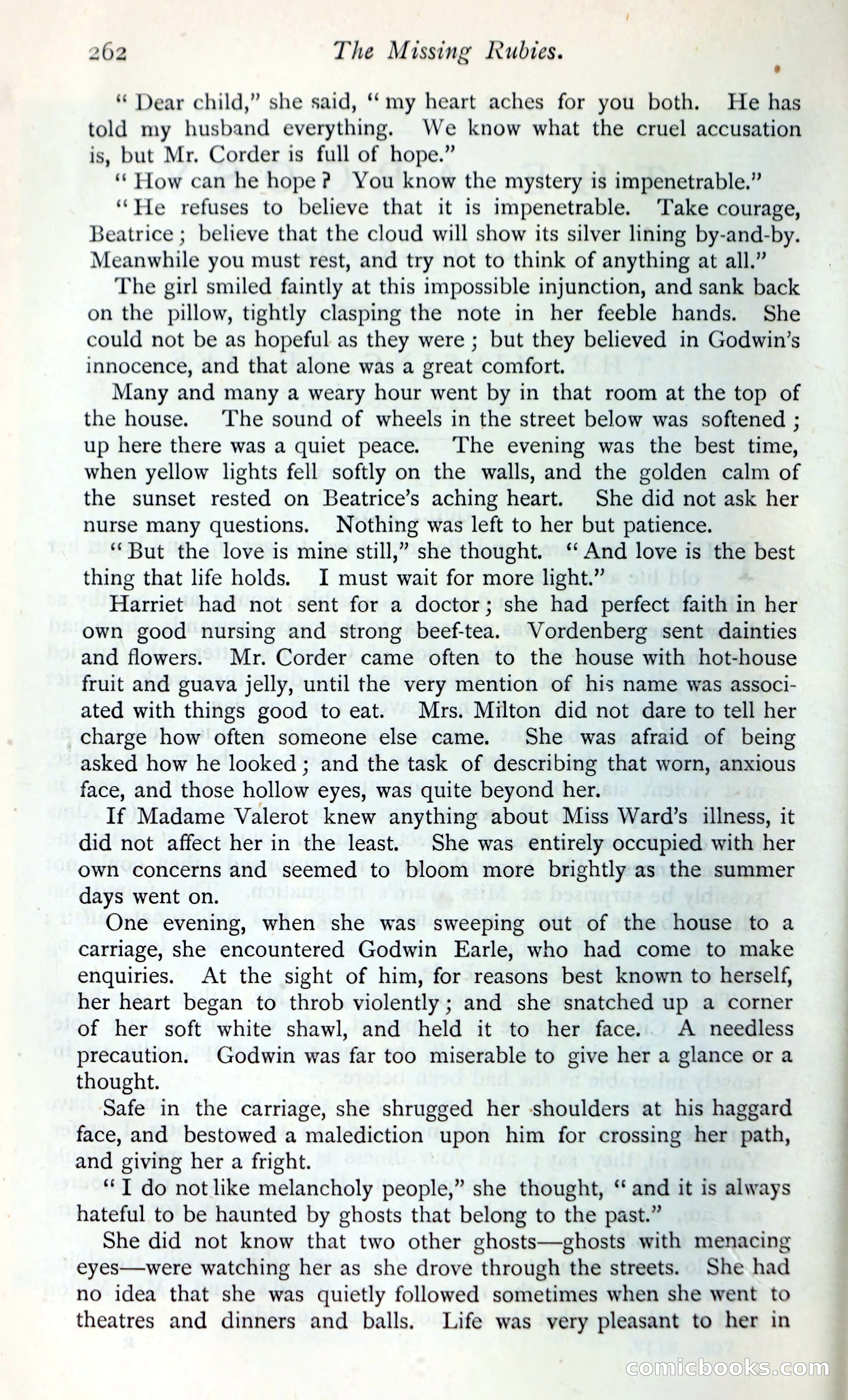
A restored page from Pulp Fiction, 1865. Page through the whole issue in the reader above.
📄 Transcribed text from this page (OCR, searchable)
Machine-transcribed from the original scan — historical spelling and the odd misread are preserved.
262 The Missing Rubies. “ Dear child,” she said, ‘my heart aches for you both. He has told my husband everything. We know what the cruel accusation is, but Mr. Corder is full of hope.” ‘How can he hope? You know the mystery is impenetrable.” ‘“FHYe refuses to believe that it is impenetrable. Take courage, Beatrice ; believe that the cloud will show its silver lining by-and-by. Meanwhile you must rest, and try not to think of anything at all.” The girl smiled faintly at this impossible injunction, and sank back on the pillow, tightly clasping the note in her feeble hands. She could not be as hopeful as they were ; but they believed in Godwin’s innocence, and that alone was a great comfort. Many and many a weary hour went by in that room at the top of the house. The sound of wheels in the street below was softened ; up here there was a quiet peace. ‘The evening was the best time, when yellow lights fell softly on the walls, and the golden calm of the sunset rested on Beatrice’s aching heart. She did not ask her nurse many questions. Nothing was left to her but patience. ‘But the love is mine still,” she thought. ‘‘ And love is the best thing that life holds. I must wait for more light.” Harriet had not sent for a doctor; she had perfect faith in her own good nursing and strong beef-tea. Vordenberg sent dainties and flowers. Mr. Corder came often to the house with hot-house fruit and guava jelly, until the very mention of his name was associ- ated with things good to eat. Mrs. Milton did not dare to tell her charge how often someone else came. She was afraid of being asked how he looked ; and the task of describing that worn, anxious face, and those hollow eyes, was quite beyond her. If Madame Valerot knew anything about Miss Ward’s illness, it did not affect her in the least. She was entirely occupied with her own concerns and seemed to bloom more brightly as the summer days went on. One evening, when she was sweeping out of the house to a carriage, she encountered Godwin Earle, who had come to make enquiries. At the sight of him, for reasons best known to herself, her heart began to throb violently; and she snatched up a corner of her soft white shawl, and held it to her face. A needless precaution. Godwin was far too miserable to give her a glance or a thought. Safe in the carriage, she shrugged her -shoulders at his haggard face, and bestowed a malediction upon him for crossing her path, and giving her a fright. ‘IT do not like melancholy people,” she thought, ‘‘ and it is always hateful to be haunted by ghosts that belong to the past.” She did not know that two other ghosts—ghosts with menacing eyes—were watching her as she drove through the streets. She had no idea that she was quietly followed sometimes when she went to theatres and dinners and balls. Life was very pleasant to her in COMIC OOOKS.C© OE K—$E§FECC CCC a = -