
Pulp Fiction, 1865 · page 271 of 400
The Argosy — page 271: what you’re looking at
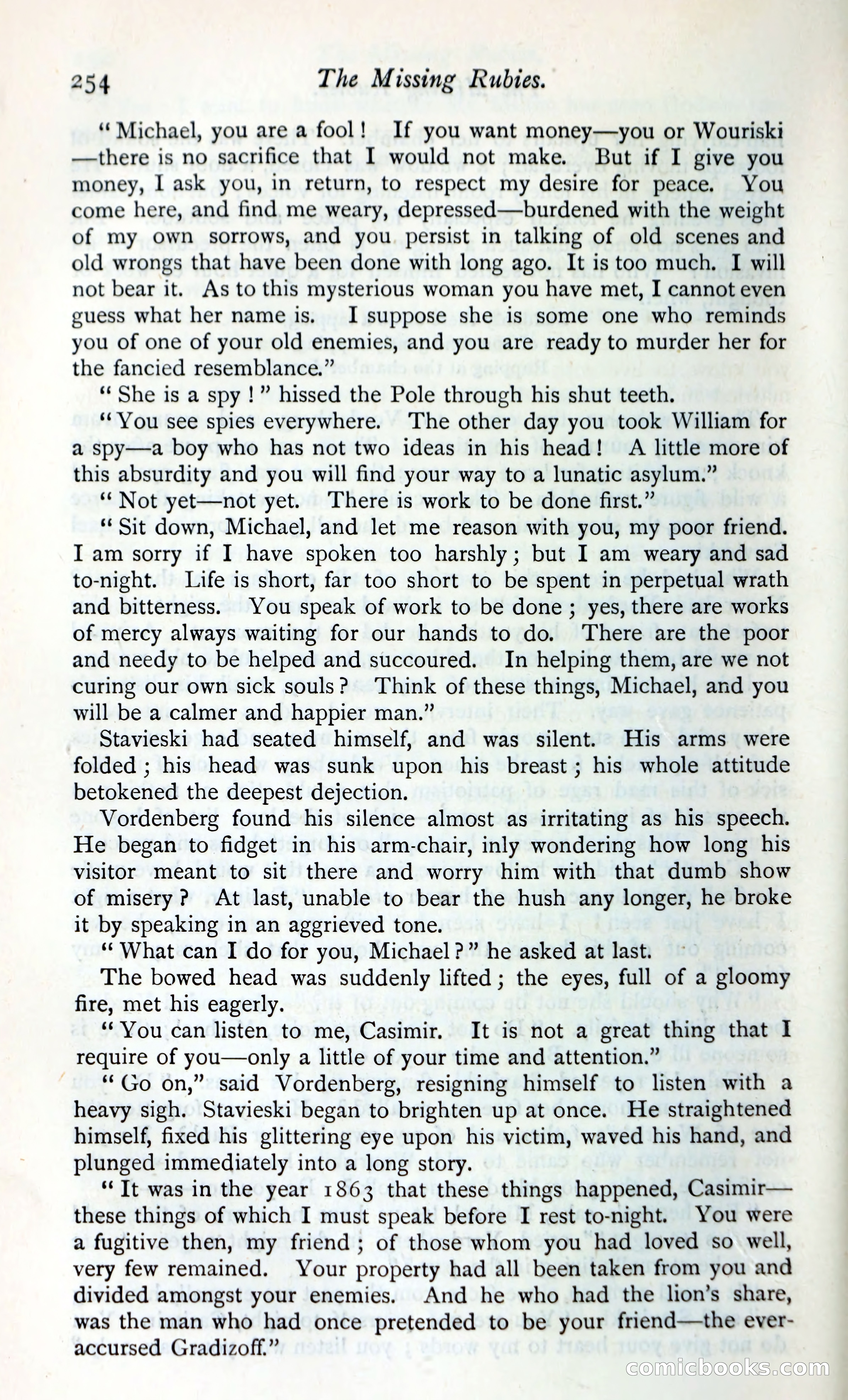
A restored page from Pulp Fiction, 1865. Page through the whole issue in the reader above.
📄 Transcribed text from this page (OCR, searchable)
Machine-transcribed from the original scan — historical spelling and the odd misread are preserved.
254 The Missing Rubies. ‘Michael, you are a fool! If you want money—you or Wouriski —there is no sacrifice that I would not make. But if I give you money, l ask you, in return, to respect my desire for peace. You come here, and find me weary, depressed—burdened with the weight of my own sorrows, and you persist in talking of old scenes and old wrongs that have been done with long ago. It is too much, I will not bear it. As to this mysterious woman you have met, I cannot even guess what her name is. I suppose she is some one who reminds you of one of your old enemies, and you are ready to murder her for the fancied resemblance.” ‘She is a spy!” hissed the Pole through his shut teeth. “You see spies everywhere. The other day you took William for a spy—a boy who has not two ideas in his head! A little more of this absurdity and you will find your way to a lunatic asylum.” ‘ Not yet—not yet. There is work to be done first.” *¢ Sit down, Michael, and let me reason with you, my poor friend. I am sorry if I have spoken too harshly; but 1 am weary and sad to-night. Life is short, far too short to be spent in perpetual wrath and bitterness. You speak of work to be done; yes, there are works of mercy always waiting for our hands to do. ‘There are the poor and needy to be helped and succoured. In helping them, are we not curing our own sick souls? ‘Think of these things, Michael, and you will be a calmer and happier man.” Stavieski had seated himself, and was silent. His arms were folded ; his head was sunk upon his breast; his whole attitude betokened the deepest dejection. Vordenberg found his silence almost as irritating as his speech. He began to fidget in his arm-chair, inly wondering how long his visitor meant to sit there and worry him with that dumb show of misery? At last, unable to bear the hush any longer, he broke it by speaking in an aggrieved tone. ‘What can I do for you, Michael?” he asked at last. The bowed head was suddenly lifted; the eyes, full of a gloomy fire, met his eagerly. “You can listen to me, Casimir. It is not a great thing that l require of you—only a little of your time and attention.” “Go on,” said Vordenberg, resigning himself to listen with a heavy sigh. Stavieski began to brighten up at once. He straightened himself, fixed his glittering eye upon his victim, waved his hand, and plunged immediately into a long story. ‘Tt was in the year 1863 that these things happened, Casimir— these things of which I must speak before I rest to-night. You were a fugitive then, my friend; of those whom you had loved so well, very few remained. Your property had all been taken from you and divided amongst your enemies. And he who had the lion’s share, was the man who had once pretended to be your friend—the ever- accursed Gradizoff.” ECORNIELOOOKS,E©