
Pulp Fiction, 1865 · page 269 of 400
The Argosy — page 269: what you’re looking at
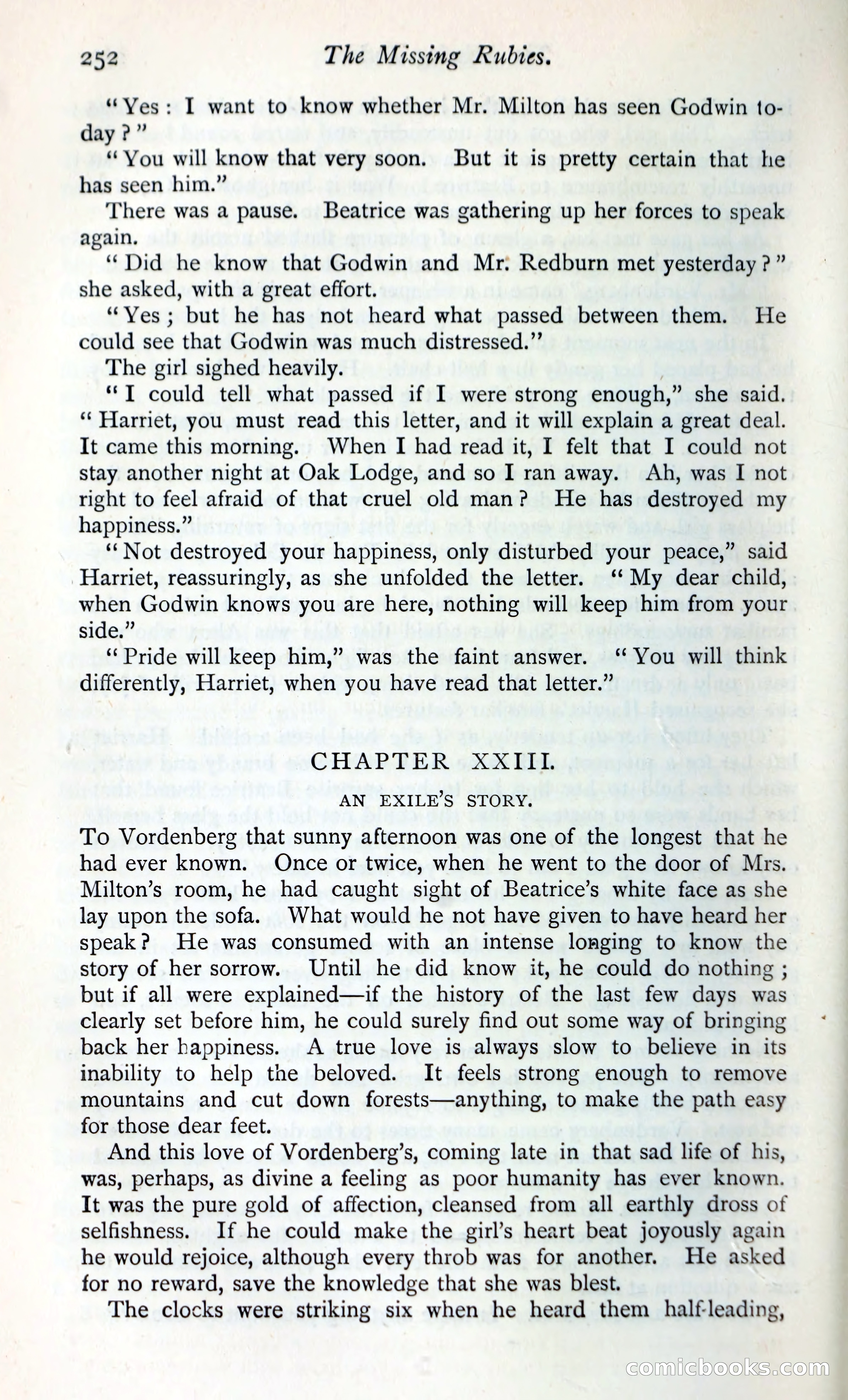
A restored page from Pulp Fiction, 1865. Page through the whole issue in the reader above.
📄 Transcribed text from this page (OCR, searchable)
Machine-transcribed from the original scan — historical spelling and the odd misread are preserved.
252 The Missing Rubtes. ‘Yes: I want to know whether Mr. Milton has seen Godwin to- day ?” “You will know that very soon. But it is pretty certain that he has seen him.” There was a pause. Beatrice was gathering up her forces to speak again. ‘Did he know that Godwin and Mr. Redburn met yesterday ? ” she asked, with a great effort. “Yes; but he has not heard what passed between them. He could see that Godwin was much distressed.”’ The girl sighed heavily. “T could tell what passed if I were strong enough,” she said. “Harriet, you must read this letter, and it will explain a great deal. It came this morning. When I had read it, I felt that I could not stay another night at Oak Lodge, and so I ran away. Ah, was I not right to feel afraid of that cruel old man? He has destroyed my happiness.” ‘*Not destroyed your happiness, only disturbed your peace,” said Harriet, reassuringly, as she unfolded the letter. ‘‘ My dear child, when Godwin knows you are here, nothing will keep him from your side.” “Pride will keep him,” was the faint answer. ‘“ You will think differently, Harriet, when you have read that letter.” CHAPTER XXIII. AN EXILE’S STORY. To Vordenberg that sunny afternoon was one of the longest that he had ever known. Once or twice, when he went to the door of Mrs. Milton’s room, he had caught sight of Beatrice’s white face as she lay upon the sofa. What would he not have given to have heard her speak? He was consumed with an intense longing to know the story of her sorrow. Until he did know it, he could do nothing ; but if all were explained—if the history of the last few days was clearly set before him, he could surely find out some way of bringing back her happiness. A true love is always slow to believe in its inability to help the beloved. It feels strong enough to remove mountains and cut down forests—anything, to make the path easy for those dear feet. And this love of Vordenberg’s, coming late in that sad life of his, was, perhaps, as divine a feeling as poor humanity has ever known. It was the pure gold of affection, cleansed from all earthly dross of selfishness. If he could make the girl’s heart beat joyously again he would rejoice, although every throb was for another. He asked for no reward, save the knowledge that she was blest. The clocks were striking six when he heard them half-leading, ECOMICOOOKS. GO