
Pulp Fiction, 1865 · page 25 of 400
The Argosy — page 25: what you’re looking at
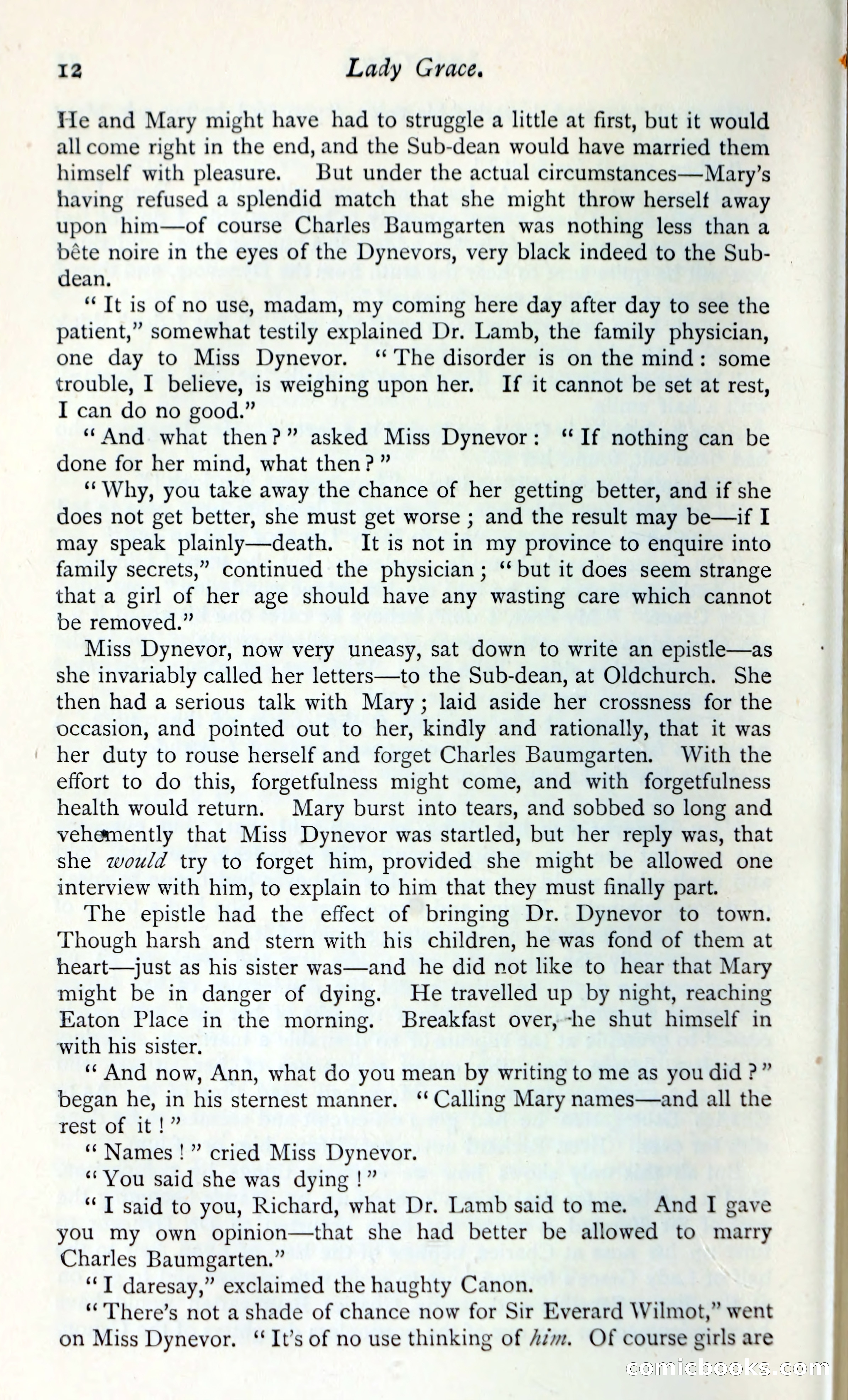
A restored page from Pulp Fiction, 1865. Page through the whole issue in the reader above.
📄 Transcribed text from this page (OCR, searchable)
Machine-transcribed from the original scan — historical spelling and the odd misread are preserved.
12 Lady Grace. ¥{e and Mary might have had to struggle a little at first, but it would allcome right in the end, and the Sub-dean would have married them himself with pleasure. But under the actual circumstances—Mary’s having refused a splendid match that she might throw herself away upon him—of course Charles Baumgarten was nothing less than a béte noire in the eyes of the Dynevors, very black indeed to the Sub- dean. “Tt is of no use, madam, my coming here day after day to see the patient,” somewhat testily explained Dr. Lamb, the family physician, one day to Miss Dynevor. ‘‘ The disorder is on the mind: some trouble, I believe, is weighing upon her. If it cannot be set at rest, I can do no good.” “And what then?” asked Miss Dynevor: “If nothing can be done for her mind, what then?” “Why, you take away the chance of her getting better, and if she does not get better, she must get worse ; and the result may be—if I may speak plainly—death. It is not in my province to enquire into family secrets,” continued the physician; ‘‘ but it does seem strange that a girl of her age should have any wasting care which cannot be removed.” Miss Dynevor, now very uneasy, sat down to write an epistle—as she invariably called her letters—to the Sub-dean, at Oldchurch. She then had a serious talk with Mary; laid aside her crossness for the occasion, and pointed out to her, kindly and rationally, that it was her duty to rouse herself and forget Charles Baumgarten. With the effort to do this, forgetfulness might come, and with forgetfulness health would return. Mary burst into tears, and sobbed so long and vehemently that Miss Dynevor was startled, but her reply was, that she would try to forget him, provided she might be allowed one interview with him, to explain to him that they must finally part. The epistle had the effect of bringing Dr. Dynevor to town. Though harsh and stern with his children, he was fond of them at heart—just as his sister was—and he did not like to hear that Mary might be in danger of dying. He travelled up by night, reaching Eaton Place in the morning. Breakfast over,-he shut himself in with his sister. ‘ And now, Ann, what do you mean by writing to me as you did ?” began he, in his sternest manner. ‘‘ Calling Mary names—and all the resto. it!” ‘““ Names !” cried Miss Dynevor. ‘You said she was dying!” “T said to you, Richard, what Dr. Lamb said tome. And I gave you my own opinion—that she had better be allowed to marry Charles Baumgarten.” ‘“‘T daresay,” exclaimed the haughty Canon. There’s not a shade of chance now for Sir Everard Wilmot,” went on Miss Dynevor. “It’s of no use thinking of Az. Of course girls are CONMIEOOOKS (C©)