
Pulp Fiction, 1865 · page 235 of 400
The Argosy — page 235: what you’re looking at
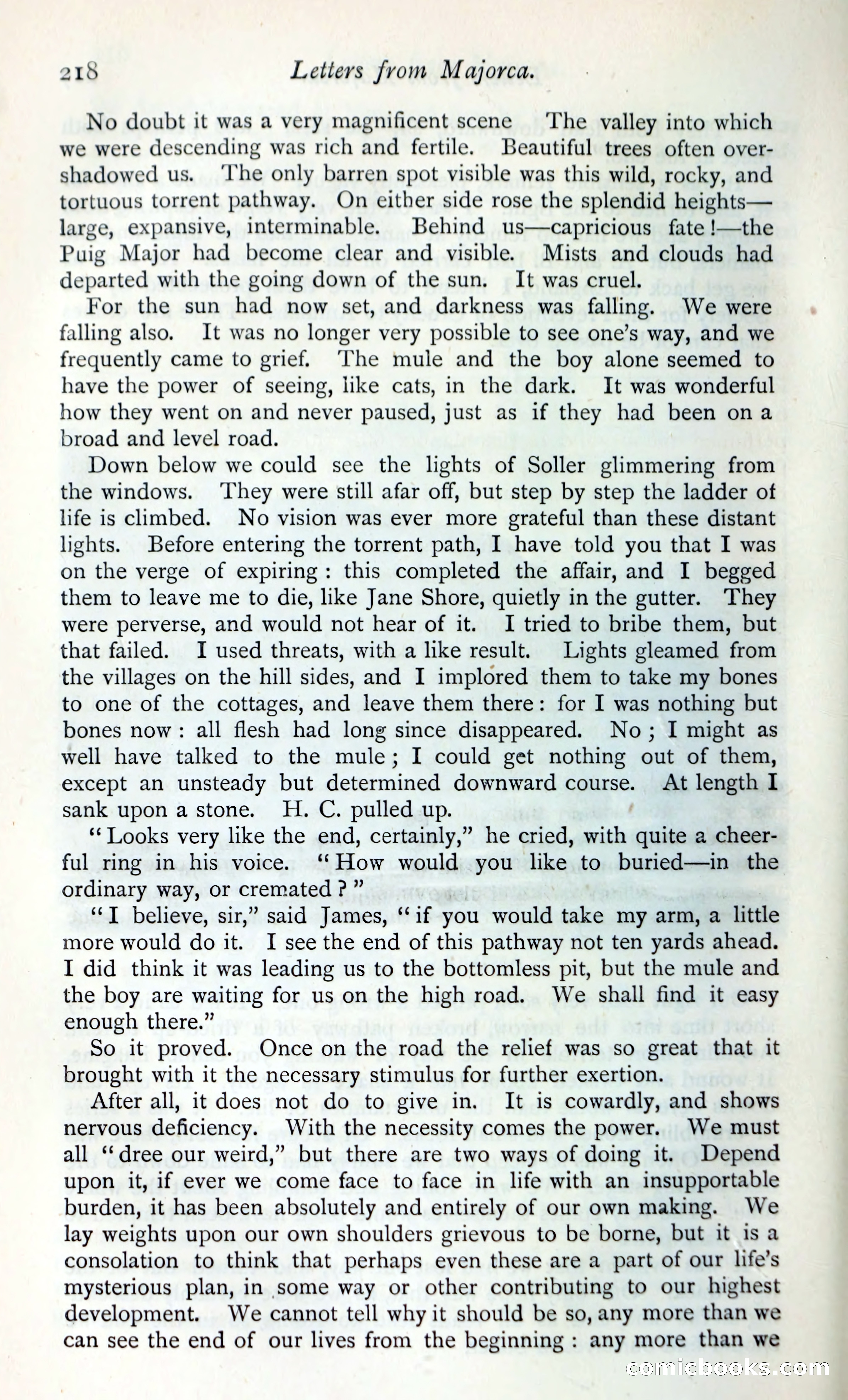
A restored page from Pulp Fiction, 1865. Page through the whole issue in the reader above.
📄 Transcribed text from this page (OCR, searchable)
Machine-transcribed from the original scan — historical spelling and the odd misread are preserved.
218 Letters from Majorca. No doubt it was a very magnificent scene ‘The valley into which we were descending was rich and fertile. Beautiful trees often over- shadowed us. ‘The only barren spot visible was this wild, rocky, and tortuous torrent pathway. On either side rose the splendid heights— large, expansive, interminable. Behind us—capricious fate !—the Puig Major had become clear and visible. Mists and clouds had departed with the going down of the sun. It was cruel. For the sun had now set, and darkness was falling. We were falling also. It was no longer very possible to see one’s way, and we frequently came to grief. ‘The mule and the boy alone seemed to have the power of seeing, like cats, in the dark. It was wonderful how they went on and never paused, just as if they had been ona broad and level road. Down below we could see the lights of Soller glimmering from the windows. ‘They were still afar off, but step by step the ladder of life is climbed. No vision was ever more grateful than these distant lights. Before entering the torrent path, I have told you that I was on the verge of expiring: this completed the affair, and I begged them to leave me to die, like Jane Shore, quietly in the gutter. ‘They were perverse, and would not hear of it. I tried to bribe them, but that failed. I used threats, with a like result. Lights gleamed from the villages on the hill sides, and I implored them to take my bones to one of the cottages, and leave them there: for I was nothing but bones now: all flesh had long since disappeared. No; I might as well have talked to the mule; I could get nothing out of them, except an unsteady but determined downward course. At length I sank upon a stone. H. C. pulled up. ‘Looks very like the end, certainly,” he cried, with ai a cheer- ful ring in his voice. ‘‘ How would you like to buried—in the ordinary way, or cremated P” ‘‘T believe, sir,” said James, ‘‘if you would take my arm, a little more would do it. I see the end of this pathway not ten yards ahead. I did think it was leading us to the bottomless pit, but the mule and the boy are waiting for us on the high road. We shall find it easy enough there.” So it proved. Once on the road the relief was so great that it brought with it the necessary stimulus for further exertion. After all, it does not do to give in. It is cowardly, and shows nervous deficiency. With the necessity comes the power. We must all ‘‘dree our weird,” but there are two ways of doing it. Depend upon it, if ever we come face to face in life with an insupportable burden, it has been absolutely and entirely of our own making. We lay weights upon our own shoulders grievous to be borne, but it is a consolation to think that perhaps even these are a part of our life’s mysterious plan, in some way or other contributing to our highest development. We cannot tell why it should be so, any more than we can see the end of our lives from the beginning : any more than we ECOMICOOOKS. GO