
Pulp Fiction, 1865 · page 210 of 400
The Argosy — page 210: what you’re looking at
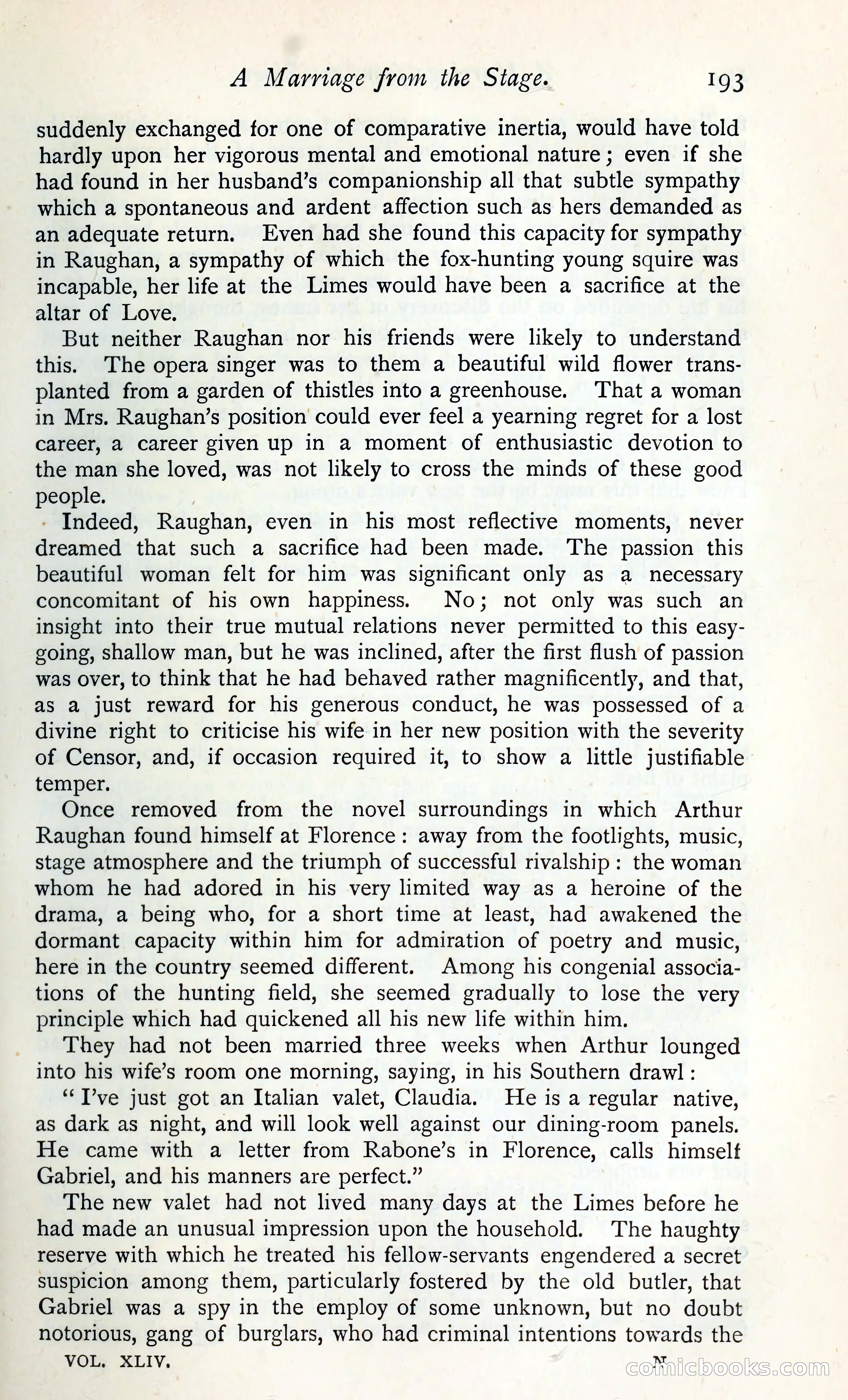
A restored page from Pulp Fiction, 1865. Page through the whole issue in the reader above.
📄 Transcribed text from this page (OCR, searchable)
Machine-transcribed from the original scan — historical spelling and the odd misread are preserved.
A Marnage from the Stage. 193 suddenly exchanged for one of comparative inertia, would have told hardly upon her vigorous mental and emotional nature ; even if she had found in her husband’s companionship all that subtle sympathy which a spontaneous and ardent affection such as hers demanded as an adequate return. Even had she found this capacity for sympathy in Raughan, a sympathy of which the fox-hunting young squire was incapable, her life at the Limes would have been a sacrifice at the altar of Love. But neither Raughan nor his friends were likely to understand this. ‘The opera singer was to them a beautiful wild flower trans- planted from a garden of thistles into a greenhouse. That a woman in Mrs. Raughan’s position could ever feel a yearning regret for a lost career, a Career given up in a moment of enthusiastic devotion to the man she loved, was not likely to cross the minds of these good people. | - Indeed, Raughan, even in his most reflective moments, never dreamed that such a sacrifice had been made. The passion this beautiful woman felt for him was significant only as a necessary concomitant of his own happiness. No; not only was such an insight into their true mutual relations never permitted to this easy- going, shallow man, but he was inclined, after the first flush of passion was over, to think that he had behaved rather magnificently, and that, as a just reward for his generous conduct, he was possessed of a divine right to criticise his wife in her new position with the severity of Censor, and, if occasion required it, to show a little justifiable temper. Once removed from the novel surroundings in which Arthur Raughan found himself at Florence: away from the footlights, music, stage atmosphere and the triumph of successful rivalship: the woman whom he had adored in his very limited way as a heroine of the drama, a being who, for a short time at least, had awakened the dormant capacity within him for admiration of poetry and music, here in the country seemed different. Among his congenial associa- tions of the hunting field, she seemed gradually to lose the very principle which had quickened all his new life within him. They had not been married three weeks when Arthur lounged into his wife’s room one morning, saying, in his Southern drawl : “T’ve just got an Italian valet, Claudia. He is a regular native, as dark as night, and will look well against our dining-room panels. He came with a letter from Rabone’s in Florence, calls himself Gabriel, and his manners are perfect.” The new valet had not lived many days at the Limes before he had made an unusual impression upon the household. The haughty reserve with which he treated his fellow-servants engendered a secret suspicion among them, particularly fostered by the old butler, that Gabriel was a spy in the employ of some unknown, but no doubt notorious, gang of burglars, who had criminal intentions towards the VOL. XLIV. coMnicloo SS (CO)