
Pulp Fiction, 1865 · page 201 of 400
The Argosy — page 201: what you’re looking at
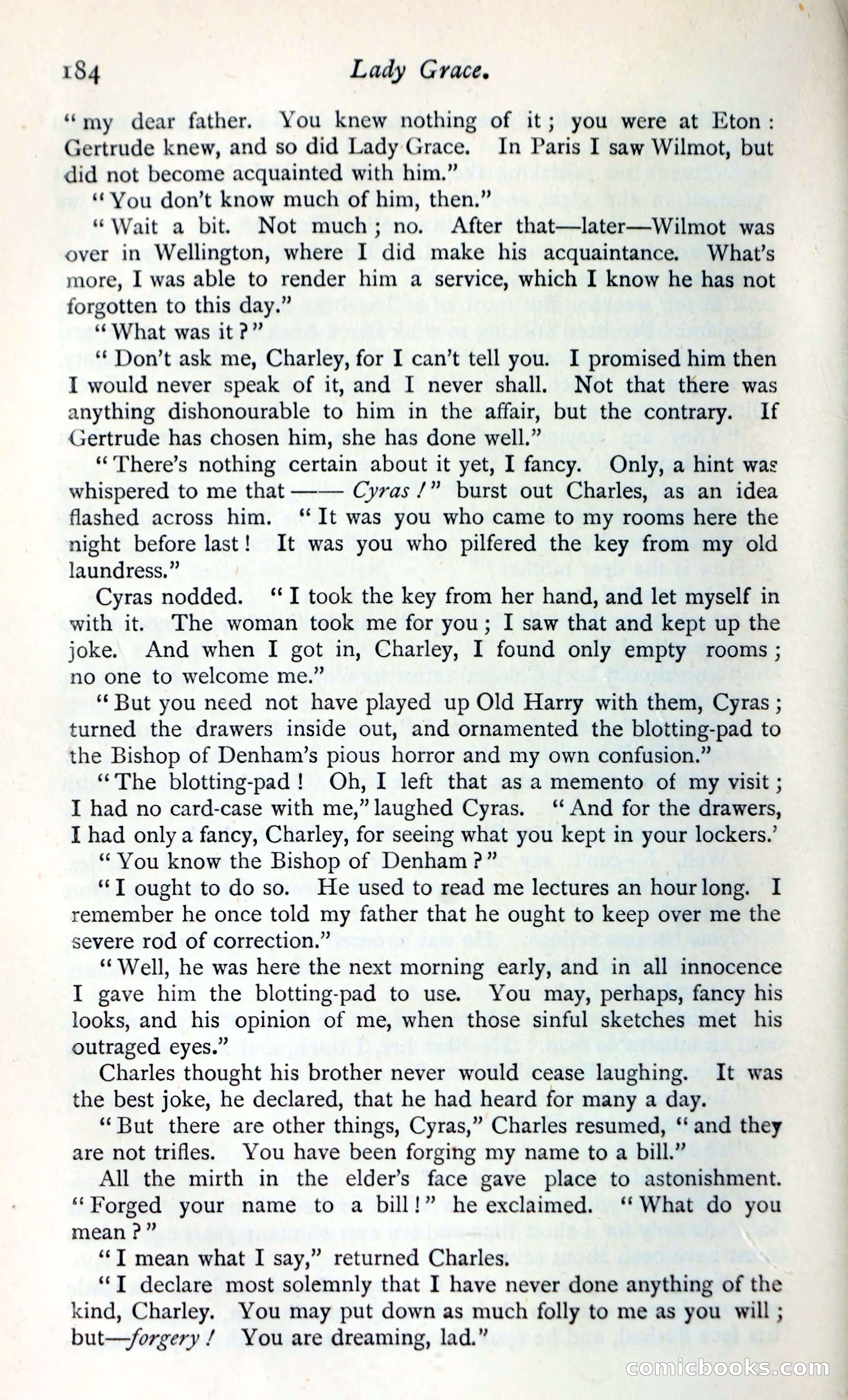
A restored page from Pulp Fiction, 1865. Page through the whole issue in the reader above.
📄 Transcribed text from this page (OCR, searchable)
Machine-transcribed from the original scan — historical spelling and the odd misread are preserved.
184 Lady Grace. “my dear father. You knew nothing of it; you were at Eton: Gertrude knew, and so did Lady Grace. In Paris I saw Wilmot, but did not become acquainted with him.” ‘You don’t know much of him, then.” “Wait a bit. Not much; no. After that—later—Wilmot was over in Wellington, where I did make his acquaintance. What’s more, I was able to render him a service, which I know he has not forgotten to this day.” “What was it ?” ‘Don’t ask me, Charley, for I can’t tell you. I promised him then I would never speak of it, and I never shall. Not that there was anything dishonourable to him in the affair, but the contrary. If Gertrude has chosen him, she has done well.” ‘'There’s nothing certain about it yet, I fancy. Only, a hint was whispered to me that ——— Cyras /” burst out Charles, as an idea flashed across him. ‘It was you who came to my rooms here the night before last! It was you who pilfered the key from my old laundress.” Cyras nodded. ‘‘I took the key from her hand, and let myself in with it. The woman took me for you; I saw that and kept up the joke. And when I got in, Charley, I found only empty rooms ; no one to welcome me.” ‘‘But you need not have played up Old Harry with them, Cyras ; turned the drawers inside out, and ornamented the blotting-pad to the Bishop of Denham’s pious horror and my own confusion.” “The blotting-pad! Oh, I left that as a memento of my visit ; I had no card-case with me,” laughed Cyras. ‘‘ And for the drawers, I had only a fancy, Charley, for seeing what you kept in your lockers.’ ‘ You know the Bishop of Denham ?” “T ought to do so. He used to read me lectures an hourlong. I remember he once told my father that he ought to keep over me the severe rod of correction.” ‘Well, he was here the next morning early, and in all innocence I gave him the blotting-pad to use. You may, perhaps, fancy his looks, and his opinion of me, when those sinful sketches met his outraged eyes.” Charles thought his brother never would cease laughing. It was the best joke, he declared, that he had heard for many a day. * But there are other things, Cyras,” Charles resumed, ‘‘ and they are not trifles. You have been forging my name to a bill.” All the mirth in the elder’s face gave place to astonishment. ‘‘Korged your name to a bill!” he exclaimed. ‘What do you mean ?” ‘‘T mean what I say,” returned Charles, ‘IT declare most solemnly that I have never done anything of the kind, Charley. You may put down as much folly to me as you will ; but—/orgery / You are dreaming, lad.” ‘ ‘ ‘ COMIC OOOKS. EO