
Pulp Fiction, 1865 · page 15 of 400
The Argosy — page 15: what you’re looking at
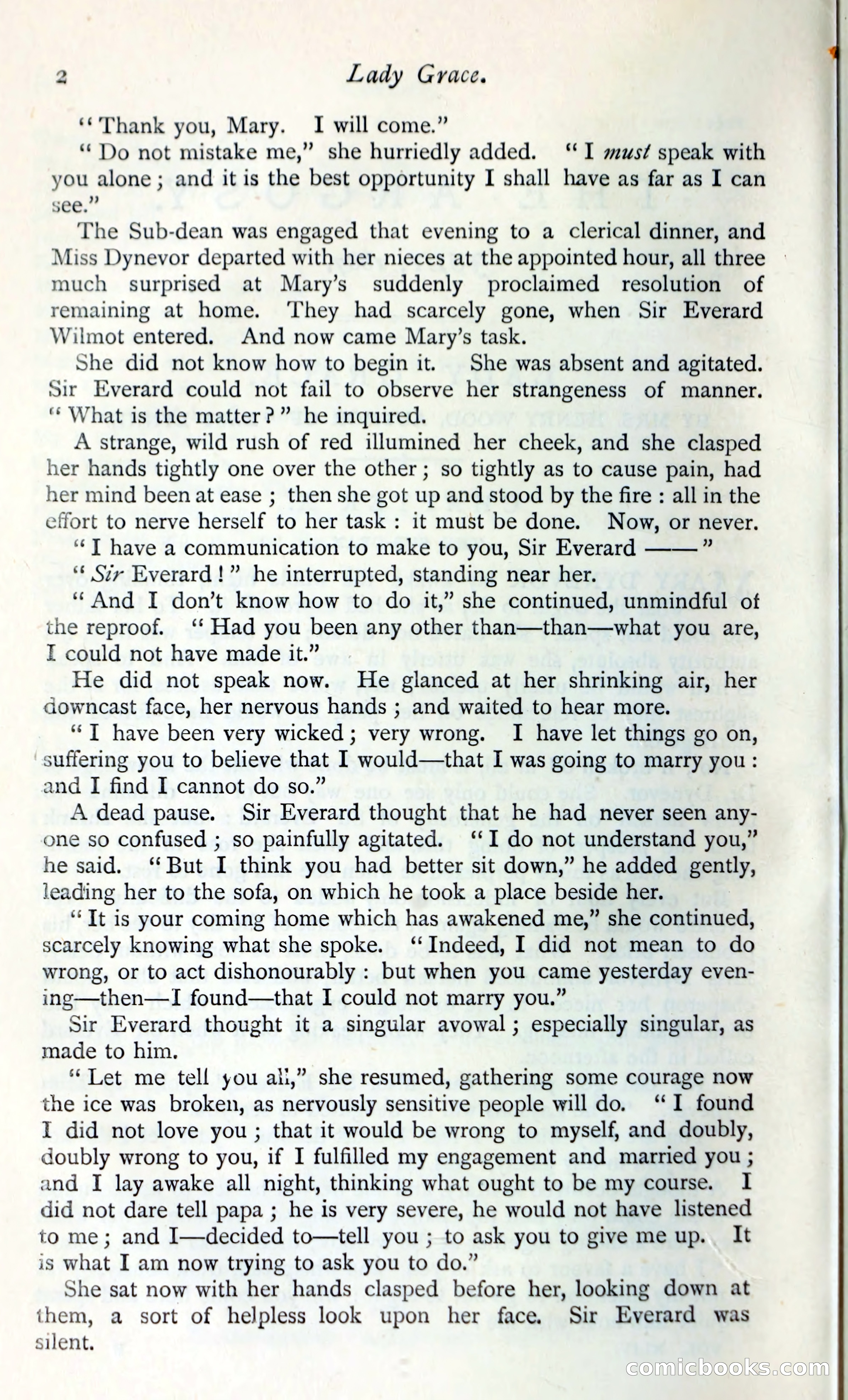
A restored page from Pulp Fiction, 1865. Page through the whole issue in the reader above.
📄 Transcribed text from this page (OCR, searchable)
Machine-transcribed from the original scan — historical spelling and the odd misread are preserved.
Lady Grace. fo ‘Thank you, Mary. I will come.” “Do not mistake me,” she hurriedly added. ‘I must speak with you alone; and it is the best opportunity I shall have as far as I can see.” The Sub-dean was engaged that evening to a clerical dinner, and Miss Dynevor departed with her nieces at the appointed hour, all three © much surprised at Mary’s suddenly proclaimed resolution of remaining at home. ‘They had scarcely gone, when Sir Everard Wilmot entered. And now came Mary’s task. She did not know how to begin it. She was absent and agitated. Sir Everard could not fail to observe her strangeness of manner. ‘What is the matter?” he inquired. A strange, wild rush of red illumined her cheek, and she clasped her hands tightly one over the other ; so tightly as to cause pain, had her mind been at ease ; then she got up and stood by the fire : all in the effort to nerve herself to her task : it must be done. Now, or never. ‘‘T have a communication to make to you, Sir Everard sj ‘* Scr Everard!” he interrupted, standing near her. “And I don’t know how to do it,” she continued, unmindful of the reproof. ‘*‘ Had you been any other than—than—what you are, I could not have made it.” He did not speak now. He glanced at her shrinking air, her downcast face, her nervous hands ; and waited to hear more. ‘‘T have been very wicked; very wrong. I have let things go on, suffering you to believe that I would—that I was going to marry you: and I find I cannot do so.” A dead pause. Sir Everard thought that he had never seen any- one so confused ; so painfully agitated. ‘‘I do not understand you,” he said. ‘But I think you had better sit down,” he added gently, leading her to the sofa, on which he took a place beside her. ‘‘TIt is your coming home which has awakened me,” she continued, scarcely knowing what she spoke. ‘‘ Indeed, I did not mean to do wrong, or to act dishonourably : but when you came yesterday even- ing—then—TI found—that I could not marry you.” Sir Everard thought it a singular avowal; especially singular, as made to him. ‘Let me tell you ali,” she resumed, gathering some courage now the ice was broken, as nervously sensitive people will do. “I found I did not love you; that it would be wrong to myself, and doubly, doubly wrong to you, if I fulfilled my engagement and married you ; and I lay awake all night, thinking what ought to be my course. I did not dare tell papa ; he is very severe, he would not have listened to me; and I—decided to—tell you ; to ask you to give me up. It is what I am now trying to ask you to do.” She sat now with her hands clasped before her, looking down at them, a sort of helpless look upon her face. Sir Everard was silent. Gomicboo (©)