
Pulp Fiction, 1865 · page 77 of 400
The Argosy — page 77: what you’re looking at
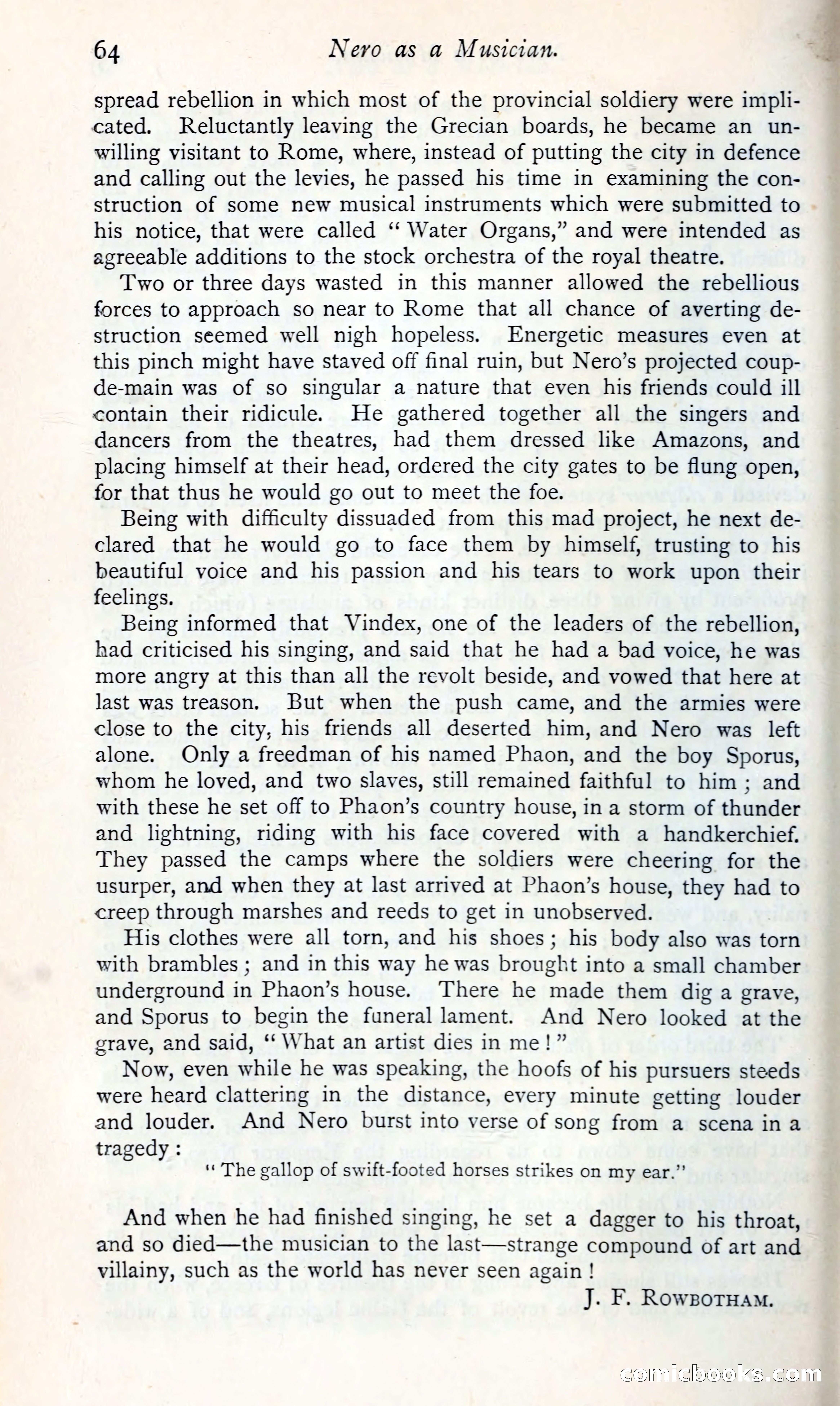
A restored page from Pulp Fiction, 1865. Page through the whole issue in the reader above.
📄 Transcribed text from this page (OCR, searchable)
Machine-transcribed from the original scan — historical spelling and the odd misread are preserved.
64 Nero as a Musician. spread rebellion in which most of the provincial soldiery were impli- cated. Reluctantly leaving the Grecian boards, he became an un- willing visitant to Rome, where, instead of putting the city in defence and calling out the levies, he passed his time in examining the con- struction of some new musical instruments which were submitted to his notice, that were called ‘‘ Water Organs,” and were intended as agreeable additions to the stock orchestra of the royal theatre. Two or three days wasted in this manner allowed the rebellious forces to approach so near to Rome that all chance of averting de- struction seemed well nigh hopeless. Energetic measures even at this pinch might have staved off final ruin, but Nero’s projected coup- de-main was of so singular a nature that even his friends could ill contain their ridicule. He gathered together all the singers and dancers from the theatres, had them dressed like Amazons, and placing himself at their head, ordered the city gates to be flung open, for that thus he would go out to meet the foe. Being with difficulty dissuaded from this mad project, he next de- clared that he would go to face them by himself, trusting to his beautiful voice and his passion and his tears to work upon their feelings. Being informed that Vindex, one of the leaders of the rebellion, had criticised his singing, and said that he had a bad voice, he was more angry at this than all the revolt beside, and vowed that here at last was treason. But when the push came, and the armies were close to the city, his friends all deserted him, and Nero was left alone. Only a freedman of his named Phaon, and the boy Sporus, whom he loved, and two slaves, still remained faithful to him; and with these he set off to Phaon’s country house, in a storm of thunder and lightning, riding with his face covered with a handkerchief. They passed the camps where the soldiers were cheering for the usurper, and when they at last arrived at Phaon’s house, they had to creep through marshes and reeds to get in unobserved. His clothes were all torn, and his shoes; his body also was torn with brambles ; and in this way he was brought into a small chamber underground in Phaon’s house. ‘There he made them dig a grave, and Sporus to begin the funeral lament. And Nero looked at the grave, and said, ‘‘ What an artist dies in me!” Now, even while he was speaking, the hoofs of his pursuers steeds were heard clattering in the distance, every minute getting louder and louder. And Nero burst into verse of song from a scena ina tragedy : ‘The gallop of swift-footed horses strikes on my ear.” And when he had finished singing, he set a dagger to his throat, and so died—the musician to the last—strange compound of art and villainy, such as the world has never seen again! J. F. RowpoTHam. CORnNIELOOKS EO) m