
Pulp Fiction, 1865 · page 74 of 400
The Argosy — page 74: what you’re looking at
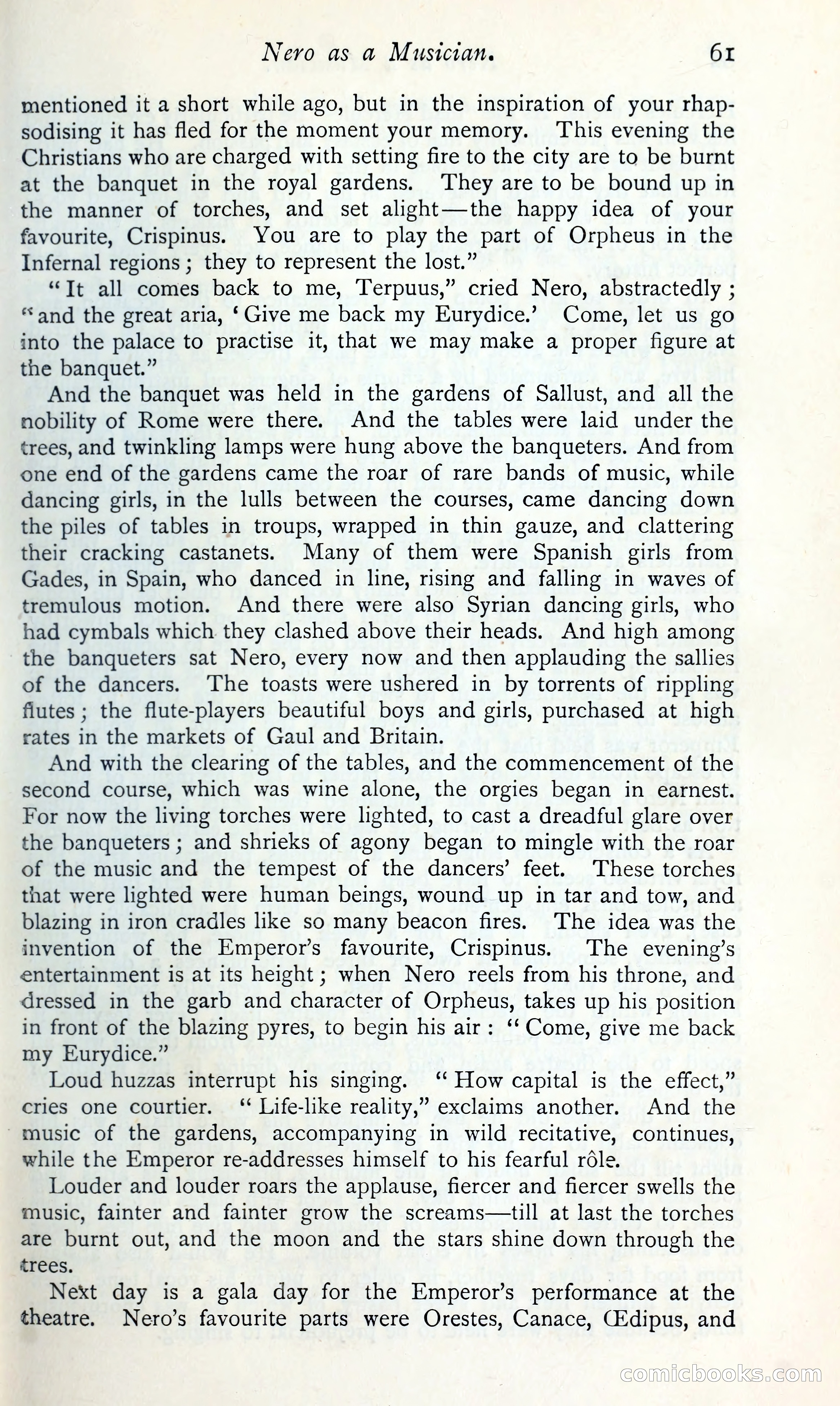
A restored page from Pulp Fiction, 1865. Page through the whole issue in the reader above.
📄 Transcribed text from this page (OCR, searchable)
Machine-transcribed from the original scan — historical spelling and the odd misread are preserved.
Nero as a Musician. 61 mentioned it a short while ago, but in the inspiration of your rhap- sodising it has fled for the moment your memory. This evening the Christians who are charged with setting fire to the city are to be burnt at the banquet in the royal gardens. ‘They are to be bound up in the manner of torches, and set alight—the happy idea of your favourite, Crispinus. You are to play the part of Orpheus in the Infernal regions ; they to represent the lost.” “Tt all comes back to me, Terpuus,” cried Nero, abstractedly ; ‘and the great aria, ‘Give me back my Eurydice.’ Come, let us go into the palace to practise it, that we may make a proper figure at the banquet.” And the banquet was held in the gardens of Sallust, and all the nobility of Rome were there. And the tables were laid under the trees, and twinkling lamps were hung above the banqueters. And from one end of the gardens came the roar of rare bands of music, while dancing girls, in the lulls between the courses, came dancing down the piles of tables in troups, wrapped in thin gauze, and clattering their cracking castanets. Many of them were Spanish girls from Gades, in Spain, who danced in line, rising and falling in waves of tremulous motion. And there were also Syrian dancing girls, who had cymbals which they clashed above their heads. And high among the banqueters sat Nero, every now and then applauding the sallies of the dancers. ‘The toasts were ushered in by torrents of rippling flutes ; the flute-players beautiful boys and girls, purchased at high rates in the markets of Gaul and Britain. And with the clearing of the tables, and the commencement of the second course, which was wine alone, the orgies began in earnest. For now the living torches were lighted, to cast a dreadful glare over the banqueters ; and shrieks of agony began to mingle with the roar of the music and the tempest of the dancers’ feet. These torches that were lighted were human beings, wound up in tar and tow, and blazing in iron cradles like so many beacon fires. The idea was the invention of the Emperor’s favourite, Crispinus. The evening’s entertainment is at its height; when Nero reels from his throne, and dressed in the garb and character of Orpheus, takes up his position in front of the blazing pyres, to begin his air: ‘‘ Come, give me back my Eurydice.” Loud huzzas interrupt his singing. ‘‘ How capital is the effect,” cries one courtier. ‘“‘ Life-like reality,” exclaims another. And the music of the gardens, accompanying in wild recitative, continues, while the Emperor re-addresses himself to his fearful role. Louder and louder roars the applause, fiercer and fiercer swells the music, fainter and fainter grow the screams—till at last the torches are burnt out, and the moon and the stars shine down through the crees. Next day is a gala day for the Emperor’s performance at the theatre. Nero’s favourite parts were Orestes, Canace, Cédipus, and COMICOOO© SS (CO) im