
Pulp Fiction, 1865 · page 62 of 400
The Argosy — page 62: what you’re looking at
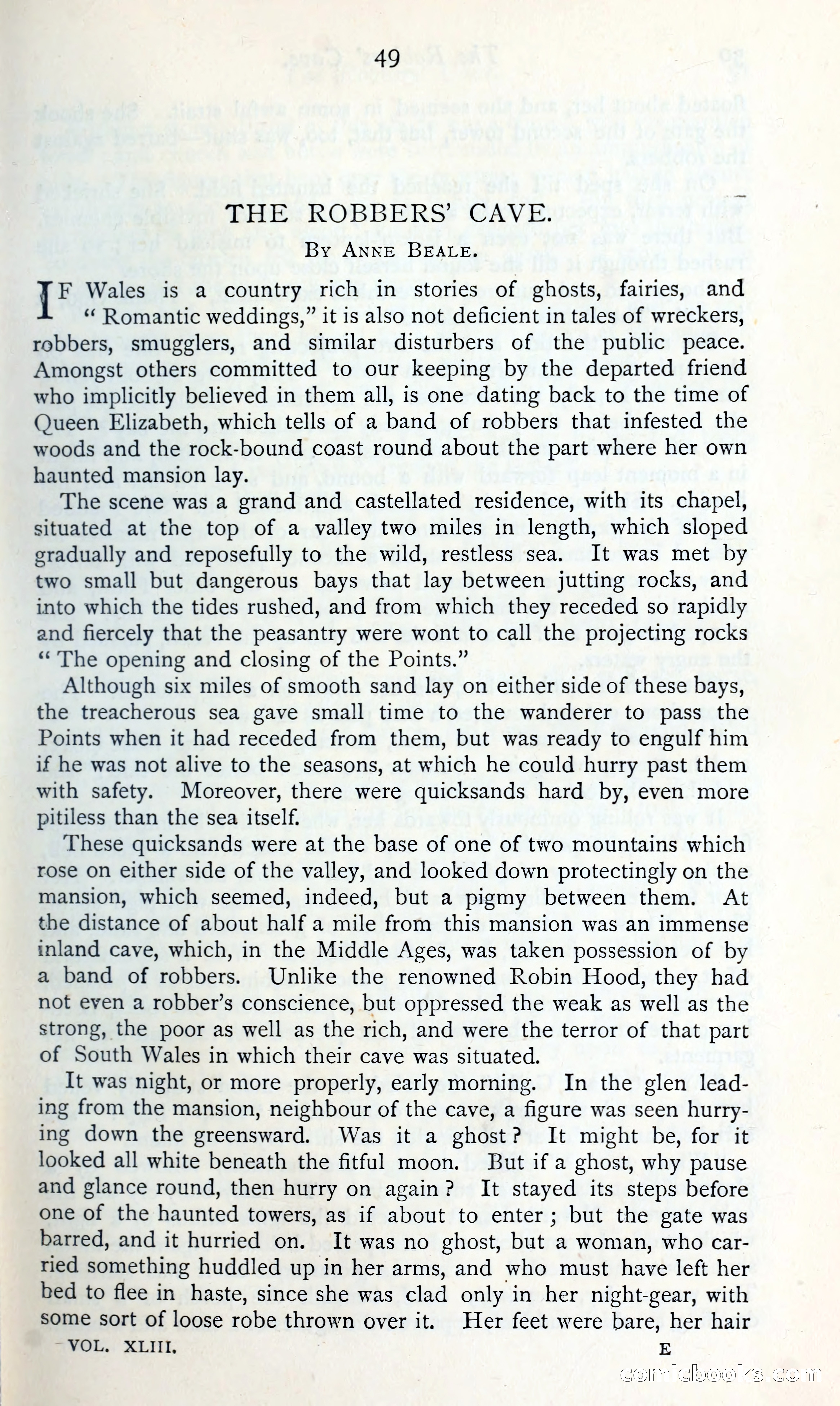
A restored page from Pulp Fiction, 1865. Page through the whole issue in the reader above.
📄 Transcribed text from this page (OCR, searchable)
Machine-transcribed from the original scan — historical spelling and the odd misread are preserved.
49 THE: ROBBERS- CAVE. By ANNE BEALE. F Wales is a country rich in stories of ghosts, fairies, and ‘ Romantic weddings,” it is also not deficient in tales of wreckers, robbers, smugglers, and similar disturbers of the public peace. Amongst others committed to our keeping by the departed friend who implicitly believed in them all, is one dating back to the time of Queen Elizabeth, which tells of a band of robbers that infested the woods and the rock-bound coast round about the part where her own haunted mansion lay. The scene was a grand and castellated residence, with its chapel, situated at the top of a valley two miles in length, which sloped gradually and reposefully to the wild, restless sea. It was met by two small but dangerous bays that lay between jutting rocks, and into which the tides rushed, and from which they receded so rapidly and fiercely that the peasantry were wont to call the projecting rocks “The opening and closing of the Points.” Although six miles of smooth sand lay on either side of these bays, the treacherous sea gave small time to the wanderer to pass the Points when it had receded from them, but was ready to engulf him if he was not alive to the seasons, at which he could hurry past them with safety. Moreover, there were quicksands hard by, even more pitiless than the sea itself. These quicksands were at the base of one of two mountains which rose on either side of the valley, and looked down protectingly on the mansion, which seemed, indeed, but a pigmy between them. At the distance of about half a mile from this mansion was an immense inland cave, which, in the Middle Ages, was taken possession of by a band of robbers. Unlike the renowned Robin Hood, they had not eyen a robber’s conscience, but oppressed the weak as well as the strong, the poor as well as the rich, and were the terror of that part of South Wales in which their cave was situated. It was night, or more properly, early morning. In the glen lead- ing from the mansion, neighbour of the cave, a figure was seen hurry- ing down the greensward. Was it a ghost? It might be, for it looked all white beneath the fitful moon. But if a ghost, why pause and glance round, then hurry on again? It stayed its steps before one of the haunted towers, as if about to enter; but the gate was barred, and it hurried on. It was no ghost, but a woman, who car- ried something huddled up in her arms, and who must have left her bed to flee in haste, since she was clad only in her night-gear, with some sort of loose robe thrown over it. Her feet were bare, her hair -VOL. XLIII. i CoOnniclbooks (CO) im