
Pulp Fiction, 1865 · page 377 of 400
The Argosy — page 377: what you’re looking at
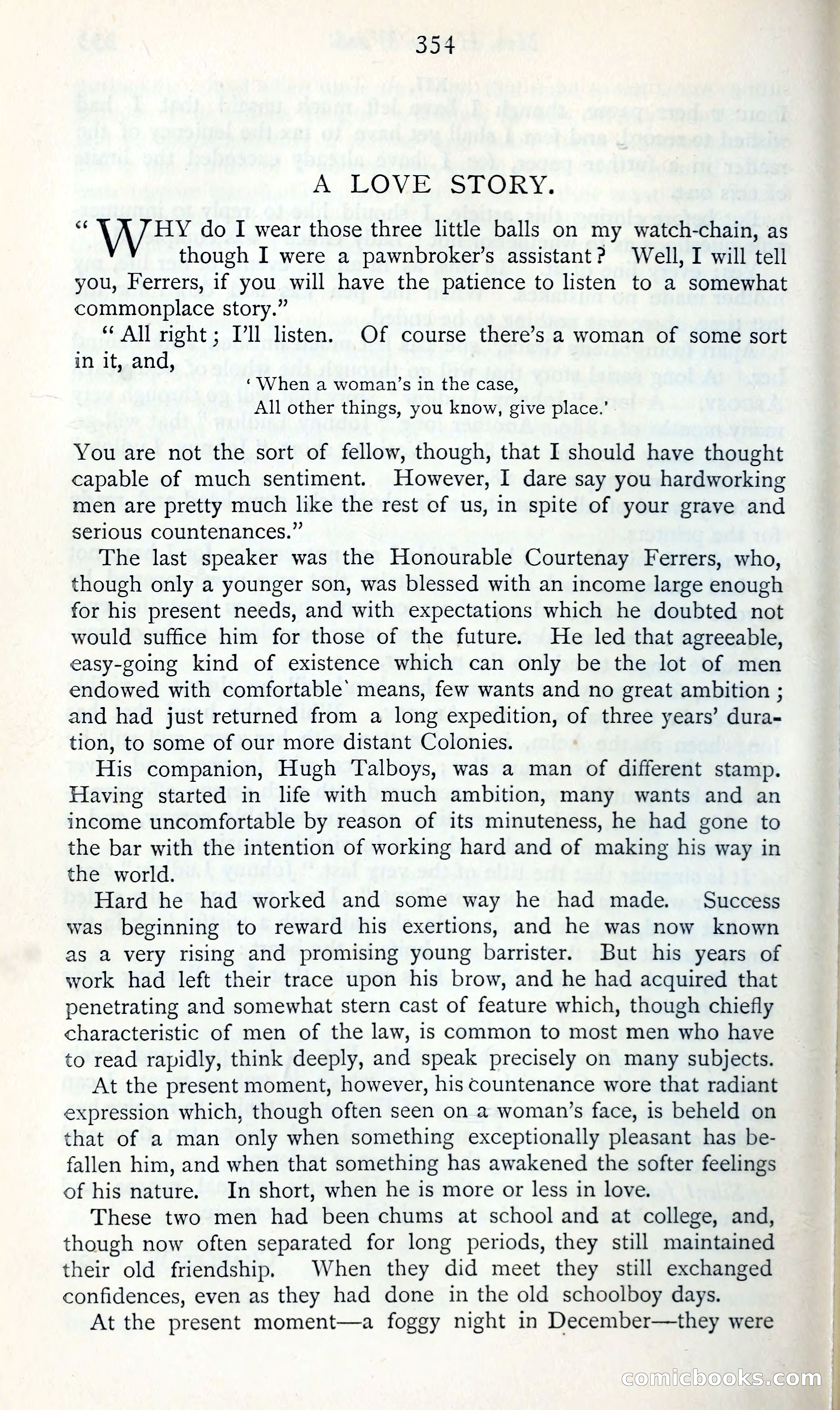
A restored page from Pulp Fiction, 1865. Page through the whole issue in the reader above.
📄 Transcribed text from this page (OCR, searchable)
Machine-transcribed from the original scan — historical spelling and the odd misread are preserved.
304 A LIONGE aod ORY. . Was do I wear those three little balls on my watch-chain, as though I were a pawnbroker’s assistant? Well, I will tell you, Ferrers, if you will have the patience to listen to a somewhat commonplace story.” “All right; Dll listen. Of course there’s a woman of some sort in it, and, ‘When a woman’s in the case, All other things, you know, give place.’ You are not the sort of fellow, though, that I should have thought capable of much sentiment. However, I dare say you hardworking men are pretty much like the rest of us, in spite of your grave and serious countenances.” The last speaker was the Honourable Courtenay Ferrers, who, though only a younger son, was blessed with an income large enough for his present needs, and with expectations which he doubted not would suffice him for those of the future. He led that agreeable, easy-going kind of existence which can only be the lot of men endowed with comfortable’ means, few wants and no great ambition ; and had just returned from a long expedition, of three years’ dura- tion, to some of our more distant Colonies. His companion, Hugh Talboys, was a man of different stamp. Having started in life with much ambition, many wants and an income uncomfortable by reason of its minuteness, he had gone to the bar with the intention of working hard and of making his way in the world. Hard he had worked and some way he had made. Success was beginning to reward his exertions, and he was now known as a very rising and promising young barrister. But his years of work had left their trace upon his brow, and he had acquired that penetrating and somewhat stern cast of feature which, though chiefly characteristic of men of the law, is common to most men who have to read rapidly, think deeply, and speak precisely on many subjects. At the present moment, however, his countenance wore that radiant expression which, though often seen on a woman’s face, is beheld on that of a man only when something exceptionally pleasant has be- fallen him, and when that something has awakened the softer feelings of his nature. In short, when he is more or less in love. These two men had been chums at school and at college, and, though now often separated for long periods, they still maintained their old friendship. When they did meet they still exchanged confidences, even as they had done in the old schoolboy days. At the present moment—a foggy night in December—they were aoe OTE oO OEE eT ee ee—~—— _— _— oe -_- CONMMICMDOOLKS, (Evo)