
Pulp Fiction, 1865 · page 365 of 400
The Argosy — page 365: what you’re looking at
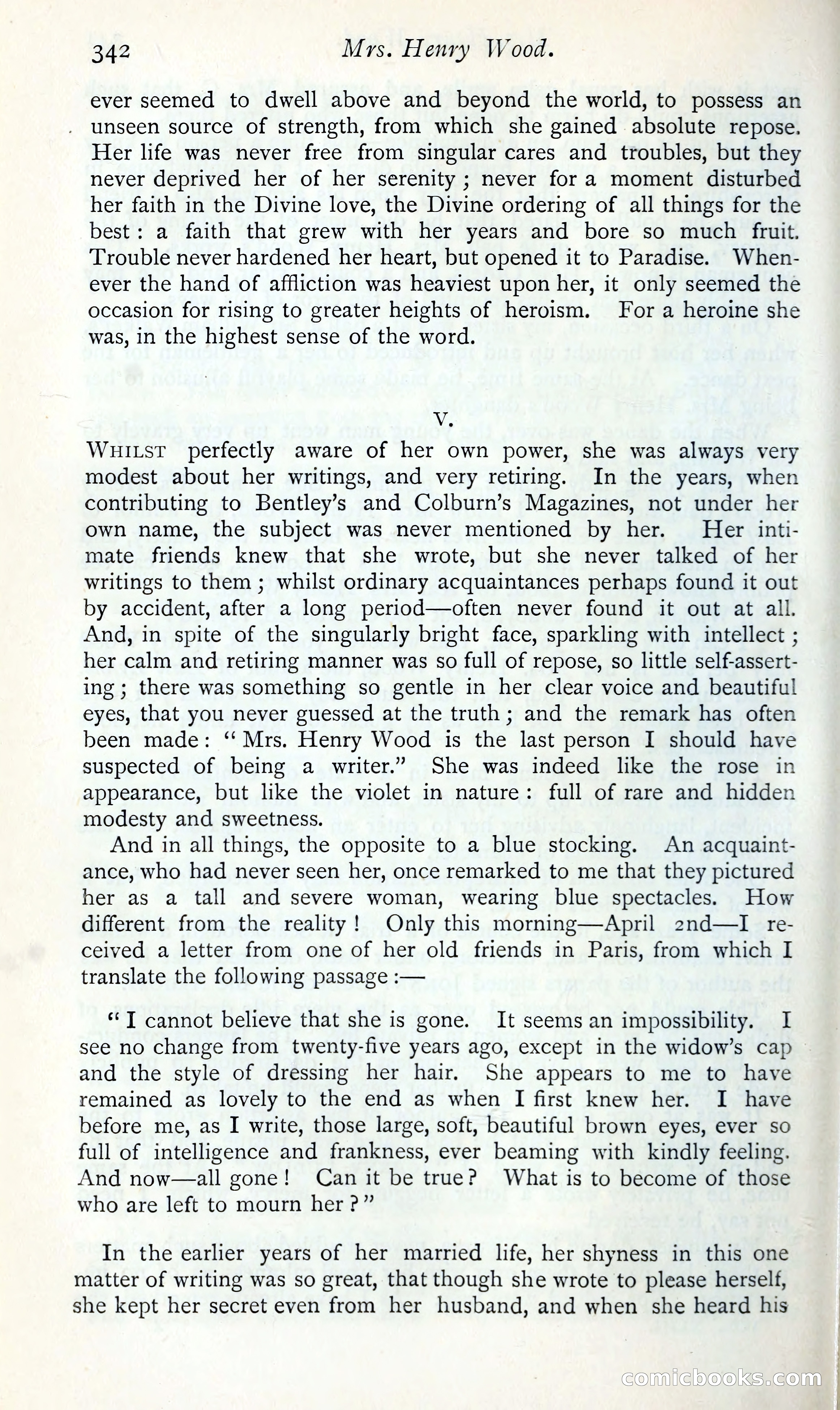
A restored page from Pulp Fiction, 1865. Page through the whole issue in the reader above.
📄 Transcribed text from this page (OCR, searchable)
Machine-transcribed from the original scan — historical spelling and the odd misread are preserved.
342 Mrs. Henry Wood. ever seemed to dwell above and beyond the world, to possess an unseen source of strength, from which she gained absolute repose. Her life was never free from singular cares and troubles, but they never deprived her of her serenity ; never fora moment disturbed her faith in the Divine love, the Divine ordering of all things for the best: a faith that grew with her years and bore so much fruit. Trouble never hardened her heart, but opened it to Paradise. When- ever the hand of affliction was heaviest upon her, it only seemed the occasion for rising to greater heights of heroism. For a heroine she was, in the highest sense of the word. V. WHILST perfectly aware of her own power, she was always very modest about her writings, and very retiring. In the years, when contributing to Bentley’s and Colburn’s Magazines, not under her own name, the subject was never mentioned by her. Her inti- mate friends knew that she wrote, but she never talked of her writings to them ; whilst ordinary acquaintances perhaps found it out by accident, after a long period—often never found it out at all. And, in spite of the singularly bright face, sparkling with intellect ; her calm and retiring manner was so full of repose, so little self-assert- ing; there was something so gentle in her clear voice and beautiful! eyes, that you never guessed at the truth; and the remark has often been made: ‘“‘ Mrs. Henry Wood 1s the last person I should have suspected of being a writer.” She was indeed like the rose in appearance, but like the violet in nature: full of rare and hidden modesty and sweetness. And in all things, the opposite to a blue stocking. An acquaint- ance, who had never seen her, once remarked to me that they pictured her as a tall and severe woman, wearing blue spectacles. How different from the reality! Only this morning—April 2znd—I re- ceived a letter from one of her old friends in Paris, from which I translate the following passage :— “T cannot believe that she is gone. It seems an impossibility. I see no change from twenty-five years ago, except in the widow’s cap and the style of dressing her hair. She appears to me to have remained as lovely to the end as when I first knew her. I have before me, as I write, those large, soft, beautiful brown eyes, ever so full of intelligence and frankness, ever beaming with kindly feeling. And now—all gone! Can it be true? What is to become of those who are left to mourn her ?” In the earlier years of her married life, her shyness in this one matter of writing was so great, that though she wrote to please herself, she kept her secret even from her husband, and when she heard his CONMICLDOO;KS, EC) m a