
Pulp Fiction, 1865 · page 320 of 400
The Argosy — page 320: what you’re looking at
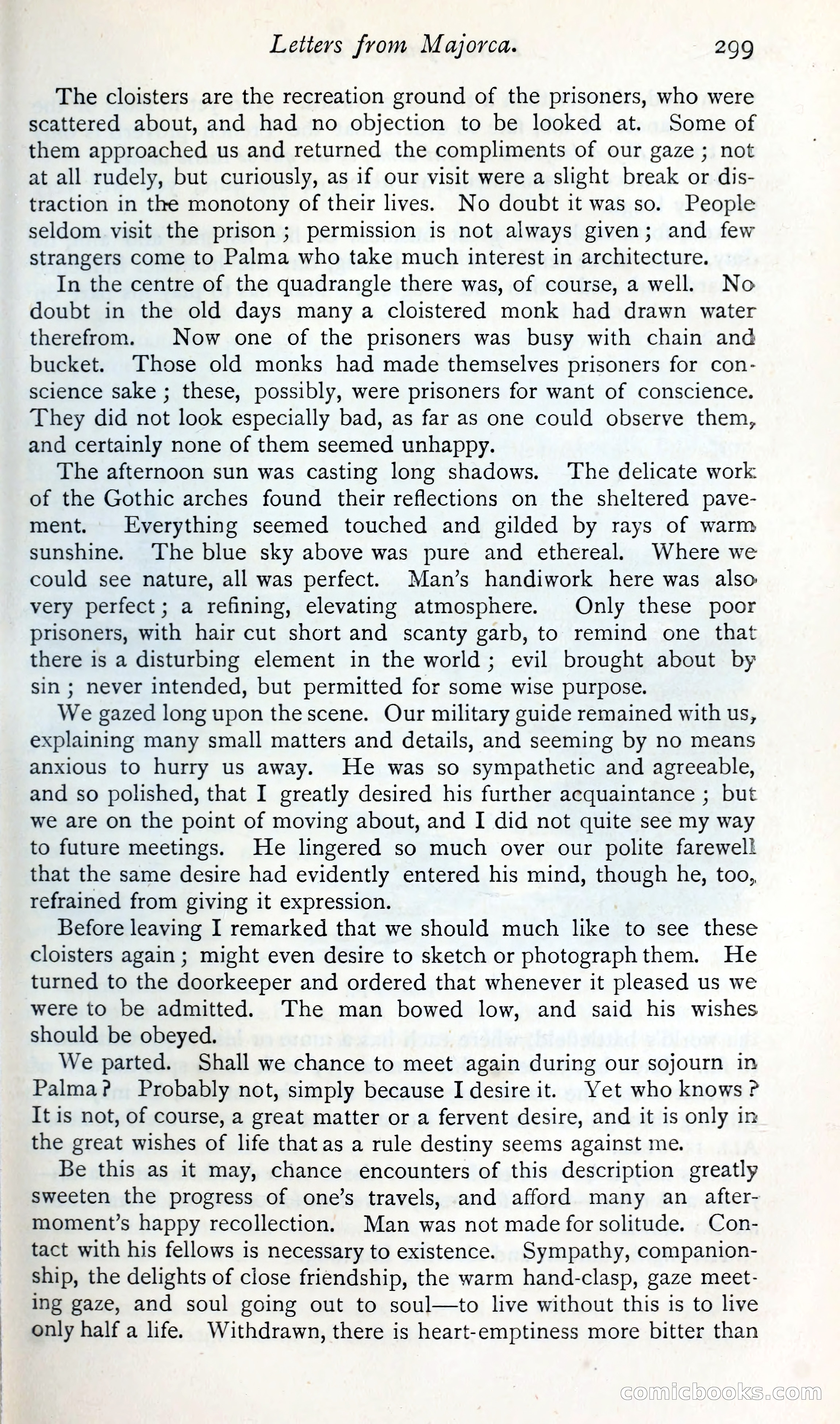
A restored page from Pulp Fiction, 1865. Page through the whole issue in the reader above.
📄 Transcribed text from this page (OCR, searchable)
Machine-transcribed from the original scan — historical spelling and the odd misread are preserved.
— EE ————— a —— rrr _ Letters from Majorca. 299 The cloisters are the recreation ground of the prisoners, who were scattered about, and had no objection to be looked at. Some of them approached us and returned the compliments of our gaze; not at all rudely, but curiously, as if our visit were a slight break or dis- traction in the monotony of their lives. No doubt it was so. People seldom visit the prison; permission is not always given; and few strangers come to Palma who take much interest in architecture. In the centre of the quadrangle there was, of course, a well. No doubt in the old days many a cloistered monk had drawn water therefrom. Now one of the prisoners was busy with chain and bucket. ‘Those old monks had made themselves prisoners for con- science sake ; these, possibly, were prisoners for want of conscience. They did not look especially bad, as far as one could observe them, and certainly none of them seemed unhappy. The afternoon sun was casting long shadows. The delicate work of the Gothic arches found their reflections on the sheltered pave- ment. Everything seemed touched and gilded by rays of warm sunshine. ‘The blue sky above was pure and ethereal. Where we could see nature, all was perfect. Man’s handiwork here was also very perfect; a refining, elevating atmosphere. Only these poor prisoners, with hair cut short and scanty garb, to remind one that there is a disturbing element in the world; evil brought about by sin ; never intended, but permitted for some wise purpose. We gazed long upon thescene. Our military guide remained with us, explaining many small matters and details, and seeming by no means anxious to hurry us away. He was so sympathetic and agreeable, and so polished, that I greatly desired his further acquaintance ; but we are on the point of moving about, and I did not quite see my way to future meetings. He lingered so much over our polite farewell that the same desire had evidently entered his mind, though he, too, refrained from giving it expression. Before leaving I remarked that we should much like to see these cloisters again; might even desire to sketch or photographthem. He turned to the doorkeeper and ordered that whenever it pleased us we were to be admitted. The man bowed low, and said his wishes should be obeyed. We parted. Shall we chance to meet again during our sojourn in Palmar? Probably not, simply because I desire it. Yet who knows P It is not, of course, a great matter or a fervent desire, and it is only in the great wishes of life that as a rule destiny seems against me. Be this as it may, chance encounters of this description greatly sweeten the progress of one’s travels, and afford many an after- moment’s happy recollection. Man was not made for solitude. Con- tact with his fellows is necessary to existence. Sympathy, companion- ship, the delights of ciose friendship, the warm hand-clasp, gaze meet- ing gaze, and soul going out to soul—to live without this is to live only half a life. Withdrawn, there is heart-emptiness more bitter than comicooolks Co