
Pulp Fiction, 1865 · page 316 of 400
The Argosy — page 316: what you’re looking at
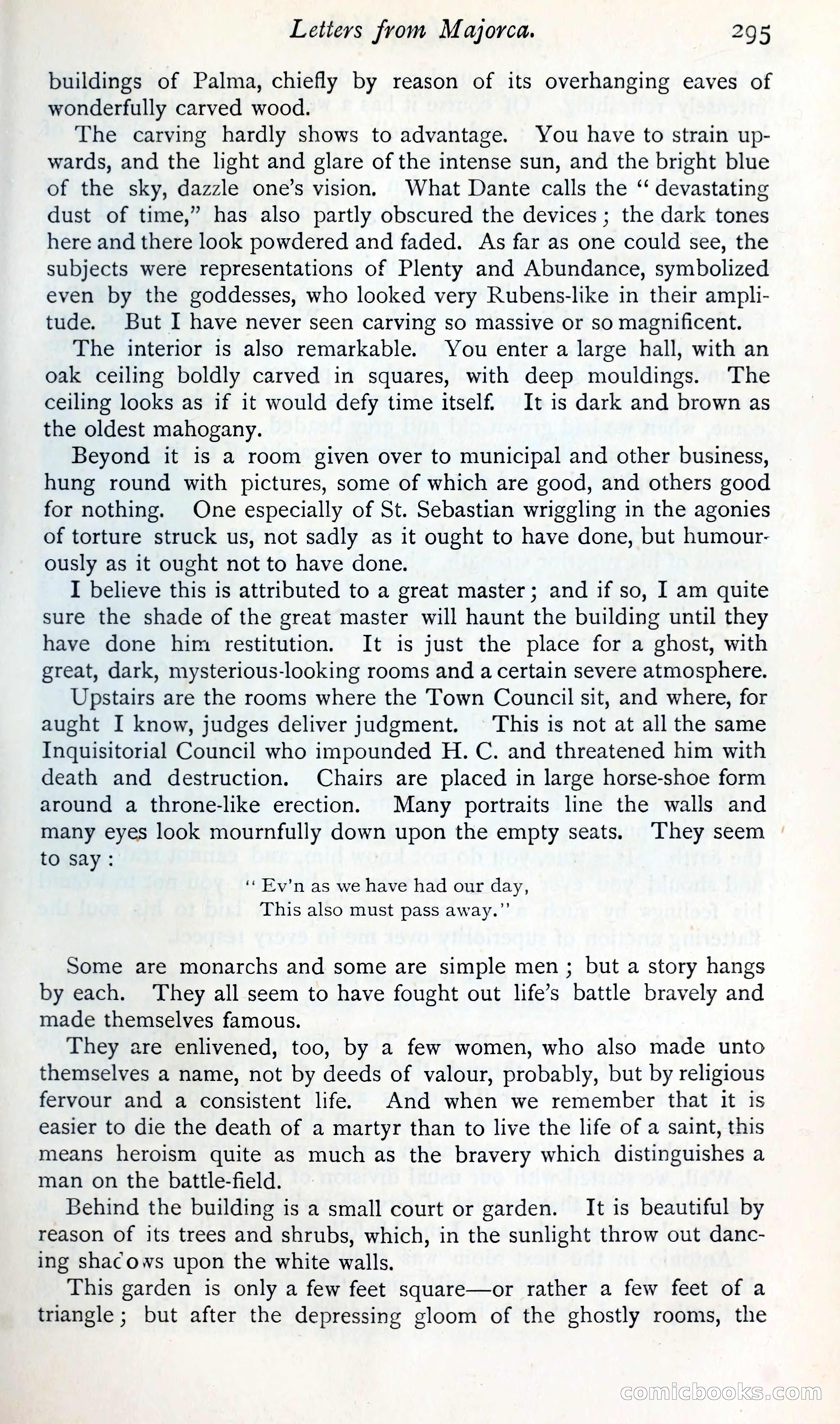
A restored page from Pulp Fiction, 1865. Page through the whole issue in the reader above.
📄 Transcribed text from this page (OCR, searchable)
Machine-transcribed from the original scan — historical spelling and the odd misread are preserved.
Letters from Majorca. 295 buildings of Palma, chiefly by reason of its overhanging eaves of wonderfully carved wood. The carving hardly shows to advantage. You have to strain up- wards, and the light and glare of the intense sun, and the bright blue of the sky, dazzle one’s vision. What Dante calls the ‘‘ devastating dust of time,” has also partly obscured the devices ; the dark tones here and there look powdered and faded. As far as one could see, the subjects were representations of Plenty and Abundance, symbolized even by the goddesses, who looked very Rubens-like in their amph- tude. But I have never seen carving so massive or so magnificent. The interior is also remarkable. You enter a large hall, with an oak ceiling boldly carved in squares, with deep mouldings. The ceiling looks as if it would defy time itself. It is dark and brown as the oldest mahogany. Beyond it is a room given over to municipal and other business, hung round with pictures, some of which are good, and others good for nothing. One especially of St. Sebastian wriggling in the agonies of torture struck us, not sadly as it ought to have done, but humour- ously as it ought not to have done. I believe this is attributed to a great master; and if so, I am quite sure the shade of the great master will haunt the building until they have done him restitution. It is just the place for a ghost, with great, dark, mysterious-looking rooms and a certain severe atmosphere. Upstairs are the rooms where the Town Council sit, and where, for aught I know, judges deliver judgment. This is not at all the same Inquisitorial Council who impounded H. C. and threatened him with death and destruction. Chairs are placed in large horse-shoe form around a throne-like erection. Many portraits line the walls and many eyes look mournfully down upon the empty seats. They seem tO say: ‘“Ev’'n as we have had our day, This also must pass away.”’ Some are monarchs and some are simple men; but a story hangs by each. They all seem to have fought out life’s battle bravely and made themselves famous. They are enlivened, too, by a few women, who also made unto themselves a name, not by deeds of valour, probably, but by religious fervour and a consistent life. And when we remember that it is easier to die the death of a martyr than to live the life of a saint, this means heroism quite as much as the bravery which distinguishes a man on the battle-field. Behind the building is a small court or garden. It is beautiful by reason of its trees and shrubs, which, in the sunlight throw out danc- ing shacows upon the white walls. This garden is only a few feet square—or rather a few feet of a triangle; but after the depressing gloom of the ghostly rooms, the conmicbooolks (SO