
Pulp Fiction, 1865 · page 311 of 400
The Argosy — page 311: what you’re looking at
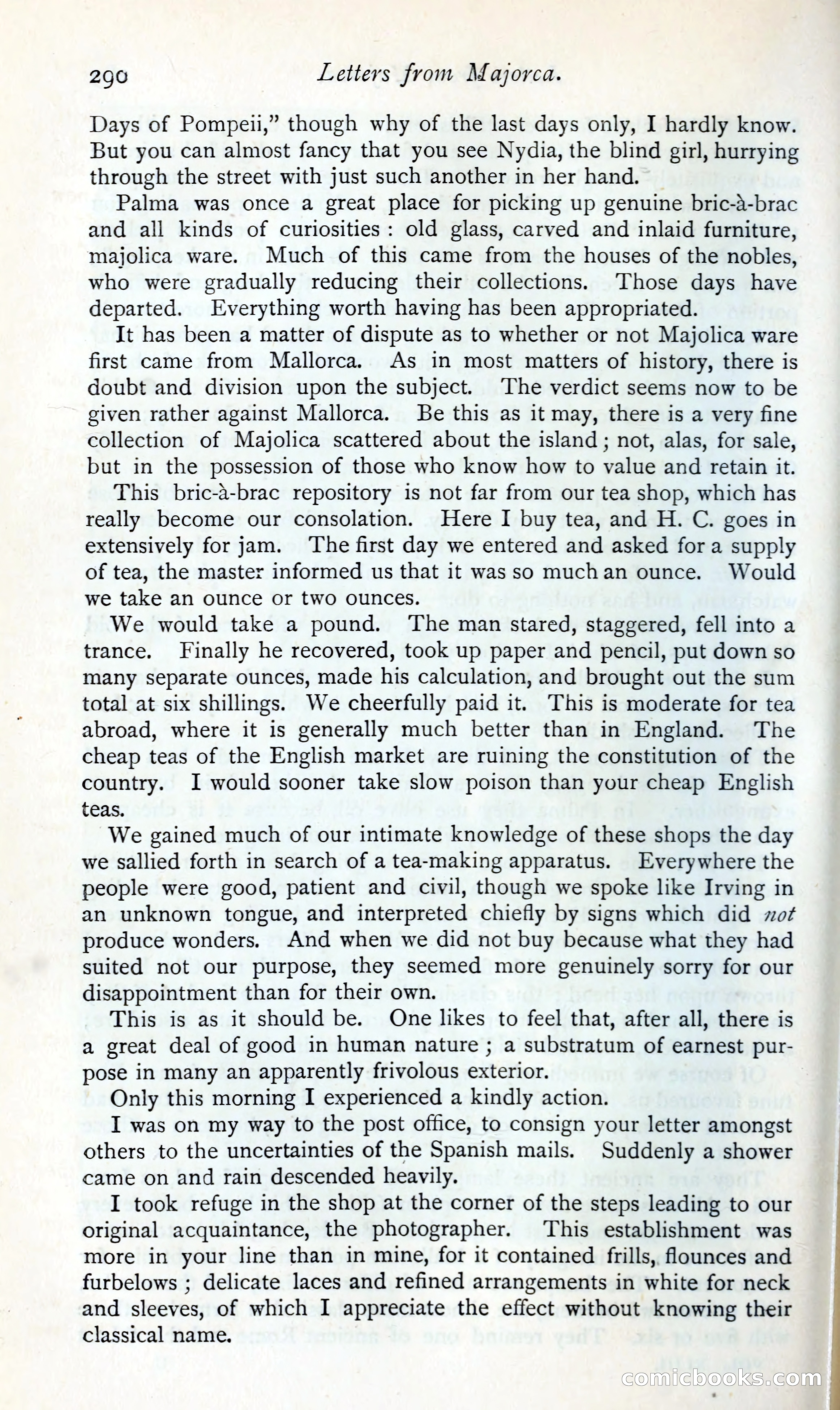
A restored page from Pulp Fiction, 1865. Page through the whole issue in the reader above.
📄 Transcribed text from this page (OCR, searchable)
Machine-transcribed from the original scan — historical spelling and the odd misread are preserved.
290 Letters from Majorca. Days of Pompeii,” though why of the last days only, I hardly know. But you can almost fancy that you see Nydia, the blind girl, hurrying through the street with just such another in her hand. Palma was once a great place for picking up genuine bric-a-brac and all kinds of curiosities: old glass, carved and inlaid furniture, majolica ware. Much of this came from the houses of the nobles, who were gradually reducing their collections. ‘Those days have departed. Everything worth having has been appropriated. It has been a matter of dispute as to whether or not Majolica ware first came from Mallorca. As in most matters of history, there is doubt and division upon the subject. The verdict seems now to be given rather against Mallorca. Je this as it may, there is a very fine collection of Majolica scattered about the island; not, alas, for sale, but in the possession of those who know how to value and retain it. This bric-a-brac repository is not far from our tea shop, which has really become our consolation. Here I buy tea, and H. C. goes in extensively for jam. The first day we entered and asked fora supply of tea, the master informed us that it wasso muchan ounce. Would we take an ounce or two ounces. We would take a pound. ‘The man stared, staggered, fell into a trance. Finally he recovered, took up paper and pencil, put down so many separate ounces, made his calculation, and brought out the sum total at six shillings. We cheerfully paid it. This is moderate for tea abroad, where it is generally much better than in England. The cheap teas of the English market are ruining the constitution of the country. I would sooner take slow poison than your cheap English teas. We gained much of our intimate knowledge of these shops the day we sallied forth in search of a tea-making apparatus. Everywhere the people were good, patient and civil, though we spoke like Irving in an unknown tongue, and interpreted chiefly by signs which did zof produce wonders. And when we did not buy because what they had suited not our purpose, they seemed more genuinely sorry for our disappointment than for their own. This is as it should be. One likes to feel that, after all, there is a great deal of good in human nature ; a substratum of earnest pur- pose in many an apparently frivolous exterior. Only this morning I experienced a kindly action. I was on my way to the post office, to consign your letter amongst others to the uncertainties of the Spanish mails. Suddenly a shower came on and rain descended heavily. I took refuge in the shop at the corner of the steps leading to our original acquaintance, the photographer. This establishment was more in your line than in mine, for it contained frills, flounces and furbelows ; delicate laces and refined arrangements in white for neck and sleeves, of which I appreciate the effect without knowing their classical name. CONMMICOOOKS,. 0)