
Pulp Fiction, 1865 · page 305 of 400
The Argosy — page 305: what you’re looking at
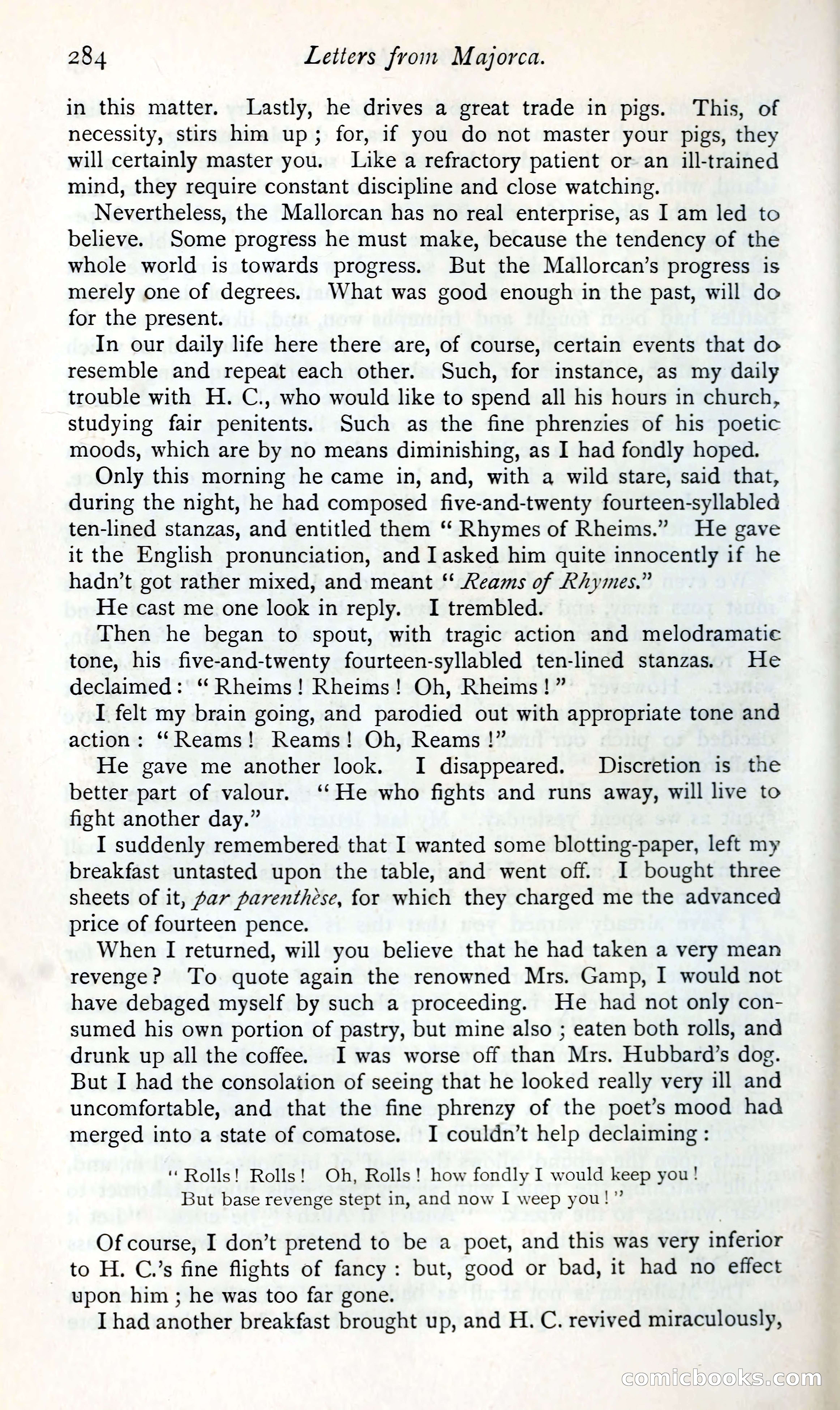
A restored page from Pulp Fiction, 1865. Page through the whole issue in the reader above.
📄 Transcribed text from this page (OCR, searchable)
Machine-transcribed from the original scan — historical spelling and the odd misread are preserved.
284 Letters from Majorca. in this matter. Lastly, he drives a great trade in pigs. This, of necessity, stirs him up; for, if you do not master your pigs, they will certainly master you. Like a refractory patient or an ill-trained mind, they require constant discipline and close watching. Nevertheless, the Mallorcan has no real enterprise, as I am led to believe. Some progress he must make, because the tendency of the whole world is towards progress. But the Mallorcan’s progress is merely one of degrees. What was good enough in the past, will do for the present. In our daily life here there are, of course, certain events that do resemble and repeat each other. Such, for instance, as my daily trouble with H. C., who would like to spend all his hours in church, studying fair penitents. Such as the fine phrenzies of his poetic moods, which are by no means diminishing, as I had fondly hoped. Only this morning he came in, and, with a wild stare, said that, during the night, he had composed five-and-twenty fourteen-syllabled ten-lined stanzas, and entitled them “ Rhymes of Rheims.” He gave it the English pronunciation, and I asked him quite innocently if he hadn’t got rather mixed, and meant ‘‘ Reams of Rhymes.” He cast me one look in reply. I trembled. Then he began to spout, with tragic action and melodramatic tone, his five-and-twenty fourteen-syllabled ten-lined stanzas. He declaimed: ‘‘ Rheims! Rheims! Oh, Rheims!” I felt my brain going, and parodied out with appropriate tone and action: ‘‘ Reams! Reams! Oh, Reams !” He gave me another look. I disappeared. Discretion is the better part of valour. ‘‘ He who fights and runs away, will live to fight another day.” I suddenly remembered that I wanted some blotting-paper, left my breakfast untasted upon the table, and went off. I bought three sheets of it, par parenthéese, for which they charged me the advanced price of fourteen pence. When I returned, will you believe that he had taken a very mean revenge? ‘To quote again the renowned Mrs. Gamp, I would not have debaged myself by such a proceeding. He had not only con- sumed his own portion of pastry, but mine also ; eaten both rolls, and drunk up all the coffee. I was worse off than Mrs. Hubbard’s dog. But I had the consolation of seeing that he looked really very ill and uncomfortable, and that the fine phrenzy of the poet’s mood had merged into a state of comatose. I couldn’t help declaiming : “ Rolls! Rolls! Oh, Rolls! how fondly I would keep you! But base revenge stept in, and now I weep you!” Of course, I don’t pretend to be a poet, and this was very inferior to H. C.’s fine flights of fancy: but, good or bad, it had no effect upon him ; he was too far gone. I had another breakfast brought up, and H. C. revived miraculously, CONNIECLOOKS.E@) m