
Pulp Fiction, 1865 · page 297 of 400
The Argosy — page 297: what you’re looking at
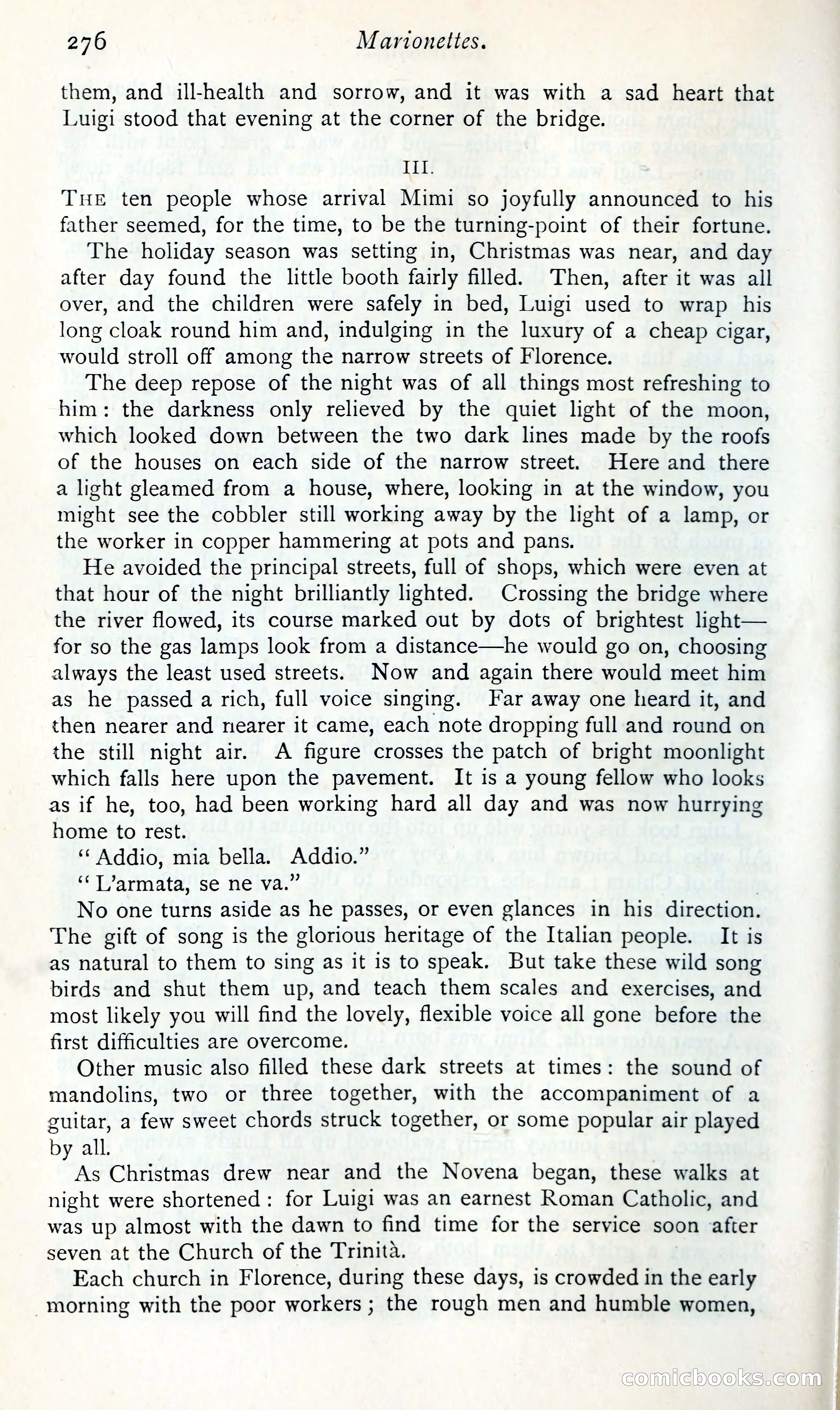
A restored page from Pulp Fiction, 1865. Page through the whole issue in the reader above.
📄 Transcribed text from this page (OCR, searchable)
Machine-transcribed from the original scan — historical spelling and the odd misread are preserved.
276 Marionettes. them, and ill-health and sorrow, and it was with a sad heart that Luigi stood that evening at the corner of the bridge. TER THE ten people whose arrival Mimi so joyfully announced to his father seemed, for the time, to be the turning-point of their fortune. The holiday season was setting in, Christmas was near, and day after day found the little booth fairly filled. Then, after it was all over, and the children were safely in bed, Luigi used to wrap his long cloak round him and, indulging in the luxury of a cheap cigar, would stroll off among the narrow streets of Florence. The deep repose of the night was of all things most refreshing to him: the darkness only relieved by the quiet light of the moon, which looked down between the two dark lines made by the roofs of the houses on each side of the narrow street. Here and there a light gleamed from a house, where, looking in at the window, you might see the cobbler still working away by the light of a lamp, or the worker in copper hammering at pots and pans. He avoided the principal streets, full of shops, which were even at that hour of the night brilliantly lighted. Crossing the bridge where the river flowed, its course marked out by dots of brightest light— for so the gas lamps look from a distance—he would go on, choosing always the least used streets. Now and again there would meet him as he passed a rich, full voice singing. Far away one heard it, and then nearer and nearer it came, each note dropping full and round on the still night air. A figure crosses the patch of bright moonlight which falls here upon the pavement. It is a young fellow who looks as if he, too, had been working hard all day and was now hurrying home to rest. ‘ Addio, mia bella. Addio.” ‘“T/armata, se ne va.” No one turns aside as he passes, or even glances in his direction. The gift of song is the glorious heritage of the Italian people. It is as natural to them to sing as it is to speak. But take these wild song birds and shut them up, and teach them scales and exercises, and most likely you will find the lovely, flexible voice all gone before the first difficulties are overcome. Other music also filled these dark streets at times: the sound of mandolins, two or three together, with the accompaniment of a guitar, a few sweet chords struck together, or some popular air played by all. Oa Christmas drew near and the Novena began, these walks at night were shortened: for Luigi was an earnest Roman Catholic, and was up almost with the dawn to find time for the service soon after seven at the Church of the Trinita. Each church in Florence, during these days, is crowded in the early -morning with the poor workers ; the rough men and humble women, CORMIELMOOKS (EO) ee ho ee