
Pulp Fiction, 1865 · page 294 of 400
The Argosy — page 294: what you’re looking at
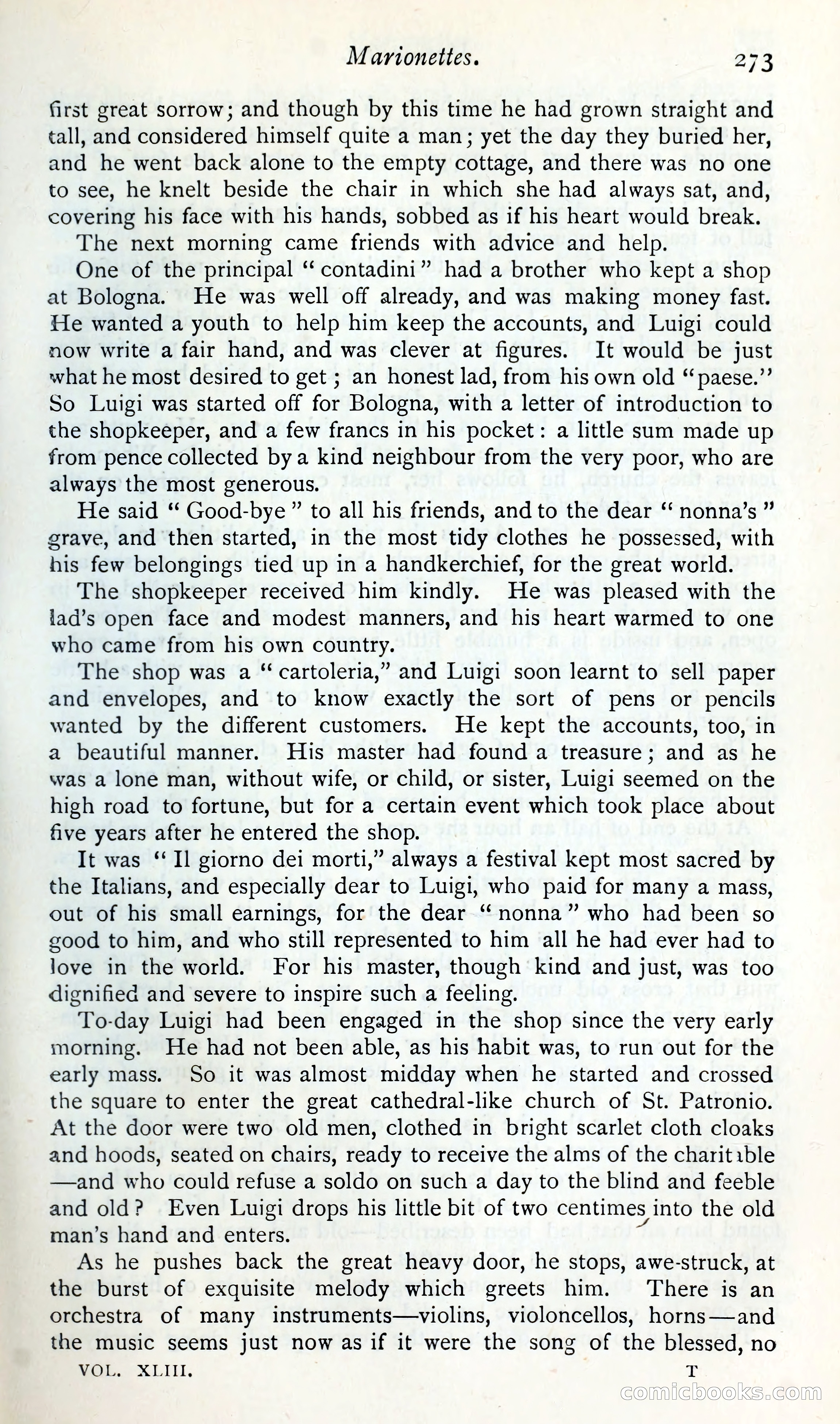
A restored page from Pulp Fiction, 1865. Page through the whole issue in the reader above.
📄 Transcribed text from this page (OCR, searchable)
Machine-transcribed from the original scan — historical spelling and the odd misread are preserved.
Martonettes. 273 first great sorrow; and though by this time he had grown straight and tall, and considered himself quite a man; yet the day they buried her, and he went back alone to the empty cottage, and there was no one to see, he knelt beside the chair in which she had always sat, and, covering his face with his hands, sobbed as if his heart would break. The next morning came friends with advice and help. One of the principal ‘‘ contadini” had a brother who kept a shop at Bologna. He was well off already, and was making money fast. He wanted a youth to help him keep the accounts, and Luigi could now write a fair hand, and was clever at figures. It would be just what he most desired to get ; an honest lad, from his own old “ paese.”’ So Luigi was started off for Bologna, with a letter of introduction to the shopkeeper, and a few francs in his pocket: a little sum made up from pence collected by a kind neighbour from the very poor, who are always the most generous. He said “‘ Good-bye” to all his friends, and to the dear ‘ nonna’s ” grave, and then started, in the most tidy clothes he possessed, with his few belongings tied up in a handkerchief, for the great world. The shopkeeper received him kindly. He was pleased with the lad’s open face and modest manners, and his heart warmed to one who came from his own country. The shop was a “‘ cartoleria,” and Luigi soon learnt to sell paper and envelopes, and to know exactly the sort of pens or pencils wanted by the different customers. He kept the accounts, too, in a beautiful manner. His master had found a treasure; and as he was a lone man, without wife, or child, or sister, Luigi seemed on the high road to fortune, but for a certain event which took place about five years after he entered the shop. It was ‘Il giorno dei morti,” always a festival kept most sacred by the Italians, and especially dear to Luigi, who paid for many a mass, out of his small earnings, for the dear ‘“‘nonna” who had been so good to him, and who still represented to him all he had ever had to love in the world. For his master, though kind and just, was too dignified and severe to inspire such a feeling. To-day Luigi had been engaged in the shop since the very early morning. He had not been able, as his habit was, to run out for the early mass. So it was almost midday when he started and crossed the square to enter the great cathedral-like church of St. Patronio. At the door were two old men, clothed in bright scarlet cloth cloaks and hoods, seated on chairs, ready to receive the alms of the charit ible —and who could refuse a soldo on such a day to the blind and feeble and old? Even Luigi drops his little bit of two centimes into the old man’s hand and enters. As he pushes back the great heavy door, he stops, awe-struck, at the burst of exquisite melody which greets him. ‘There is an orchestra of many instruments—violins, violoncellos, horns—and the music seems just now as if it were the song of the blessed, no YOL. XLIII. r COMICOOOKS.c©