
Pulp Fiction, 1865 · page 291 of 400
The Argosy — page 291: what you’re looking at
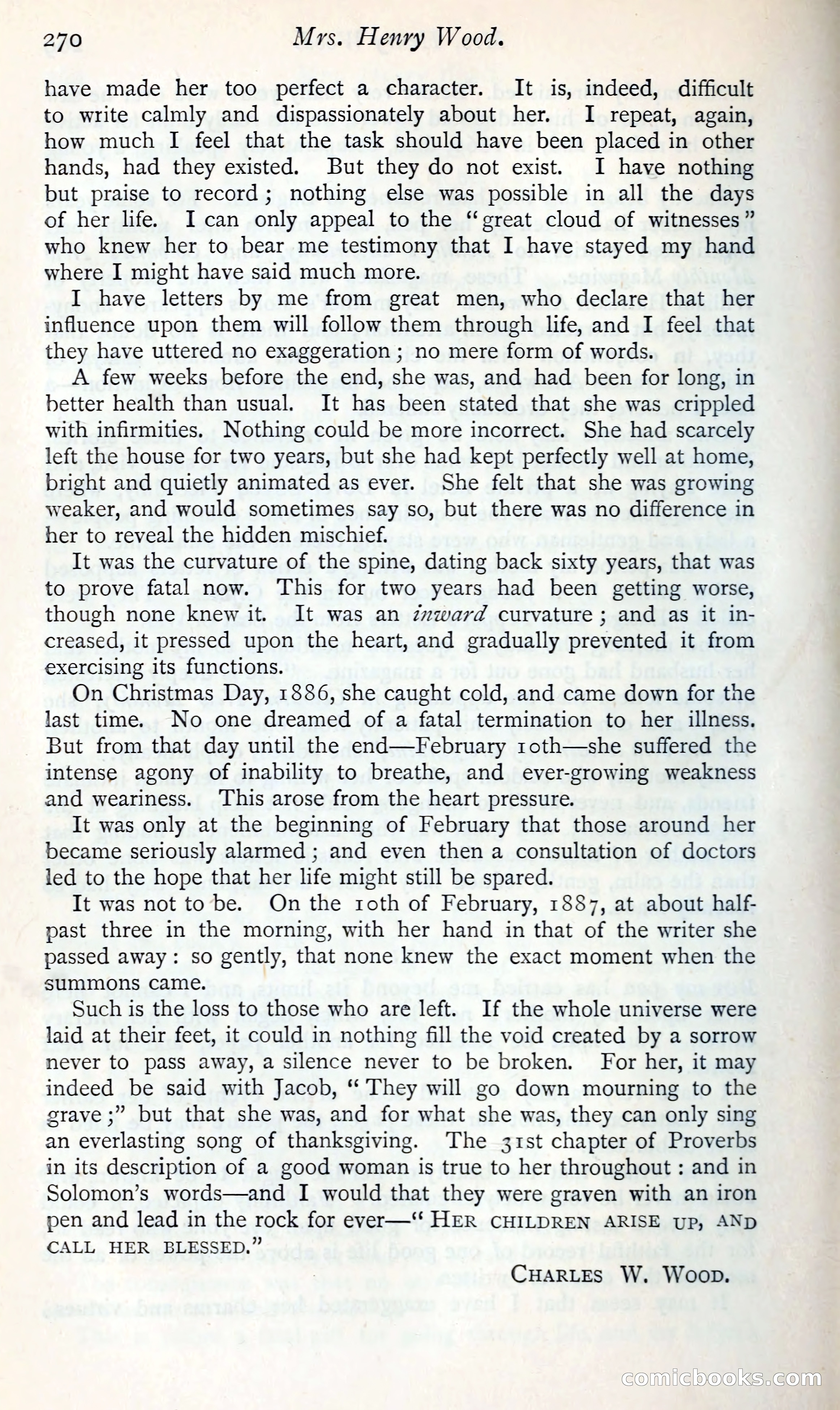
A restored page from Pulp Fiction, 1865. Page through the whole issue in the reader above.
📄 Transcribed text from this page (OCR, searchable)
Machine-transcribed from the original scan — historical spelling and the odd misread are preserved.
270 Mrs. Henry Wood. have made her too perfect a character. It is, indeed, difficult to write calmly and dispassionately about her. I repeat, again, how much I] feel that the task should have been placed in other hands, had they existed. But they do not exist. I have nothing but praise to record; nothing else was possible in all the days of her life. I can only appeal to the “great cloud of witnesses” who knew her to bear me testimony that I have stayed my hand where I might have said much more. I have letters by me from great men, who declare that her influence upon them will follow them through life, and I feel that they have uttered no exaggeration ; no mere form of words. A few weeks before the end, she was, and had been for long, in better health than usual. It has been stated that she was crippled with infirmities. Nothing could be more incorrect. She had scarcely left the house for two years, but she had kept perfectly well at home, bright and quietly animated as ever. She felt that she was growing weaker, and would sometimes say so, but there was no difference in her to reveal the hidden mischief. It was the curvature of the spine, dating back sixty years, that was to prove fatal now. This for two years had been getting worse, though none knew it. It was an zzward curvature ; and as it in- creased, it pressed upon the heart, and gradually prevented it from exercising its functions. On Christmas Day, 1886, she caught cold, and came down for the last time. No one dreamed of a fatal termination to her illness. But from that day until the end—February roth—she suffered the intense agony of inability to breathe, and ever-growing weakness and weariness. ‘This arose from the heart pressure. It was only at the beginning of February that those around her became seriously alarmed ; and even then a consultation of doctors led to the hope that her life might still be spared. It was not tobe. On the roth of February, 1887, at about half- past three in the morning, with her hand in that of the writer she passed away: so gently, that none knew the exact moment when the summons came. Such is the loss to those who are left. If the whole universe were laid at their feet, it could in nothing fill the void created by a sorrow never to pass away, a silence never to be broken. For her, it may indeed be said with Jacob, ‘They will go down mourning to the grave ;” but that she was, and for what she was, they can only sing an everlasting song of thanksgiving. ‘The 31st chapter of Proverbs in its description of a good woman is true to her throughout : and in Solomon’s words—and I would that they were graven with an iron pen and lead in the rock for ever—* HER CHILDREN ARISE up, AND CALL HER BLESSED.” CHARLES W. Woop. CORNICE OOO KS (EO)