
Pulp Fiction, 1865 · page 281 of 400
The Argosy — page 281: what you’re looking at
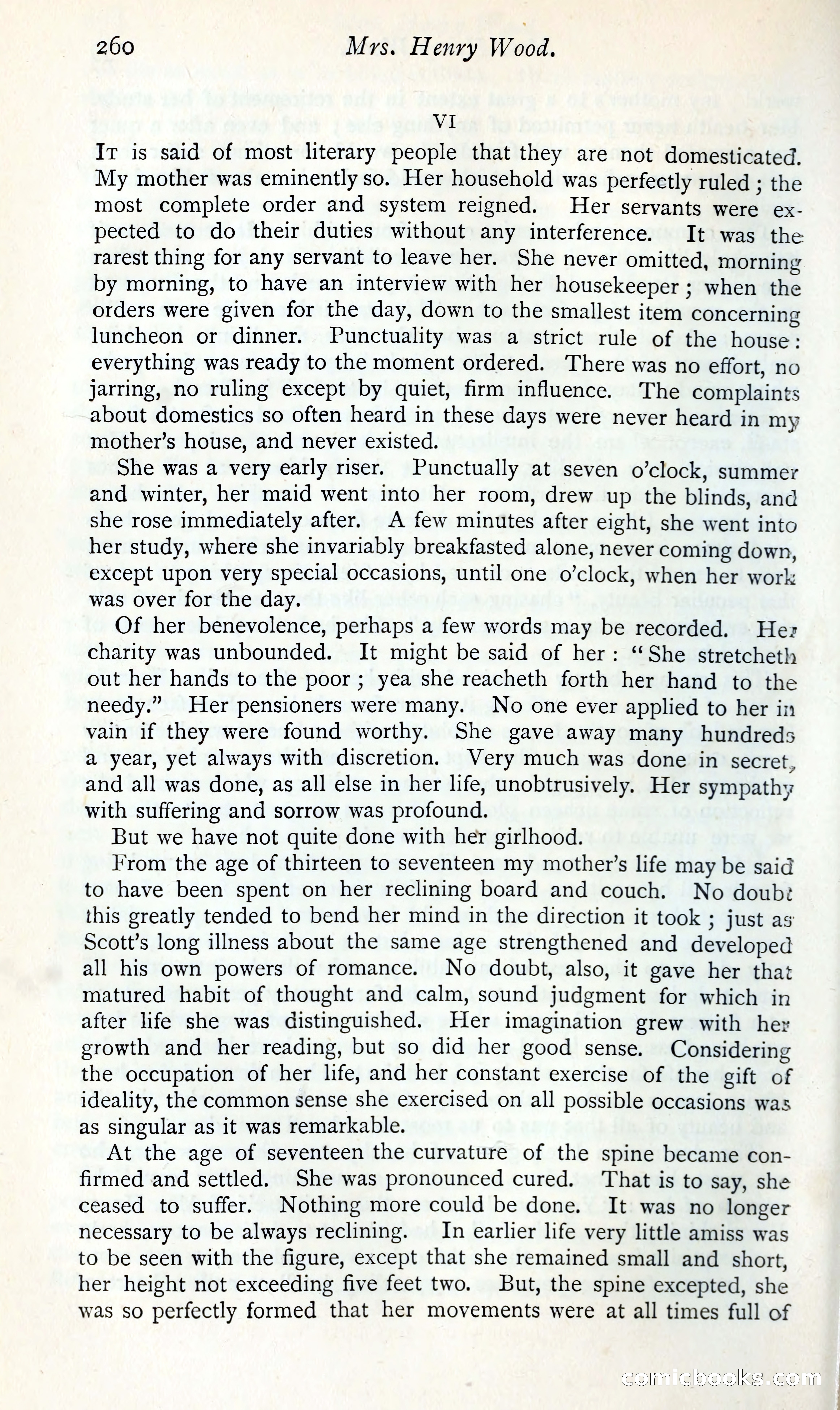
A restored page from Pulp Fiction, 1865. Page through the whole issue in the reader above.
📄 Transcribed text from this page (OCR, searchable)
Machine-transcribed from the original scan — historical spelling and the odd misread are preserved.
260 Mrs. Henry Wood. VI Ir is said of most literary people that they are not domesticated. My mother was eminently so. Her household was perfectly ruled ; the most complete order and system reigned. Her servants were ex- pected to do their duties without any interference. It was the rarest thing for any servant to leave her. She never omitted, morning by morning, to have an interview with her housekeeper; when the orders were given for the day, down to the smallest item concerning luncheon or dinner. Punctuality was a strict rule of the house: everything was ready to the moment ordered. There was no effort, no jarring, no ruling except by quiet, firm influence. The complaints about domestics so often heard in these days were never heard in my mother’s house, and never existed. She was a very early riser. Punctually at seven o’clock, summery and winter, her maid went into her room, drew up the blinds, and she rose immediately after. A few minutes after eight, she went into her study, where she invariably breakfasted alone, never coming down, except upon very special occasions, until one o’clock, when her work was over for the day. Of her benevolence, perhaps a few words may be recorded. Hez charity was unbounded. It might be said of her: ‘She stretcheth out her hands to the poor; yea she reacheth forth her hand to the needy.” Her pensioners were many. No one ever applied to her in vain if they were found worthy. She gave away many hundreds a year, yet always with discretion. Very much was done in secret, and all was done, as all else in her life, unobtrusively. Her sympathy with suffering and sorrow was profound. But we have not quite done with her girlhood. From the age of thirteen to seventeen my mother’s life may be said to have been spent on her reclining board and couch. No doub? this greatly tended to bend her mind in the direction it took ; just as Scott’s long illness about the same age strengthened and developed all his own powers of romance. No doubt, also, it gave her that matured habit of thought and calm, sound judgment for which in after life she was distinguished. Her imagination grew with her erowth and her reading, but so did her good sense. Considering the occupation of her life, and her constant exercise of the gift of ideality, the common sense she exercised on all possible occasions was as singular as it was remarkable. At the age of seventeen the curvature of the spine became con- firmed and settled. She was pronounced cured. That is to say, she ceased to suffer. Nothing more could be done. It was no longer necessary to be always reclining. In earlier life very little amiss was to be seen with the figure, except that she remained small and short, her height not exceeding five feet two. But, the spine excepted, she was so perfectly formed that her movements were at all times full of COMMICOOOKS.E@