
Pulp Fiction, 1865 · page 278 of 400
The Argosy — page 278: what you’re looking at
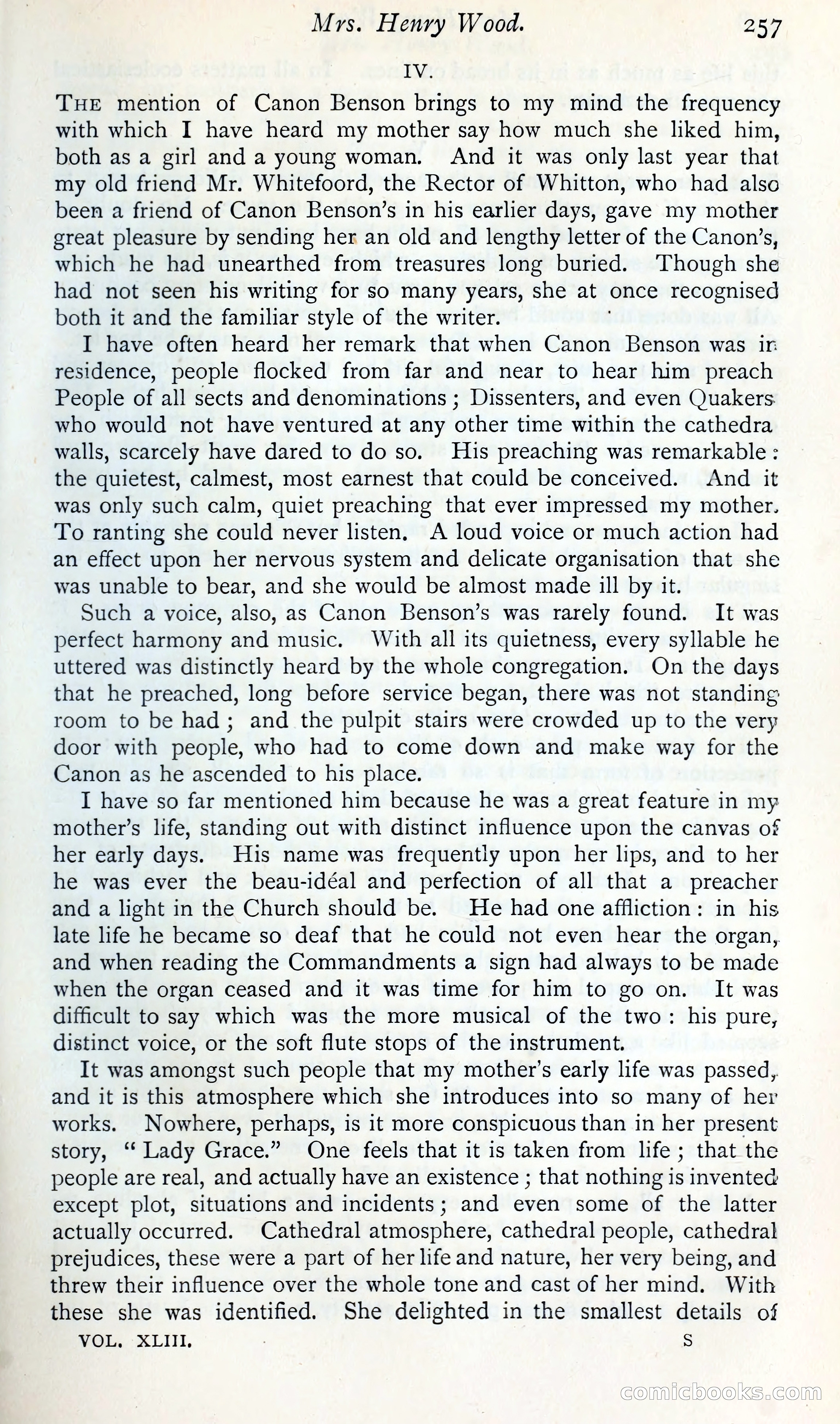
A restored page from Pulp Fiction, 1865. Page through the whole issue in the reader above.
📄 Transcribed text from this page (OCR, searchable)
Machine-transcribed from the original scan — historical spelling and the odd misread are preserved.
Mrs. Henry Wood. 257 IV. THE mention of Canon Benson brings to my mind the frequency with which I have heard my mother say how much she liked him, both as a girl and a young woman. And it was only last year that my old friend Mr. Whitefoord, the Rector of Whitton, who had also been a friend of Canon Benson’s in his earlier days, gave my mother great pleasure by sending her an old and lengthy letter of the Canon’s, which he had unearthed from treasures long buried. ‘Though she had not seen his writing for so many years, she at once recognised both it and the familiar style of the writer. I have often heard her remark that when Canon Benson was ir residence, people flocked from far and near to hear him preach People of all sects and denominations ; Dissenters, and even Quakers. who would not have ventured at any other time within the cathedra walls, scarcely have dared to do so. His preaching was remarkable : the quietest, calmest, most earnest that could be conceived. And it was only such calm, quiet preaching that ever impressed my mother. To ranting she could never listen, A loud voice or much action had an effect upon her nervous system and delicate organisation that she was unable to bear, and she would be almost made ill by it. Such a voice, also, as Canon Benson’s was rarely found. It was perfect harmony and music. With all its quietness, every syllable he uttered was distinctly heard by the whole congregation. On the days that he preached, long before service began, there was not standing room to be had; and the pulpit stairs were crowded up to the very door with people, who had to come down and make way for the Canon as he ascended to his place. I have so far mentioned him because he was a great feature in my mother’s life, standing out with distinct influence upon the canvas of her early days. His name was frequently upon her lips, and to her he was ever the beau-idéal and perfection of all that a preacher and a light in the Church should be. He had one affliction: in his late life he became so deaf that he could not even hear the organ, and when reading the Commandments a sign had always to be made when the organ ceased and it was time for him to go on. It was difficult to say which was the more musical of the two: his pure, distinct voice, or the soft flute stops of the instrument. It was amongst such people that my mother’s early life was passed,. and it is this atmosphere which she introduces into so many of her works. Nowhere, perhaps, is it more conspicuous than in her present story, “‘ Lady Grace.” One feels that it is taken from life; that the people are real, and actually have an existence ; that nothing is invented except plot, situations and incidents; and even some of the latter actually occurred. Cathedral atmosphere, cathedral people, cathedral prejudices, these were a part of her lifeand nature, her very being, and threw their influence over the whole tone and cast of her mind. With these she was identified. She delighted in the smallest details of ek. XLII, . S COMMICOOOKS.C©