
Pulp Fiction, 1865 · page 276 of 400
The Argosy — page 276: what you’re looking at
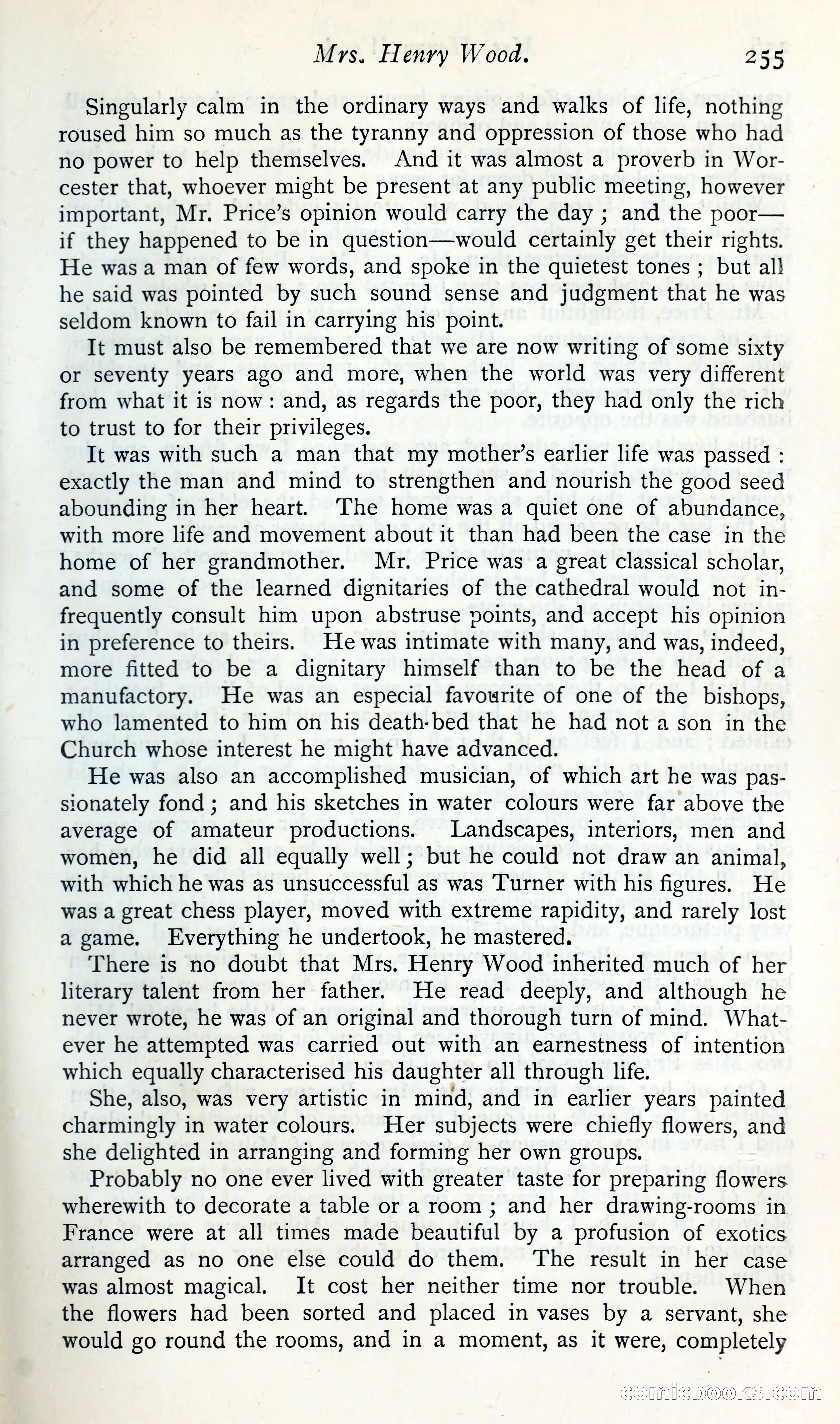
A restored page from Pulp Fiction, 1865. Page through the whole issue in the reader above.
📄 Transcribed text from this page (OCR, searchable)
Machine-transcribed from the original scan — historical spelling and the odd misread are preserved.
Mrs. Henry Wood. 255 Singularly calm in the ordinary ways and walks of life, nothing roused him so much as the tyranny and oppression of those who had no power to help themselves. And it was almost a proverb in Wor- cester that, whoever might be present at any public meeting, however important, Mr. Price’s opinion would carry the day ; and the poor— if they happened to be in question—would certainly get their rights. He was a man of few words, and spoke in the quietest tones ; but all he said was pointed by such sound sense and judgment that he was seldom known to fail in carrying his point. It must also be remembered that we are now writing of some sixty or seventy years ago and more, when the world was very different from what it is now: and, as regards the poor, they had only the rich to trust to for their privileges. It was with such a man that my mother’s earlier life was passed : exactly the man and mind to strengthen and nourish the good seed abounding in her heart. The home was a quiet one of abundance, with more life and movement about it than had been the case in the home of her grandmother. Mr. Price was a great classical scholar, and some of the learned dignitaries of the cathedral would not in- frequently consult him upon abstruse points, and accept his opinion in preference to theirs. He was intimate with many, and was, indeed, more fitted to be a dignitary himself than to be the head of a manufactory. He was an especial favourite of one of the bishops, who lamented to him on his death-bed that he had not a son in the Church whose interest he might have advanced. He was also an accomplished musician, of which art he was pas- sionately fond ; and his sketches in water colours were far above the average of amateur productions. Landscapes, interiors, men and women, he did all equally well; but he could not draw an animal, with which he was as unsuccessful as was Turner with his figures. He was a great chess player, moved with extreme rapidity, and rarely lost agame. Everything he undertook, he mastered. There is no doubt that Mrs. Henry Wood inherited much of her literary talent from her father. He read deeply, and although he never wrote, he was of an original and thorough turn of mind. What- ever he attempted was carried out with an earnestness of intention which equally characterised his daughter all through life. She, also, was very artistic in mind, and in earlier years painted charmingly in water colours. Her subjects were chiefly flowers, and she delighted in arranging and forming her own groups. Probably no one ever lived with greater taste for preparing flowers wherewith to decorate a table or a room ; and her drawing-rooms in France were at all times made beautiful by a profusion of exotics arranged as no one else could do them. ‘The result in her case was almost magical. It cost her neither time nor trouble. When the flowers had been sorted and placed in vases by a servant, she would go round the rooms, and in a moment, as it were, completely COMICHOOOKS.C©