
Pulp Fiction, 1865 · page 274 of 400
The Argosy — page 274: what you’re looking at
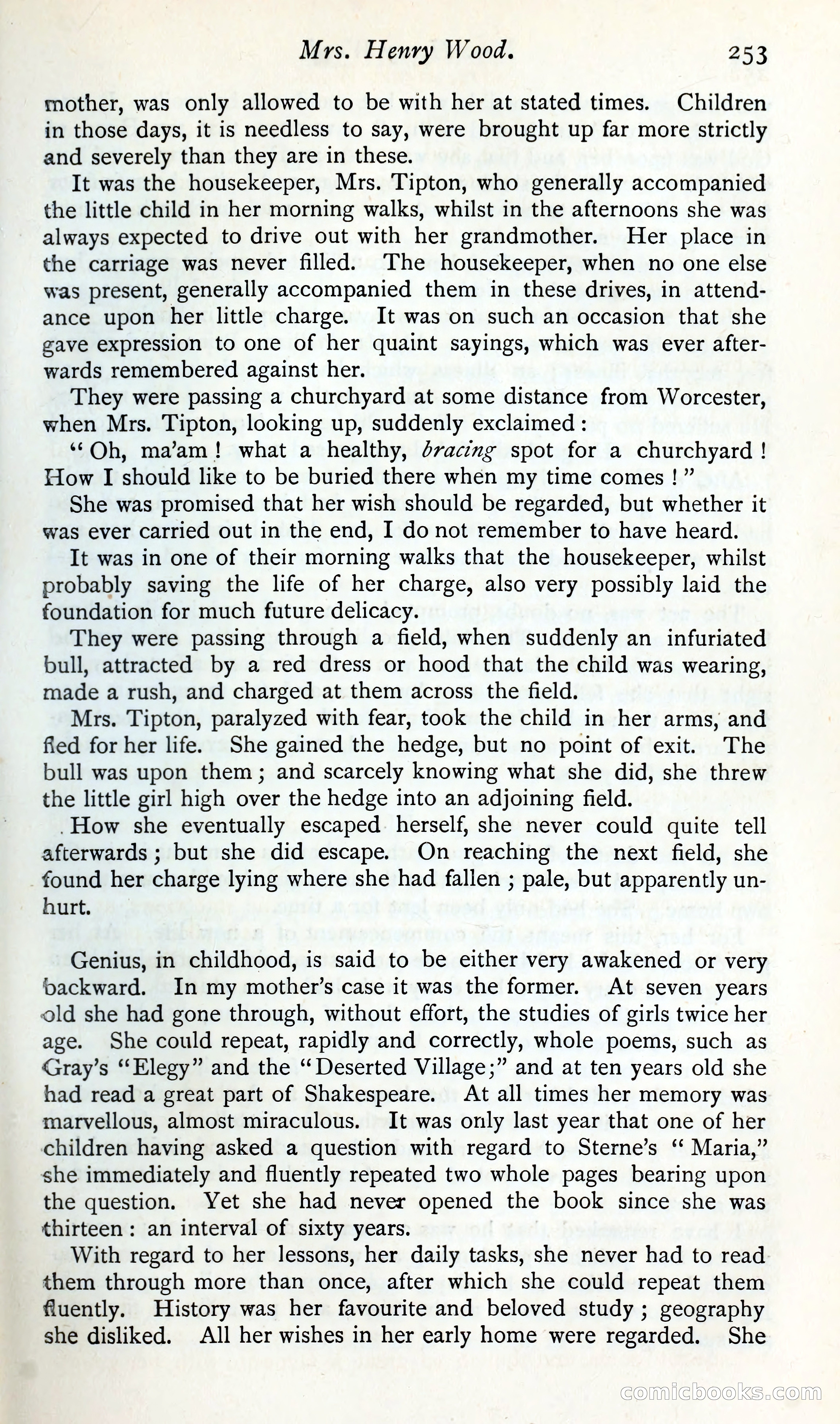
A restored page from Pulp Fiction, 1865. Page through the whole issue in the reader above.
📄 Transcribed text from this page (OCR, searchable)
Machine-transcribed from the original scan — historical spelling and the odd misread are preserved.
Mrs. Henry Wood. 253 mother, was only allowed to be with her at stated times. Children in those days, it is needless to say, were brought up far more strictly and severely than they are in these. It was the housekeeper, Mrs. Tipton, who generally accompanied the little child in her morning walks, whilst in the afternoons she was always expected to drive out with her grandmother. Her place in the carriage was never filled. ‘The housekeeper, when no one else was present, generally accompanied them in these drives, in attend- ance upon her little charge. It was on such an occasion that she gave expression to one of her quaint sayings, which was ever after- wards remembered against her. They were passing a churchyard at some distance from Worcester, when Mrs. Tipton, looking up, suddenly exclaimed : ‘‘Oh, ma’am! what a healthy, dracimg spot for a churchyard ! How I should like to be buried there when my time comes !” She was promised that her wish should be regarded, but whether it was ever carried out in the end, I do not remember to have heard. It was in one of their morning walks that the housekeeper, whilst probably saving the life of her charge, also very possibly laid the foundation for much future delicacy. They were passing through a field, when suddenly an infuriated bull, attracted by a red dress or hood that the child was wearing, made a rush, and charged at them across the field. Mrs. Tipton, paralyzed with fear, took the child in her arms, and fied for her life. She gained the hedge, but no point of exit. The bull was upon them; and scarcely knowing what she did, she threw the little girl high over the hedge into an adjoining field. How she eventually escaped herself, she never could quite tell afterwards ; but she did escape. On reaching the next field, she found her charge lying where she had fallen ; pale, but apparently un- hurt. Genius, in childhood, is said to be either very awakened or very backward. In my mother’s case it was the former. At seven years old she had gone through, without effort, the studies of girls twice her age. She could repeat, rapidly and correctly, whole poems, such as Gray’s “Elegy” and the “Deserted Village;” and at ten years old she had read a great part of Shakespeare. At all times her memory was marvellous, almost miraculous. It was only last year that one of her children having asked a question with regard to Sterne’s ‘ Maria,” she immediately and fluently repeated two whole pages bearing upon the question. Yet she had never opened the book since she was thirteen: an interval of sixty years. With regard to her lessons, her daily tasks, she never had to read them through more than once, after which she could repeat them fluently. History was her favourite and beloved study ; geography she disliked. All her wishes in her early home were regarded. She COMmicooolkks ) (CO)