
Pulp Fiction, 1865 · page 255 of 400
The Argosy — page 255: what you’re looking at
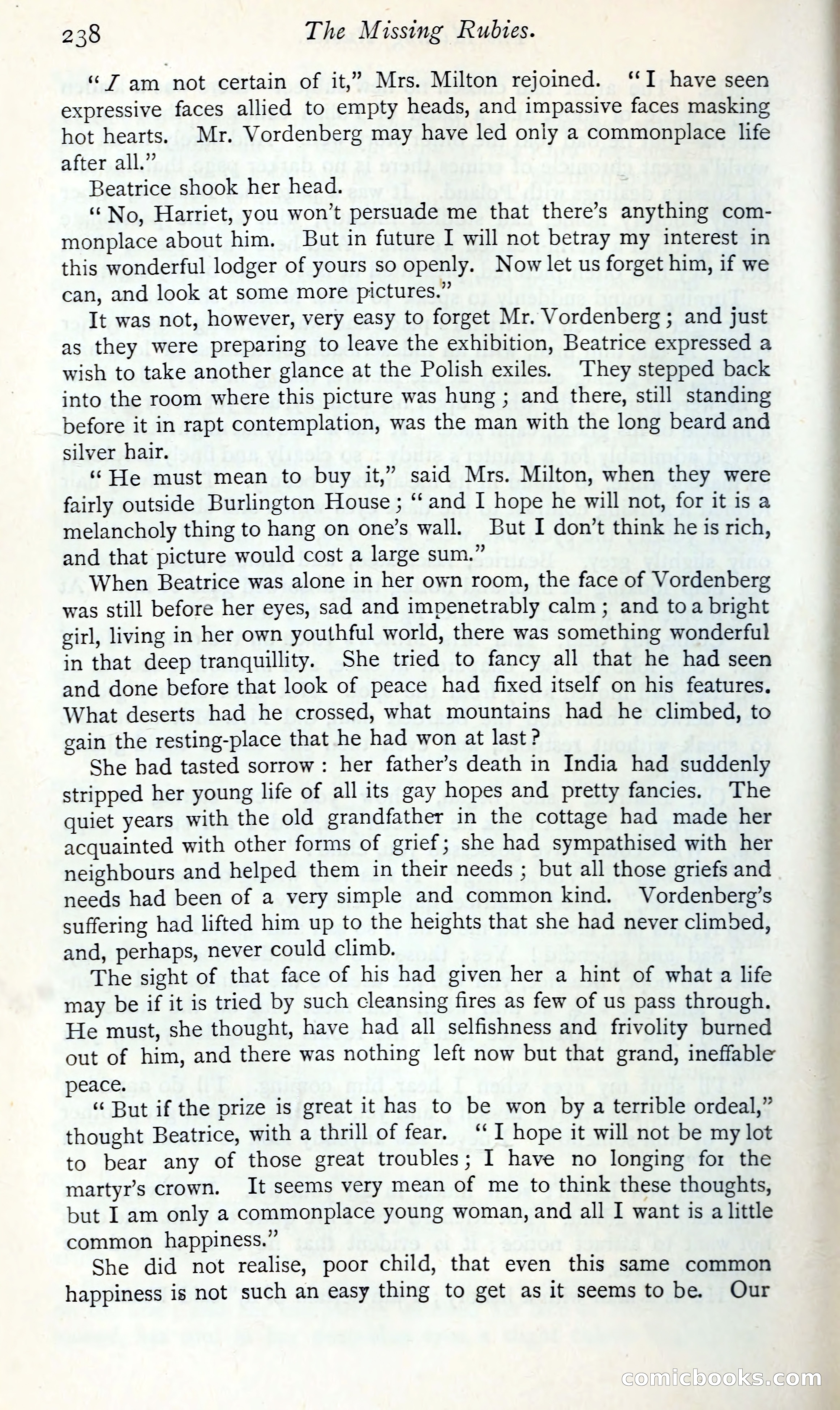
A restored page from Pulp Fiction, 1865. Page through the whole issue in the reader above.
📄 Transcribed text from this page (OCR, searchable)
Machine-transcribed from the original scan — historical spelling and the odd misread are preserved.
238 The Missing Rubies. “ Tam not certain of it,” Mrs. Milton rejoined. ‘‘I have seen expressive faces allied to empty heads, and impassive faces masking hot hearts. Mr. Vordenberg may have led only a commonplace life after all.” Beatrice shook her head. ‘No, Harriet, you won’t persuade me that there’s anything com- monplace about him. But in future I will not betray my interest in this wonderful lodger of yours so openly. Now let us forget him, if we can, and look at some more pictures.” It was not, however, very easy to forget Mr. Vordenberg ; and just as they were preparing to leave the exhibition, Beatrice expressed a wish to take another glance at the Polish exiles. ‘They stepped back into the room where this picture was hung ; and there, still standing before it in rapt contemplation, was the man with the long beard and silver hair. ‘Fe must mean to buy it,” said Mrs. Milton, when they were fairly outside Burlington House; ‘“‘ and I hope he will not, for it is a melancholy thing to hang on one’s wall. But I don’t think he is rich, and that picture would cost a large sum.” When Beatrice was alone in her own room, the face of Vordenberg was still before her eyes, sad and impenetrably calm; and toa bright girl, living in her own youthful world, there was something wonderful in that deep tranquillity. She tried to fancy all that he had seen and done before that look of peace had fixed itself on his features. What deserts had he crossed, what mountains had he climbed, to gain the resting-place that he had won at last? She had tasted sorrow: her father’s death in India had suddenly stripped her young life of all its gay hopes and pretty fancies. The quiet years with the old grandfather in the cottage had made her acquainted with other forms of grief; she had sympathised with her neighbours and helped them in their needs ; but all those griefs and needs had been of a very simple and common kind. Vordenberg’s suffering had lifted him up to the heights that she had never climbed, and, perhaps, never could climb. The sight of that face of his had given her a hint of what a life may be if it is tried by such cleansing fires as few of us pass through. He must, she thought, have had all selfishness and frivolity burned out of him, and there was nothing left now but that grand, ineffable peace. “ But if the prize is great it has to be won by a terrible ordeal,” thought Beatrice, with a thrill of fear. “I hope it will not be my lot to bear any of those great troubles; I have no longing for the martyr’s crown. It seems very mean of me to think these thoughts, but I am only a commonplace young woman, and all I want is a little common happiness.” She did not realise, poor child, that even this same common happiness is not such an easy thing to get as it seems to be. Our CONNICLOOOKS EOL)