
Pulp Fiction, 1865 · page 242 of 400
The Argosy — page 242: what you’re looking at
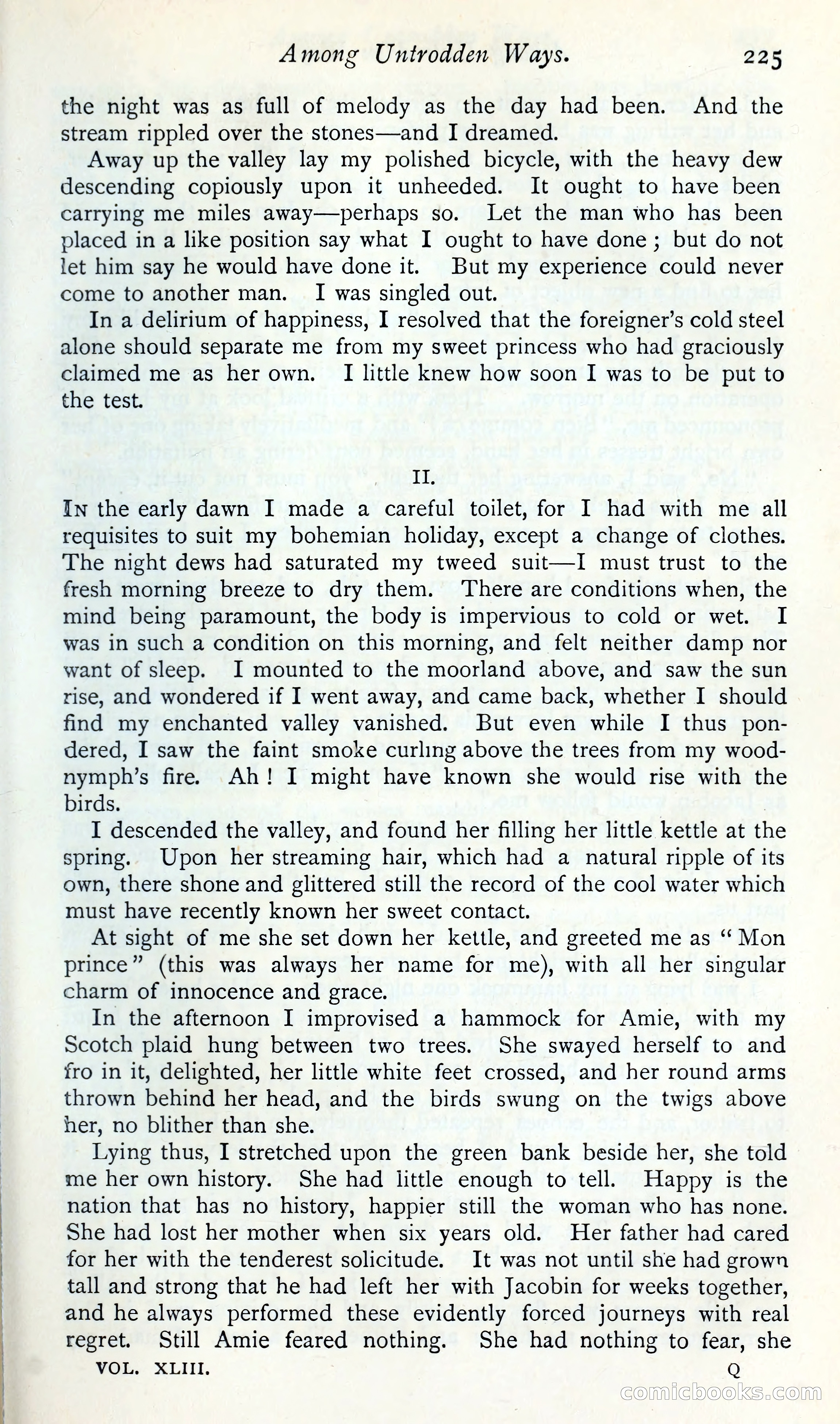
A restored page from Pulp Fiction, 1865. Page through the whole issue in the reader above.
📄 Transcribed text from this page (OCR, searchable)
Machine-transcribed from the original scan — historical spelling and the odd misread are preserved.
Among Untrodden Ways. 225 the night was as full of melody as the day had been. And the stream rippled over the stones—and I dreamed. Away up the valley lay my polished bicycle, with the heavy dew descending copiously upon it unheeded. It ought to have been carrying me miles away—perhaps so. Let the man who has been placed in a like position say what I ought to have done; but do not let him say he would have done it. But my experience could never come to another man. _ I was singled out. In a delirium of happiness, I resolved that the foreigner’s cold steel alone should separate me from my sweet princess who had graciously claimed me as her own. I little knew how soon I was to be put to the test. II, In the early dawn I made a careful toilet, for I had with me all requisites to suit my bohemian holiday, except a change of clothes. The night dews had saturated my tweed suit—I must trust to the fresh morning breeze to dry them. There are conditions when, the mind being paramount, the body is impervious to cold or wet. I was in such a condition on this morning, and felt neither damp nor want of sleep. I mounted to the moorland above, and saw the sun rise, and wondered if I went away, and came back, whether I should find my enchanted valley vanished. But even while I thus pon- dered, I saw the faint smoke curling above the trees from my wood- nymph’s fire Ah! I might have known she would rise with the birds. | I descended the valley, and found her filling her little kettle at the spring. Upon her streaming hair, which had a natural ripple of its own, there shone and glittered still the record of the cool water which must have recently known her sweet contact. At sight of me she set down her kettle, and greeted me as “ Mon prince” (this was always her name for me), with all her singular charm of innocence and grace. In the afternoon I improvised a hammock for Amie, with my Scotch plaid hung between two trees. She swayed herself to and fro in it, delighted, her little white feet crossed, and her round arms thrown behind her head, and the birds swung on the twigs above her, no blither than she. Lying thus, I stretched upon the green bank beside her, she told me her own history. She had little enough to tell. Happy is the nation that has no history, happier still the woman who has none. She had lost her mother when six years old. MHer father had cared for her with the tenderest solicitude. It was not until she had grown tall and strong that he had left her with Jacobin for weeks together, and he always performed these evidently forced journeys with real regret. Still Amie feared nothing. She had nothing to fear, she VOL. XLIII. Q COM ) VHOO|kKS.CO