
Pulp Fiction, 1865 · page 232 of 400
The Argosy — page 232: what you’re looking at
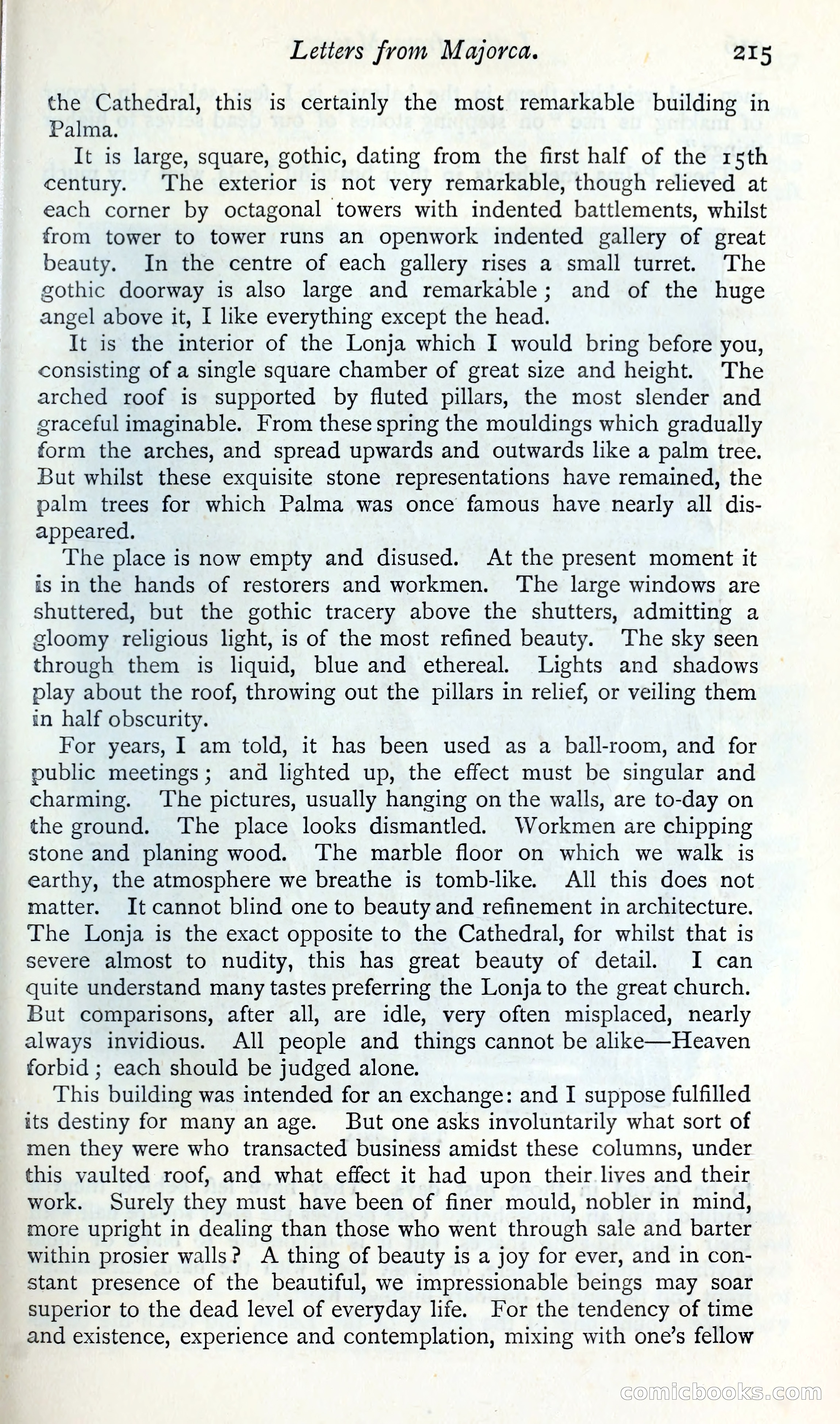
A restored page from Pulp Fiction, 1865. Page through the whole issue in the reader above.
📄 Transcribed text from this page (OCR, searchable)
Machine-transcribed from the original scan — historical spelling and the odd misread are preserved.
Letters from Majorca. 215 the Cathedral, this is certainly the most remarkable building in Palma. It is large, square, gothic, dating from the first half of the 15th century. The exterior is not very remarkable, though relieved at each corner by octagonal towers with indented battlements, whilst from tower to tower runs an openwork indented gallery of great beauty. In the centre of each gallery rises a small turret. The gothic doorway is also large and remarkable; and of the huge angel above it, I like everything except the head. It is the interior of the Lonja which I would bring before you, consisting of a single square chamber of great size and height. The arched roof is supported by fluted pillars, the most slender and graceful imaginable. From these spring the mouldings which gradually form the arches, and spread upwards and outwards like a palm tree. But whilst these exquisite stone representations have remained, the palm trees for which Palma was once famous have nearly all dis- appeared. The place is now empty and disused. At the present moment it is in the hands of restorers and workmen. ‘The large windows are shuttered, but the gothic tracery above the shutters, admitting a gloomy religious light, is of the most refined beauty. The sky seen through them is liquid, blue and ethereal. Lights and shadows play about the roof, throwing out the pillars in relief, or veiling them in half obscurity. For years, I am told, it has been used as a ball-room, and for nublic meetings; and lighted up, the effect must be singular and charming. ‘The pictures, usually hanging on the walls, are to-day on the ground. ‘The place looks dismantled. Workmen are chipping stone and planing wood. ‘The marble floor on which we walk is earthy, the atmosphere we breathe is tomb-like. All this does not matter. It cannot blind one to beauty and refinement in architecture. The Lonja is the exact opposite to the Cathedral, for whilst that is severe almost to nudity, this has great beauty of detail. I can quite understand many tastes preferring the Lonja to the great church. But comparisons, after all, are idle, very often misplaced, nearly always invidious. All people and things cannot be alike—Heaven forbid ; each should be judged alone. This building was intended for an exchange: and I suppose fulfilled its destiny for many an age. But one asks involuntarily what sort of men they were who transacted business amidst these columns, under this vaulted roof, and what effect it had upon their lives and their work. Surely they must have been of finer mould, nobler in mind, more upright in dealing than those who went through sale and barter within prosier walls? <A thing of beauty is a joy for ever, and in con- stant presence of the beautiful, we impressionable beings may soar superior to the dead level of everyday life. For the tendency of time and existence, experience and contemplation, mixing with one’s fellow ) COM NOOKS (SO)