
Pulp Fiction, 1865 · page 224 of 400
The Argosy — page 224: what you’re looking at
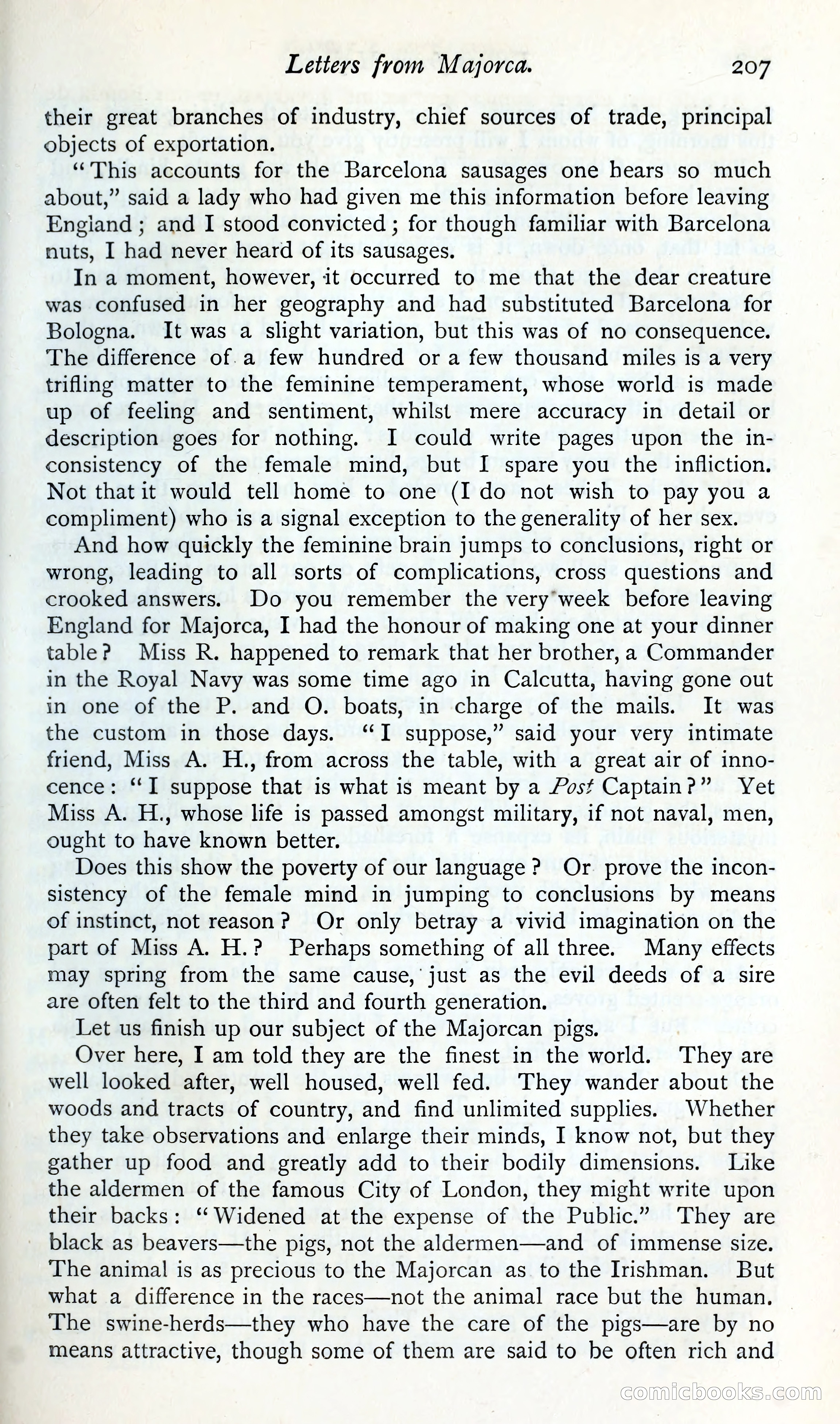
A restored page from Pulp Fiction, 1865. Page through the whole issue in the reader above.
📄 Transcribed text from this page (OCR, searchable)
Machine-transcribed from the original scan — historical spelling and the odd misread are preserved.
Letters from Majorca. 207 their great branches of industry, chief sources of trade, principal objects of exportation. ‘This accounts for the Barcelona sausages one hears so much about,” said a lady who had given me this information before leaving Engiand ; and I stood convicted ; for though familiar with Barcelona nuts, I had never heard of its sausages. In a moment, however, it occurred to me that the dear creature was confused in her geography and had substituted Barcelona for Bologna. It was a slight variation, but this was of no consequence. The difference of.a few hundred or a few thousand miles is a very trifling matter to the feminine temperament, whose world is made up of feeling and sentiment, whilst mere accuracy in detail or description goes for nothing. I could write pages upon the in- consistency of the female mind, but I spare you the infliction. Not that it would tell home to one (I do not wish to pay you a compliment) who is a signal exception to the generality of her sex. And how quickly the feminine brain jumps to conclusions, right or wrong, leading to all sorts of complications, cross questions and crooked answers. Do you remember the very’week before leaving England for Majorca, I had the honour of making one at your dinner table? Miss R. happened to remark that her brother, a Commander in the Royal Navy was some time ago in Calcutta, having gone out in one of the P. and O. boats, in charge of the mails. It was the custom in those days. “I suppose,” said your very intimate friend, Miss A. H., from across the table, with a great air of inno- cence: “I suppose that is what is meant by a Fost Captain?” Yet Miss A. H., whose life is passed amongst military, if not naval, men, ought to have known better. Does this show the poverty of our language ? Or. prove the incon- sistency of the female mind in jumping to conclusions by means of instinct, not reason? Or only betray a vivid imagination on the part of Miss A. H.? Perhaps something of all three. Many effects may spring from the same cause,’ just as the evil deeds of a sire are often felt to the third and fourth generation. Let us finish up our subject of the Majorcan pigs. Over here, I am told they are the finest in the world. They are well looked after, well housed, well fed. They wander about the woods and tracts of country, and find unlimited supplies. Whether they take observations and enlarge their minds, I know not, but they gather up food and greatly add to their bodily dimensions. Like the aldermen of the famous City of London, they might write upon their backs: ‘‘Widened at the expense of the Public.” They are black as beavers—the pigs, not the aldermen—and of immense size. The animal is as precious to the Majorcan as to the Irishman. But what a difference in the races—not the animal race but the human. The swine-herds—they who have the care of the pigs—are by no means attractive, though some of them are said to be often rich and COMICOOOKS.c©